Whatever curious and interesting subject strikes my fancy, be it silly or serious, gets posted for your reading pleasure.
Showing posts with label christian traditions. Show all posts

Friday, 29 September 2017

The Feast Day of an Angelic Champion

September 29 is the feast day held in honour St. Michael, the Confessor of God's Infinite Divinity, and the Champion of Heaven and the Church.

I cannot let this time pass without another blog post in his honour, and he has never failed to answer one of my prayers!


As Tradition states, he received his name right after the creation of the angels when Lucifer rebelled against the Creator and declared himself to be like unto God. While the rebellious seraph-turned-devil was busy stirring up rebels for his cause, an Archangel came forward from the lower choirs, he was not even a seraph like Lucifer, or a blazing cherub. “Who is like unto God?” became his battle cry as he mustered the loyal angels. Together they drove out Lucifer renamed Satan and all the other evil rebels from Heaven.


As a reward, God raised up Michael - “Who is Like unto God”- and made him Prince over all the Angels, and as we know from Scripture and Tradition he is one of the Seven that stand before the Throne of the Almighty.


Tradition also holds that one of St. Michael's duties is to lead the souls of the recently departed to their Particular Judgement before God, and he has also been given the task of weighing every good and evil deed in the Eternal Scales to see if that soul is fit for Heaven or Hell. He himself confirmed this to the approved mystic Marie-Julie Jahenny (1850-1941) in addition to revelations about his other roles in Heaven: he also conducts the Angelic choirs and the angelic symphonies, so in fact, he is the Angel of Music when you think about it. He also revealed some other interesting details, Heaven has books and Rosaries!

You can find out more about that interesting apparition, click here: Conversation with St. Michael, Prince of the Angels

In another revelation to Marie-Julie Jahenny, he declared that after God, the power granted to him is very great, and that if we knew the extent of this power, we would not be slack in offering our prayers to him and asking for protection. (Hint hint!) No wonder! The demons never sleep, and we need all the protection we can get.

He also revealed to Marie-Julie other fantastic revelations about the future of France and the Church, which will affect the whole world: he will be there to protect the Great Catholic Monarch when he arrives to restore the absolute monarchy, and with his flaming sword will root out everything the Freemasons had tried to accomplish in their efforts to destroy both Church and monarchies, also warning of the chastisements that will take place before then as a warning. You can find more here: Revelations of St. Michael to Marie-Julie Jahenny.


There are some interesting theories about St. Michael being the Angel of Peace of Fatima, Portugal. After living in Portugal for many years now, I've discovered by talking to the locals that St. Michael was always traditionally venerated as the Guardian Angel of the country. One story I've heard is the miraculous apparition of the “red sword and wing” in the sky during the medieval period as the Christian soldiers were driving the Muslims out of the country, which led to the founding of “St. Michael's Order of the Wing” by the King of the time.


I've tried looking up details online, but nothing is appearing in English on this, however, since this comes from the mouth of monarchists whom I've met who belong to this chivalric Order, I'm going to assume it's true, eventhough I can't seem to find any dates connected with this apparition of the great red angelic wing and sword in the sky. This may have happened when the knights helped to retake the town of Santarém from the Moors on May 8, 1147. From a source I found it says a feast of St. Michael fell on this day, but sadly, no mention of any apparition! However, you will find St. Michael represented in many churches holding a shield with the emblem of Portugal, and of interest, the Red Wing is featured on the emblems of the revived order currently under the leadership of Dom Duarte, Duke of Braganza, pretender to the throne of Portugal.


Left: Cross of the Order of St. Michael of the Wing.

Right: Grand Cross of the Order


Notice the red wing in the emblems.


I cannot help but note this story of the Order's founding also has an interesting connection to the later visions of Fatima. Sr. Lucia says that in one of the visions she saw the Holy Father leading people to a great rugged cross through a destroyed city and a field of war with soldiers shooting and killing many in the procession. Overhead an angel appeared holding out his flaming sword ready to strike the earth, the flames of which were stopped by Our Lady's splendour, he then cried out “Penance! Penance! Penance!”, obviously a warning before the world is struck with great chastisements and wars, which seems very close to the warnings St. Michael gives to Marie-Julie Jahenny, who was shown his flaming sword:


I see that the battle will begin between Saint Michael and Hell, between good and evil.... Mary Immaculate watches over us, what have we to fear?” (Ecstasy date September 29, 1877).


There is an interesting story that has circulated stating that on the day the Angel of Peace gave the three children of Fatima Holy Communion, a consecrated Host and chalice went missing in a church while a festa was happening, (either the church was dedicated to St. Michael, or, the festa at the church that day was held in his honour, perhaps both! Forgive me for being fuzzy on the details). However, the chalice was later returned, but the Host was still missing. Some see this as confirmation St. Michael indeed is the Angel of Peace of Fatima.


(Site of the Apparition of the Angel of Peace where
 he brought the children Holy Communion in Aljustrel, Fatima, Portugal.)


Of course, there is another fascinating modern-day apparition of St. Michael, which allegedly happened during the Korean War, the story of which was spread after a letter written by a young Marine named Michael (of all things) to his mother in 1950 caught the attention of a Navy Chaplain, Fr. Walter Muddy, who tracked down the marine and verified the details of the letter, including the battle fought, etc. The chaplain then publicly read the letter aloud in 1951 before a crowd of 5,000 Marines at the Navla base in San Diego, California. Since then the letter has been published and spread like wildfire ever since:


Dear Mom,

I wouldn't dare write this letter to anyone but you because no one else would believe it. Maybe even you will find it hard but I have got to tell somebody.

First off, I am in a hospital. Now don't worry, ya hear me, don't worry. I was wounded but I am okay you understand. Okay. The doctor says that I will be up and around in a month. But that is not what I want to tell you.

Remember when I joined the Marines last year; remember when I left, how you told me to say a prayer to St. Michael every day. You really didn't have to tell me that. Ever since I can remember you always told me to pray to St. Michael the Archangel. You even named me after him. Well I always have.

When I got to Korea, I prayed even harder. Remember the prayer that you taught me?

"Michael, Michael of the morning fresh crop of Heaven adorning," you know the rest of it.

(Note: it is believed this is the prayer said by the Marine):

Michael, Michael of the morning,
Fresh chord of Heaven adorning,
Keep me safe today,
And in time of temptation
Drive the devil away. Amen.


Well I said it everyday. Sometimes when I was marching or sometimes resting. But always before I went to sleep. I even got some of the other fellas to say it.

Well, one day I was with an advance detail way up over the front lines. We were scouting for the Commies. I was plodding along in the bitter cold, my breath was like cigar smoke.

I thought I knew every guy in the patrol, when along side of me comes another Marine I never met before. He was bigger than any other Marine I'd ever seen. He must have been 6' 4" and built in proportion. It gave me a feeling of security to have such a body near.

Anyway, there we were trudging along. The rest of the patrol spread out. Just to start a conversation I said, "Cold ain't it." And then I laughed. Here I was with a good chance of getting killed any minute and I am talking about the weather.

My companion seemed to understand. I heard him laugh softly. I looked at him,

"I have never seen you before, I thought I knew every man in the outfit."

"I just joined at the last minute", he replied. "The name is Michael." 
 
"Is that so," I said surprised. "That is my name too."


"I know," he said and then went on, "Michael, Michael of the morning . . ."


I was too amazed to say anything for a minute. How did he know my name, and a prayer that you had taught me? Then I smiled to myself, every guy in the outfit knew about me. Hadn't I taught the prayer to anybody who would listen. Why now and then, they even referred to me as St. Michael.


Neither of us spoke for a time and then he broke the silence. "We are going to have some trouble up ahead."


He must have been in fine physical shape or he was breathing so lightly I couldn't see his breath. Mine poured out in great clouds. There was no smile on his face now. Trouble ahead, I thought to myself, well with the Commies all around us, that is no great revelation.


Snow began to fall in great thick globs. In a brief moment the whole countryside was blotted out. And I was marching in a white fog of wet sticky particles. My companion disappeared.


"Michael, " I shouted in sudden alarm.


I felt his hand on my arm, his voice was rich and strong, "This will stop shortly."


His prophecy proved to be correct. In a few minutes the snow stopped as abruptly as it had begun. The sun was a hard shining disc. I looked back for the rest of the patrol, there was no one in sight. We lost them in that heavy fall of snow. I looked ahead as we came over a little rise.


Mom, my heart stopped. There were seven of them. Seven Commies in their padded pants and jackets and their funny hats. Only there wasn't anything funny about them now. Seven rifles were aimed at us.

"Down Michael, " I screamed and hit the frozen earth.


I heard those rifles fire almost as one. I heard the bullets. There was Michael still standing. 
 
Mom, those guys couldn't have missed, not at that range. I expected to see him literally blown to bits.


But there he stood, making no effort to fire himself. He was paralyzed with fear. It happens sometimes, Mom, even to the bravest. He was like a bird fascinated by a snake.


At least, that was what I thought then. I jumped up to pull him down and that was when I got mine. I felt a sudden flame in my chest. I often wondered what it felt like to be hit, now I know.

I remember feeling strong arms about me, arms that laid me ever so gently on a pillow of snow. I opened my eyes, for one last look. I was dying. Maybe I was even dead, I remember thinking well, this is not so bad.


Maybe I was looking into the sun. Maybe I was in shock. But it seemed I saw Michael standing erect again only this time his face was shining with a terrible splendor.


As I say, maybe it was the sun in my eyes, but he seemed to change as I watched him. He grew bigger, his arms stretched out wide, maybe it was the snow falling again, but there was a brightness around him like the wings of an Angel. In his hand was a sword. A sword that flashed with a million lights.


Well, that is the last thing I remember until the rest of the fellas came up and found me. I do not know how much time had passed. Now and then I had but a moment's rest from the pain and fever. I remember telling them of the enemy just ahead.


"Where is Michael," I asked.


I saw them look at one another. "Where's who?" asked one. "Michael, Michael that big Marine I was walking with just before the snow squall hit us."


"Kid," said the sergeant, "You weren't walking with anyone. I had my eyes on you the whole time. You were getting too far out. I was just going to call you in when you disappeared in the snow."


He looked at me, curiously. "How did you do it kid?"

"How'd I do what?" I asked half angry despite my wound. "This marine named Michael and I were just . . ."

"Son, " said the sergeant kindly, "I picked this outfit myself and there just ain't another Michael in it. You are the only Mike in it."

He paused for a minute, "Just how did you do it kid? We heard shots. There hasn't been a shot fired from your rifle. And there isn't a bit of lead in them seven bodies over the hill there."

I didn't say anything, what could I say. I could only look open-mouthed with amazement. It was then the sergeant spoke again, "Kid," he said gently, "everyone of those seven Commies was killed by a sword stroke."

That is all I can tell you Mom. As I say, it may have been the sun in my eyes, it may have been the cold or the pain. But that is what happened.

Love, Michael”


Look how this young man was rewarded for honouring his name-saint each day and praying for protection!


Again, as St. Michael said to Marie-Julie Jahenny September 29, 1877: "After God, I am your protector and your support. Have recourse to me. If you knew my power, you would be more eager to address your prayers to me each day."


Of course, I could not end this blog without including one of my favourite poems written in his honour by G.K. Chesterton and fist published in 1929. It is a brilliant tribute to Heaven's Champion, the opining lines of which are reminiscent of the prayer that saved the young Marine:


Michael of the Morning,
Michael of the Army of the Lord,
Stiffen thou the hand upon the still sword, Michael,
Folded and shut upon the sheathed sword, Michael,
Under the fullness of the white robes falling,
Gird us with the secret of the sword.

When the world cracked because of a sneer in Heaven,
Leaving out for all time a scar upon the sky,
Thou didst rise up against the Horror in the highest,
Dragging down the highest that looked down on the Most High:
Rending from the seventh heaven the hell of exaltation
Down the seven heavens till the dark seas burn:
Thou that in thunder threwest down the Dragon
Knowest in what silence the Serpent can return.


Down through the universe the vast night falling
(Michael, Michael: Michael of the Morning!)
Far down the universe the deep calms calling
(Michael, Michael: Michael of the Sword!)
Bid us not forget in the baths of all forgetfulness,
In the sigh long drawn from the frenzy and the fretfulness
In the huge holy sempiternal silence
In the beginning was the Word.


When from the deeps of dying God astounded
Angels and devils who do all but die
Seeing Him fallen where thou couldst not follow,
Seeing Him mounted where thou couldst not fly,
Hand on the hilt, thou hast halted all thy legions
Waiting the Tetelestai and the acclaim,
Swords that salute Him dead and everlasting
God beyond God and greater than His Name.


Round us and over us the cold thoughts creeping
(Michael, Michael: Michael of the battle-cry!)
Round us and under us the thronged world sleeping
(Michael, Michael: Michael of the Charge!)
Guard us the Word; the trysting and the trusting
Edge upon the honour and the blade unrusting
Fine as the hair and tauter than the harpstring
Ready as when it rang upon the targe.


He that giveth peace unto us; not as the world giveth:
He that giveth law unto us; not as the scribes:
Shall he be softened for the softening of the cities
Patient in usury; delicate in bribes?
They that come to quiet us, saying the sword is broken,
Break man with famine, fetter them with gold,
Sell them as sheep; and He shall know the selling
For He was more than murdered. He was sold.


Michael, Michael: Michael of the Mustering,
Michael of the marching on the mountains of the Lord,
Marshal the world and purge of rot and riot
Rule through the world till all the world be quiet:
Only establish when the world is broken
What is unbroken is the Word.


Friday, 21 April 2017

Messages of Divine Mercy to Marie-Julie Jahenny

Did you know that the prophet, stigmatist, mystic and Third Order Franciscan Marie-Julie Jahenny (1850-1941) was given beautiful messages about God's Divine Mercy?  Not surprisingly, they are the same messages given to St. Faustina (1905-1938).

Here are the messages she received:


A Period of Mercy before the Days of Justice and Chastisements

(September 29, 1881): St. Michael: “Friends of the Sacred Heart, I stay with you, your company is that of Jesus, you are generous and brave soldiers. The Lord desires me to tell you these words: Get ready brave servants of God as the Divine Master will soon come first in His Mercy, secondly in His righteous anger and vengeance. He wants me to say this word to His present friends and I have done my duty.” St. Michael then shows her a sword with which he will help the faithful Christians in the evil times: “This is the sword that I delegate to the friends of God, this is mine, (he shows her his own sword next to the other) they are similar, they both bear the seal of the Lord, it is the Name of Jesus written on the blade, well engraved. Dear friends of the Lord, we are here on the threshold of Mercy and the threshold of the justice of God.”


To Priests:

(March 28, 1931) Our Lord complained to Marie-Julie: “Oh My daughter I am a God of trust and love.  I am a FATHER OF MERCY and of holy abandonment. I have many priests, they never preach on My Love or My goodness or My Confidence, nor on My Mercy. PREACH TRUST BY MY WILL. Make known My goodness, I am not loved because they do not preach all that is beautiful in Heaven that would make them love Me. Pray for the priests so that the Holy Spirit (becomes?) their breath (in preaching) that they may make Me loved.”


TRUST in the DIVINE MERCY

Our Lord (July 23, 1925): “It is so easy to please Me: a good will suffices Me, YOUR TRUST IN MY MERCY WILL ERASE EVERYTHING, PARDON ALL, there remains nothing but love as a beautiful white flame that rises and descends, the Beloved visiting His beloved, it is His beloved visiting its Beloved. Here is for Me My Heaven on earth: your beautiful souls who make reparation and compensate Me in receiving Me and visiting Me, (in the Blessed Sacrament). My little spouses, do you know what name I love so much? That on which I smile and My Heavenly Father is happy: FATHER OF MERCY, it is My joy. You delight Me. It is My Name that I love because I AM ONLY MERCY. It is a joy for all of Heaven.


Ask of Me under this beautiful name Father of Mercy, grant me, accord me.’ You will feel in your souls a very sweet and penetrating grace, and I will add a sweet consolation.”


Marie-Julie confirmed there was never a time that she did not feel consoled whenever she invoked Our Lord’s mercy.

Don't forget the first Sunday after Easter is DIVINE MERCY SUNDAY: a complete plenary indulgence and forgiveness of sin is granted if you go and make a sincere confession and receive Holy Communion on that day. “YOUR TRUST IN MY MERCY WILL ERASE EVERYTHING, PARDON ALL”.  (Jesus to Marie-Julie Jahenny)


Holy Communion: IT IS LOVE AND MERCY

Our Lord: “O my dear soul, do not forget that in Holy Communion is Mercy and Love Who give themselves to misery.” (We are miserable sinners, and it is for this very reason Jesus has deigned to come to us in the Blessed Sacrament as Love and Mercy.)


HOW BEST TO PREPARE TO FOR COMMUNION:

Offer your heart to the Immaculate Heart of Mary and St. Joseph that they may purify it and make it a worthy place for the Heart of their Son in Holy Communion.

Our Lady to Marie-Julie Jahenny: “My little children, moments before Holy Communion let me take your heart of flesh with all that is in it and I will purify your lips up to your heart so that there will not be anything left, (i.e. impurities /imperfections). The perfume will be the lily of my purity, mixing the scent of holy humility and beautiful charity, beautiful charity that so has often has her beautiful white robe torn. My little children, ask me, ask St. Joseph who will place the holy scent of his holy death and afterwards let me purify in the sight of all Heaven the place of your heart, I will put it in mine with all its holiness, with all its beauty. It will be the Eucharistic Altar where Jesus will rest, it will be His heaven in my heart where the angels will love it and I will crown this throne of lilies, violets and roses, I will be the guardian of this divine Treasury. The angels will guard and nothing will tarnish the beauty of the tabernacle. It is my Immaculate Heart.”


Then, unite your heart to the DIVINE MERCY:

And then, my little children, tell the Beloved that you no longer have a heart yourselves, tell Him to grind it under the wheels of Divine Mercy and tell Him that the Divine Mercy brings these ashes to the ends of the world with these words: Love, Pity, Mercy, Recognition and Peace to the Earth and thanksgiving to the Adorable Heart that made of our miseries marvels of Mercy and sweet charity for the guilty souls (sinners).”


Those Who Trust in His Mercy will Die a Happy Death


Jesus confirmed to Marie-Julie Jahenny: “Oh! My little souls, I am Judge only for the soul that refuses My Divine Mercy.”  In other words, He will be a Merciful Saviour and not a strict Judge to those die trusting in His Divine Mercy.


Without Imperfections, there would be no need for Divine Mercy:

Our human miseries draw more Mercy upon us when we ask for It, for love and trust in Christ’s Divine Mercy forgives our imperfections, which will be blown away:


The Divine Heart (September 24, 1925): “My little souls, I leave you much misery, to make you merit, if I remove them all what is there that I will give you in Heaven since the imperfections is the work of Divine Mercy! O what a great work, this Mercy.”  “I form the diadem of your immortal crowns and the waste of your imperfections, the breath of Mercy blows them away. There will not remain the smallest particle, nothing but Mercy united to love and love to Mercy.” “I have come to tell you how much I love you and fill you with My most tender peace, and assure you of the beauty of your souls.” Marie-Julie: “Enough Divine Heart of Love. Your love is a great pain because we cannot (love), to the depth in which it crucifies us in the desire to love.” (Marie-Julie cried out it was a great pain not to be able to love God as much as she desired.) The Divine Heart: “My little souls content yourself with the desire to love Me. (The desire to love Him is enough.) I am content with your love, your good will. I am content with the desire to love Me and all of Heaven has its share of jubilation, and all of Heaven sings hymns of love while waiting for you.”

Our Lord (March 28, 1931) : “If there had been no misery, there would be no Mercy, as I am good with a sweet smile that seems to say – do you understand Me?”

The Divine Heart (July 19, 1934): “Pains of the heart, I give them to you as to reward you. I do not afflict you above your strength. If there had been no misery Mercy would not have been invented. I want to see all My loving souls to receive My Cross with open arms and kneeling, do not murmur. I permit, little souls, that you do not feel anything in your souls, it is the great moment of merit.” (i.e., when no spiritual consolation is felt when we are afflicted with temptations and suffer when combating our failings. It is because of our failings God is so merciful towards us.  Our struggles also earn us more merits.)

A message to those who are devoted to His Mercy and who spread devotion to this work of the Cross and the Divine Mercy:

Our Lord (September 3, 1925) “I unite you, little souls that I love and I choose to do much good, to sow much peace in souls and still much merciful love of mercy (this was said twice), love of Mercy. (We are called to spread Christ's message of peace, and LOVE OF HIS MERCY.) I give you this grace to be at the painful epoch of true mercy-bearers for many souls. You save Me souls by all the divine gifts that I give you today in My tenderness. Oh, I love you.” (...) “I love you so that I leave you in My goodness where I want you, My little apostles of My Divine Heart, of My Cross and My Mercy for the guilty souls (sinners) who no longer know Me. My little spouses, you replace My priests who will be lacking in many places. (i.e. we must be the apostles of Mercy where and when there are few priest who preach about it.) Beautiful mission invented by My Divine Love and My Divine Mercy.” (This was said twice)


Saturday, 11 March 2017

Martyrdom by Passion (and a Brain-Ball): an Irish Legend


One day I was glancing through a booklet entitled "The History of St. Patrick's Parish and Church" of San Francisco printed in 1976 for the 125th Anniversary of the same.  Stained glass windows are one of my favorite decorative arts, and as the booklet features passages describing adornments of the sacred edifice, which was greatly influenced by Irish Catholic heritage, I was curious to see what I would find.

In addition to the attention given to the stained glass windows depicting Irish saints, such as St. Patrick founding his main diocese in Armagh pictured here, (Photo credit: Justin Zolli ) I discovered there are a series of Tiffany glass windows in the upper clerestory of the church that feature history and legends of the ancient pagan past of Erin, a gesture to the culture and traditions of Ireland before Christianity become the religion of the isle.


I was surprised at first, but then, this artistic nod to the ancient past in the Catholic Church is not unsual either depending on the pagans honoured by this gesture of recognition.


 It is no secret that the Vatican has masterpieces depicting the pagan past of Italy and Greece in its hallowed halls, and a handful of heathens have been given the distinction of being represented in the Sistine Chapel ~ the Nine Sybils ~ prophets and prophetesses that did not belong to the Jewish faith yet also predicted the coming of Christ.


I mention this rare honouring of the pagans because there is one stained glass window of St. Patrick's that could be described as a 'Sybil' where Irish history is concerned: the 'martyrdom' of King Conchobar (Conor) mac Nessa of Ulster.  

His story is often declared nothing more than a mythical legend, but ancient cultures like the Celts had a rich tradition of oral history that obviously morphed into legend, for as they say, myths usually have a basis in fact. Where fact ends and mythical stories and elaborate additions begin, we do not always know.  That is the delightful mystery with which the ancient tales continue to fascinate us.


Let us travel back to the ancient past of the warrior Celts: honour was won by daring feats of valour and great deeds in battle. The heads of defeated enemies were hung up as trophies displaying the number of men slain by a warrior indicating prowess in battle. Decapitating people and tossing their heads about was a manly thing to do it seems.


According to one legend, the warriors of Connacht and Ulster were staying in the home of Mac DĂ¡ ThĂ³ in Leinster as a guest. During a feast the soldiers held a contest with each other to determine who had the right to carve the hero's portion of the roast and thus commenced boasting of their mighty deeds. Cet mac MĂ¡gach of Connacht silenced them by reminding them how he had bested them all in his great exploits in battle and was about to carve the hero's portion when another warrior entered the scene, Conall Cernach of Ulster who was late to the party. Cet had to admit defeat when presented with Conall's list of deeds, but tried not to lose face entirely by claiming if his brother AnlĂºan was there, he would have to give him the honoured portion, for AnlĂºan was the best warrior among all present. What did Conall Cernach do? Reach into a sack and throw its contents at Cet ~ the head of AnlĂºan. End of contest. Conall got the lion's share of whatever they roasted that night.

  
However, the most fearsome and magically potent weapon a warrior could have was a 'brain-ball' to sling at his foes. A brain-ball was made using, (you guessed it), the brains of an enemy slain in battle and mixed with lime, which was then left to harden into a projectile. No doubt they were the most sought after weapon depending on whose grey matter went into the mix: the warrior Cet of Connacht re-enters our story as he dared to sneak into Ulster and steal a prized brain-ball from the King's treasury in Emain Macha. The ball was made from the brains of King Mesgedra of Leinster, and Cet kept it with him wherever he went.   A rare weapon like that couldn't be thrown at just any old common warrior you know!


King Conor Mac Nessa of Ulster mentioned earlier received that dubious honor, getting struck with his own weapon, for it was he who killed King Mesgedra of Leinster and had the brain-ball made as Mesgedra's head was too big to carry back as a trophy. One day the Connacht warriors raided King Conor's land and stole his cattle. A battle was eminent when Conor overtook the warrior-thieves in Westmeath. Conor was eager to prove himself in battle, but Cet who was lurking in ambush shot him with the dreaded brain-ball with his sling, which lodged right in King Conor's forehead.

However, he did not die. Fintan the physcian realised the best thing to do was not to touch it, for to remove it would bring on the King's death. In the end, the brain-ball was sewn into place with gold threads matching the colour of the king's hair to ensure it wouldn't move. The King was advised never to exert himself in any violent activity that could dislodge it, including horse riding, for if it moved it meant certain death.

According to the legend, the King lived for another seven years following this advice and had to forego the warring exploits he was accustomed to.  It is at this point we find a curious twist to his legend.

One mid-day the sky darkened, and troubled by the sight King Conor wished to know what this omen meant. 

He summoned his chief Druid to explain what was happening, and entering into a trance in a sacred grove the priest described a scene that horrified even the hard core, gore-accustomed Celtic king: the Druid saw a hill in a distant land upon which three crosses stood, on the three crosses there were human forms nailed, yet one of them was like unto the Immortals. In some accounts we hear the King was also allowed to see the vision.
 

The King recognised the scene was an execution and asked the Druid "if the one likened to the Immortals was a criminal?”


“Nay,” answered the Druid, “but the Son of the Living God,” and still in a trance he proceeded to relate the full details of Christ's execution.

The thought of mortals daring to kill this Immortal was too much for King Conor, and in a fury over so foul a deed he drew his sword with the cry: “Thus would I deal with His enemies!” and rising to battle-fury pitch, proceeded to hack the oak trees in the sacred grove despite the danger to his own life.

The passionate outburst dislodged the brain-ball, in some accounts we read that the ball literally burst into pieces with his exertions, and King Connor died wishing he could have defended the Christ while symbolically eradicating the hold of druid paganism over Ireland just before the Apostles began to spread the Faith.

To further seal his honour as the destined pagan, it is said he was born on the same day as Christ, (although not the same year).

Is this an early Medieval romanticised addition to the legend, or a tale of a true occurence that was rendered into myth at a later age? I will leave for the reader to decide.

As a result King Conor became honoured as the Druid pagan who ended up becoming a martyr for Christ by blood and courageous desire, and in a way, a Sybil of the new Faith brought centuries later by numerous missionaries and saints, including St. Patrick,  who would transform the Emerald Isle into the Island of Saints and Scholars.


(Image: King Conor's Vision, St. Patrick's Church San Francisco. Photo by Justin Zolli.)

Here are other St. Patrick's Day / Irish themed entries you may find interesting:


Friday, 11 March 2016

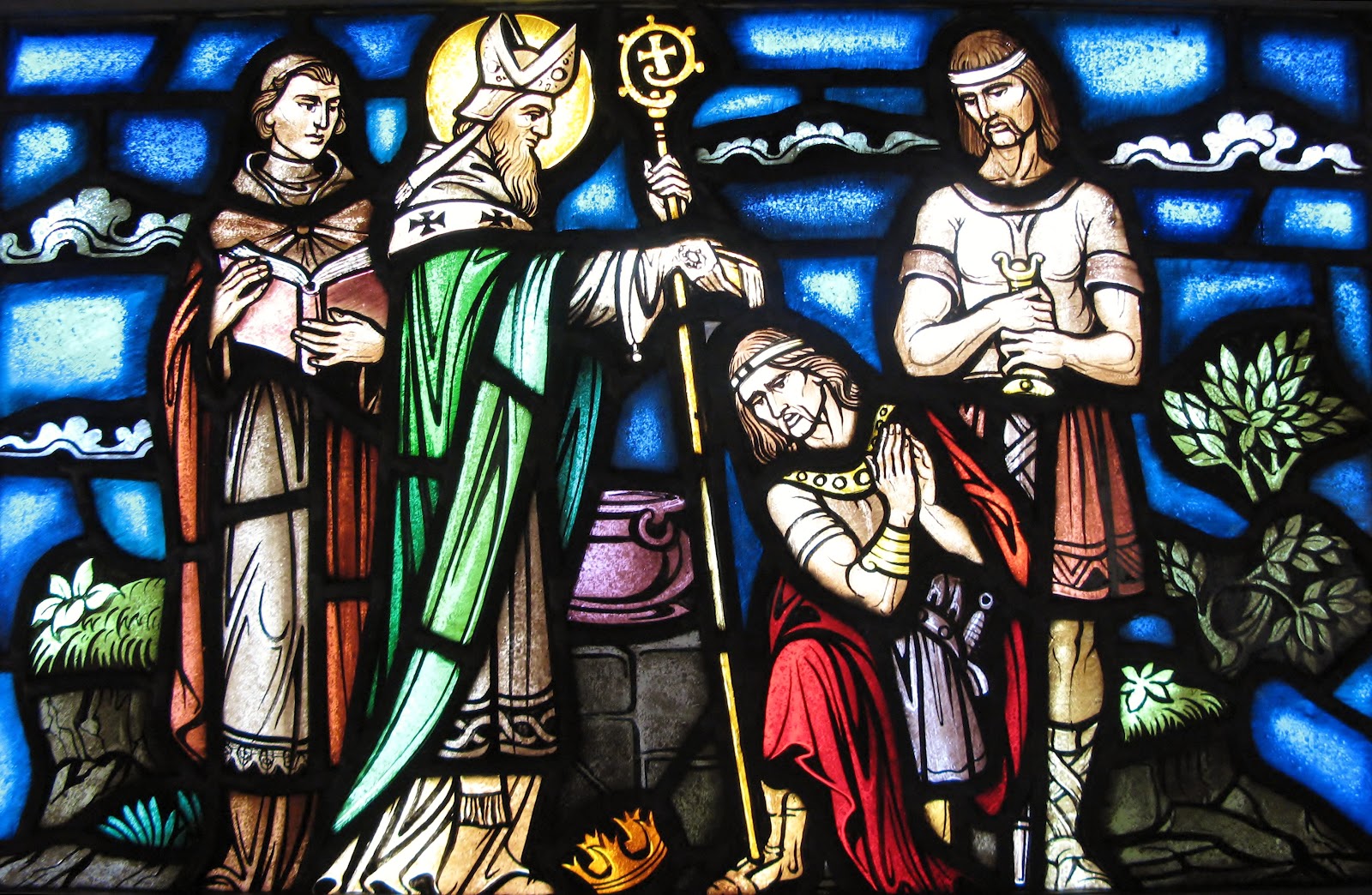
When St. Patrick Impaled a Convert


There are so many stories of St. Patrick, but one that sticks in my mind, (forgive the pun, you’ll see it in a minute), is the story of how the King of Munster bravely suffered for both no reason and for every reason.


The name of the King was Aengus, and after learning about the Christian faith, Aengus earnestly desired to be baptised.  St. Patrick travelled to the royal seat of Munster, the Rock of Cashel, where he was eagerly welcomed by the people circa 445 AD.  Apparently the baptismal ceremony took place at the famous Rock, for it is also known as the Rock of Patrick.


 Image: The Rock of Cashel, site of Prince Aengus' baptism.
Hardly any ancient ruins are artifacts remain.
 The structures seen here date from the 12th and 13th centuries.


Now, St. Patrick had a habit of driving his crosier into the ground when needed, allowing him to free his hands and prepare for whatever ceremony he was presiding at, and from one version of the story I heard, St. Patrick’s pastoral staff actually had a sharp iron spike at the end.  Well, as the good saint was getting ready, he wasn’t paying too much attention to where everyone’s feet were at, so you guessed it ~ he drove his crosier right through the foot of King Aengus, nailing him to the spot.

Lo and behold, the king never uttered a sound. In fact, he stood impaled for practically the whole ceremony.

When St. Patrick was nearing the end of the ritual, he finally saw the blood flowing and realised what he had done.  He immediately freed his royal highness and cried: “I’ve injured you! Why didn’t you say something?"

The king answered simply as his wound was tended: “I thought it was part of the ceremony.”

“Why no, it’s not!  Your Highness should have spoken out! I’ve injured you, and you may be made lame for life!”

Still, King Aengus was not ruffled in the least. According to the version I heard, he replied something like this:

“Since Christ shed all His blood and gave His Life to save my soul, it is fitting I should shed a little of my blood for Him for Eternal Life.”

So, the King suffered for 'no reason', and yet for every reason!

Admiring his courage, St. Patrick took the king's shield and inscribed a cross on it with the spear point of the same crosier, saying that this shield would stand as a sign  of countless spiritual and temporal triumphs.
    

Image: stained glass window depicting St. Patrick baptising King Aengus. Author of photo unknown.

"The royal foot transfixed, the gushing blood
Enrich'd the pavement with a noble flood."


I find it interesting that the name 'Aengus' originates from the Proto-Celtic words  oino "one" and gus "strength" (or possibly "choice").  May we all be as strong and courageous in our faith as the King of Munster.

The saint stayed for some time in the province, for  the ancient Life of St. Patrick states:

"After Patrick had founded cells and churches in Munster, and had ordained persons of every grade, and healed the sick, and resuscitated the dead, he bade them farewell, and imparted his blessing to them." 

The same record also gives us the words of his blessing, which he gave from the hills of Tipperary:

A blessing on the Munster people —
Men, youths, and women;
A blessing on the land
That yields them fruit.

A blessing on every treasure
That shall be produced on their plains,
Without any one being in want of help,
God's blessing be on Munster.

A blessing on their peaks,
On their bare flagstones,
A blessing on their glens,
A blessing on their ridges.

Like the sand of the sea under ships,
Be the number in their hearths;
On slopes, on plains,
On mountains, on hills, a blessing.


Happy St. Patrick’s Day!


(Source for the information on on St. Patrick in Munster: 
www.newadvent.org/cathen/11554a.htm)

***

***
 
If you like my blog, you may LOVE my books!


Monday, 1 February 2016

February 13th ~ Hell's Birthday?

Two years ago, I came across an interesting piece of Medieval trivia ~ that scholars once believed God created Hell on February 13th.
(Image: Painting depicting Hell, c. 1516
 
 This was news to me.  The bafflement was mighty!  After studying the Faustian legend  and writing about it in-depth to the point of severe academic obsession, starting with the historical Faust in the late Medieval Period who allegedly sold his soul to the devil and working my way up to Goethe’s epic closet drama published in the 19th century,  I wondered how come I never heard about this before?

Naturally, I had to do so digging and satisfy my curiosity, and lately have decided this might make an interesting blog post.

I began my information treasure hunt with Google, (where else?), and discovered a post dated February 13, 2014 on a Benedictine website stating that this hellish event was marked in medieval calendars.  Considering we are looking into the Medieval Period, we must not forget that in those days theological scholars believed they had also pinpointed the First Day of Creation according to their Biblical calculations based on the Julian calendar, which is currently 13 days behind ours. (So, 'Hell Day' would be the 26th of February in our modern calculation of time assuming my online source hasn't already adjusted the date.)

My theory is, if you can understand how they calculated the First Day, it should be fairly simple to see where ‘Hell Day’ originated.  Right?

Don’t worry, I won’t bore you with too much history. (Hopefully!)


We already know that the early and Medieval Christians believed the First Day began on March 25, the day Julius Caesar set forth as New Year’s Day on the calendar he instituted, yes, the Julian Calendar.  He chose that day as it was the Spring Equinox, however, as his calendar was not astronomically accurate, the equinox shifted over the centuries.  

 In 1582, Pope Gregory XIII instituted a new way of reckoning the year to correct the astronomical discrepancies they crept in, changing New Year’s Day to January 1.  We continue to use the Gregorian calendar to this day, which as mentioned, has skipped forward almost two weeks due to the Julian discrepancies.

 However, it is the Julian Calendar that still is of interest to us, and indeed, is still used by Orthodox Christians.  Despite the shift in the spring equinox, March 25th continued to be regarded as the First Day of Creation in both the east and west during the Medieval period:  it seemed logical that Creation had to have taken place sometime within the life-giving season of springtime. The day was also mystically significant as it was the Feast of the Annunciation, the day of Christ’s conception.

Our information digging doesn’t stop there; the majority of the earliest Christians up until the Middle Ages believed that Creation began circa 5500 BC give or take a few years.  Yes, there were various calculations proposed, but for some time, this was the basic accounting of years according to calculations of the Septuagint.

Okay, enough of calendar history! 

According to the Medieval way of thinking, we have March 25 as the Day of Creation and also the year c. 5500 BC as the Anno Mundi to work with.  Some theologians believed that Hell had to have been created for the evil angels that fell before God turned to work on the rest of Creation, although there is Biblical evidence God had already created the physical earth already before Satan fell.  However, for those scholars who believed Hell was created first, it is logical to assume they thought Hell must have been created around or slightly before this date in March and about the same year ~ so that would be from February to March.

Curiously, we find that in Dante’s time it was  believed the First Day of Creation took place when the sun was in the constellation Aries, a belief he recorded in his poetic classic ‘The Divine Comedy’ (1308-1320):


“The hour was morning’s prime, and on his way
Aloft the sun ascended with those stars (Aries)
That with him rose when Love Divine first moved
Those fair works: (...)”

          ~ Canto I, The Divine Comedy, (Harvard Classics, Vol. 20)


 https://upload.wikimedia.org/wikipedia/commons/e/e2/Michelino_DanteAndHisPoem.jpg

(Image: Dante holding a copy of The Divine Comedy next to the entrance to Hell, the seven terraces of Mount Purgatory and the city of Florence, with the spheres of Heaven above.  Fresco by Michelino, 1465)


Thanks to modern astronomy technology, we can now test out this information with some stellar experimentation!

Looking at the sky with the Stellarium app, we find that around 5500 BC the sun was indeed in Aries, right in sync with Dante’s fine verses.

Using this year, we can also see why theologians and scholars thought Hell was created in February.

Not only is the sun in Aries in 5500 BC, it is above the constellation Cetus ~ right over the head of the evil sea monster of Greek mythology that was destroyed by Perseus.  Remember the movie Clash of the Titans? 


 (Image: 12 PM screenshot of the sun Cetus, 5500 BC, from the Stellarium App.   Assuming the date February 13th is according to the Julian calendar, I’ve set the date in the App to the 26th, taking into account that we are now 13 days ahead in the Gregorian Calendar.)
 

Now, get this...

Cetus is also called the ‘Whale’ ~ a beast that was considered a symbol of Hell.

How did they come up with that?

In the Gospel of Matthew 12: 38-40 we find the following:

“Then some of the scribes and Pharisees answered him, saying: Master we would see a sign from thee. Who answering said to them: An evil and adulterous generation seeketh a sign: and a sign shall not be given it, but the sign of Jonas the prophet.  For as Jonas was in the whale' s belly three days and three nights: so shall the Son of man be in the heart of the earth three days and three nights.” (Bible: Douay-Rheims edition.)

Using the symbol of Jonah and the whale, Christ was foretelling His death, his following decent to the Underworld and His resurrection that would happen three days later. 

In those days it was taught that both the Limbo of the just souls and the Inferno of the damned were part of ‘Hell’. 

 Christ descended to free the just souls, and it is also believed He entered Hell, commanding Satan and all the demons to bow before Him and acknowledge Him as the Lord God ~ the 'Harrowing of Hell'.  Of interest, when St. Jerome translated this passage of the Sacred Vulgate, he used the word ‘cetus’, the same word as the whale constellation.


(Image: the constellation Cetus as a fish-tailed monster published in 'Urania's Mirror', 1825)


I also found a Biblical Astronomy site online edited by Robert Scot Wadsworth that states the name Mira for the bright star in Cetus is from the ancient Hebrew ‘marah’ meaning ‘rebel’, ‘rebellious’, ‘disobedient’ ~ a fitting star to be found in the constellation representing Hell where Satan the rebel angel and all his followers are doomed to remain for all eternity.

In ancient texts it is common to see the gates of Hell depicted as a monster or whale swallowing up the damned.  You can find some incredible examples in the following  post published in the British Library Medieval Manuscripts blog: “Prepare to Meet You Doom”.  Oh heck, I'm borrowing one of their images... here it is:


Yates_thompson_ms_13_f142r

 (Image: detail of demons throwing sinner in to the mouth of hell from the 'Taymouth Hours', Yates Thompson MS 13, f. 142 r.)
Detail of a bas-de-page scene showing the casting of souls into Hell, from the ‘Taymouth Hours’, - See more at: http://britishlibrary.typepad.co.uk/digitisedmanuscripts/2014/02/prepare-to-meet-your-doom.html#sthash.4K2slu3g.dpuf
Detail of a bas-de-page scene showing the casting of souls into Hell, from the ‘Taymouth Hours’, Yates Thompson MS 13, f. 142r. - See more at: http://britishlibrary.typepad.co.uk/digitisedmanuscripts/2014/02/prepare-to-meet-your-doom.html#sthash.4K2slu3g.dpuf


There we have it!  So, if we use the theory that Hell was created for the devil and his angels before God turned His attentions to creating the physical cosmos, (although there is evidence in the Bible the devil actually fell to earth as well), and if we take 5500 BC and observe the sun’s position in Cetus in February, we can see how the scholars of those times arrived at their calculation, February being before March, the month some theologians believed God began his Great Work of Creation.  Even when adjusting the 5500 BC assumed date of Creation back and forth a decade or two, the sun is still in Cetus, the Mouth of Hell.  How they arrived at the date, the 13th, I’m not sure: that’s another mystery to unravel, which I shall leave to the experts in biblical astronomy.


Click to see other posts on my blog here -  TABLE OF CONTENTS


***
 
Like my blog?  You'll LOVE my books!