There are so many stories of St. Patrick,
but one that sticks in my mind, (forgive the pun, you’ll see it in a minute),
is the story of how the King of Munster bravely suffered for both
no reason and for every reason.
The name of the King was Aengus, and
after learning about the Christian faith, Aengus earnestly desired to be
baptised. St. Patrick travelled to the
royal seat of Munster, the Rock of Cashel, where he was eagerly welcomed by the people circa 445 AD. Apparently the
baptismal ceremony took place at the famous Rock, for it is also known
as the Rock of Patrick.

Image: The Rock of Cashel, site of Prince Aengus' baptism.
Hardly any ancient ruins are artifacts remain.
The structures seen here date from the 12th and 13th centuries.
Now, St. Patrick had a habit of driving his crosier into the ground when needed, allowing him to free his hands and prepare
for whatever ceremony he was presiding at, and from one version of the story I
heard, St. Patrick’s pastoral staff actually had a sharp iron spike at the end. Well, as the good saint was getting ready, he
wasn’t paying too much attention to where everyone’s feet were at, so you
guessed it ~ he drove his crosier right through the foot of King Aengus,
nailing him to the spot.
Lo and behold, the king never uttered a
sound. In fact, he stood impaled for practically the whole ceremony.
When St.
Patrick was nearing the end of the ritual, he finally saw the blood flowing and realised what he had done. He immediately freed
his royal highness and cried: “I’ve injured you! Why didn’t you say something?"
The king answered simply as his wound was
tended: “I thought it was part of the ceremony.”
“Why no, it’s not! Your Highness should have spoken out! I’ve
injured you, and you may be made lame for life!”
Still, King Aengus was not ruffled in the
least. According to the version I heard, he replied something like this:
“Since Christ shed all His blood and gave
His Life to save my soul, it is fitting I should shed a little of my blood for
Him for Eternal Life.”
So, the King suffered for 'no reason', and
yet for every reason!
Admiring his courage, St. Patrick took the king's shield and inscribed a cross on it with the spear point of the same crosier, saying that this shield would stand as a sign of countless spiritual and temporal triumphs.
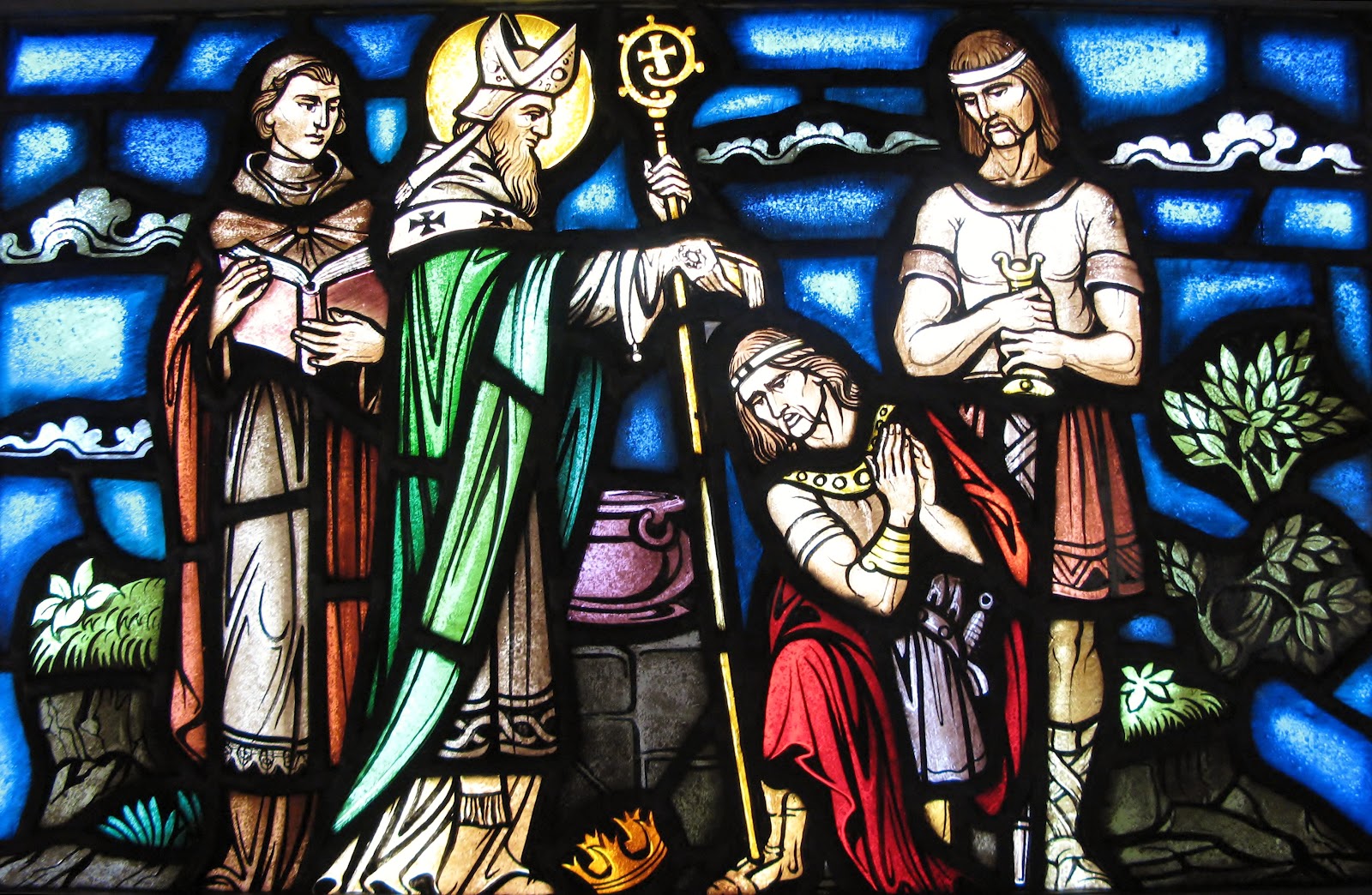
Image: stained glass window depicting St. Patrick baptising King Aengus. Author of photo unknown.
"The royal foot transfixed, the gushing blood
Enrich'd the pavement with a noble flood."
Enrich'd the pavement with a noble flood."
I find it interesting that the name 'Aengus' originates from the Proto-Celtic words oino "one" and gus "strength" (or possibly "choice"). May we all be as strong and courageous in
our faith as the King of Munster.
The saint stayed for some time in the province, for the ancient Life of St. Patrick states:
"After Patrick had founded cells and churches in Munster, and had ordained persons of every grade, and healed the sick, and resuscitated the dead, he bade them farewell, and imparted his blessing to them."
The same record also gives us the words of his blessing, which he gave from the hills of Tipperary:
A blessing on the Munster people —
Men, youths, and women;
A blessing on the land
That yields them fruit.
A blessing on every treasure
That shall be produced on their plains,
Without any one being in want of help,
God's blessing be on Munster.
A blessing on their peaks,
On their bare flagstones,
A blessing on their glens,
A blessing on their ridges.
Like the sand of the sea under ships,
Be the number in their hearths;
On slopes, on plains,
On mountains, on hills, a blessing.
Men, youths, and women;
A blessing on the land
That yields them fruit.
A blessing on every treasure
That shall be produced on their plains,
Without any one being in want of help,
God's blessing be on Munster.
A blessing on their peaks,
On their bare flagstones,
A blessing on their glens,
A blessing on their ridges.
Like the sand of the sea under ships,
Be the number in their hearths;
On slopes, on plains,
On mountains, on hills, a blessing.
Happy St. Patrick’s Day!
(Source for the information on on St. Patrick in Munster:
www.newadvent.org/cathen/11554a.htm)
***
***
St. Patrick Day Blog posts you may like:
*) St. Patrick and His Blessed Crozier: Where did he get it?)
*) Martyrdom by Passion (and a Brain-Ball): An Irish Legend
*) O'Leary the Leering Leprechaun
*) St. Patrick and His Blessed Crozier: Where did he get it?)
*) Martyrdom by Passion (and a Brain-Ball): An Irish Legend
*) O'Leary the Leering Leprechaun


 (Tomb of King Pedro)