Whatever curious and interesting subject strikes my fancy, be it silly or serious, gets posted for your reading pleasure.
Showing posts with label old Ireland. Show all posts

Thursday, 14 March 2019

St. Patrick's Well – Clonmel Ireland, Co. Tipperary

Ireland's mystic Catholic history is steeped in the tradition of holy wells dotted throughout the island.


It is said that rather than negatively pointing out to the pagan Druid Celts what they were doing wrong by declaring certain spots sacred in their nature-worship, the early missionaries like St. Patrick realised encouragement is the key and told the people that yes, they were correct about the idea of holy wells and thereby dedicated them to the service of Christ, converting them into Christan baptismal fonts.


Outside Clonmel Co. Tipperary on the Cahir road near Marlfield you will find such a holy well.  It possibly one of the largest holy wells in Ireland, and it is said that it once was a  Druid site turned into a baptismal font by St. Patrick.


 However I've also heard of one story St. Patrick met St. Declan of Ardmore here, the Apostle of the Deise people, ie. the Ardmore / Waterford region.  Those who are not familiar with all of the ancient Catholic history of Ireland often presume St. Patrick was the first missionary, but there were others who came before him or just around the same time, St. Declan was one of those bishops. 

As he was travelling from Rome to Ireland, St. Declan met St. Patrick in Italy who was not yet made a bishop.  Then it appears when St. Patrick was travelling through the south of Ireland preaching and winning many converts to the faith, St. Declan met him again at St. Patrick's well, perhaps to converse on the matter of apostolic jurisdiction since Ardmore / Waterford was in St. Declan's area.    Apparently, there are little to no records or traditions passed down regarding St. Patrick evangelising in Waterford, so it appears he respected St. Declan's authority there as agreed, and it seems St. Declan granted to St. Patrick he could have this one well where he preached to and baptised the people.


It's quite possible it was also here at St. Patrick's Well where the two saints agreed to later meet at the Rock of Cashel, the seat of King Aengus of Munster, to formally finalise the matter.  St. Ailbe was also there at Cashel, another missionary bishop who had also arrived before St. Patrick to spread the Gospel.   Tradition states the three saints came to an agreement of archdiocese boundaries at Cashel with the King as witness.  St. Declan remained in the Waterford / Admore region, while St. Patrick was granted a few church in the Munster area, he agreed to return to the northern Kingdom of Ulster, his archdiocesean seat becoming Armagh where is buried.  (For St. Patrick's dramatic encounter with King Aengus of Cashel, click here.)


Apparently, the church at St. Patrick's Well at Clonmel was granted the grace of becoming a Plenary Indulgenced site by Pope John V in 1619. (Source: Pilgrimage in Medieval Ireland).  The Pope  declared all pilgrims visiting the church there on the feast of Pentecost or on the feast day of St Patrick, provided they went to confession and communion, would receive a plenary indulgence. (If you want to know what a plenary indulgence is, read my blog post, Remember Remember the Dead in November).


The well is reached by descending a small limestone cliff into a dell via some wide but steep steps, and it is a lovely, peaceful spot to visit.


 Some of the early photos I have discovered thanks to 'Medieval Pilgrimage in Ireland' are truly stunning in a time-capsule sort of way, showing what it looked like in the last turn of the century c. the 1900s.  

It still looked kind of 'druidy'  didn't it!  Sadly, that old tree with its roots wrapped around the well is no longer there. 


(Above: photo: Robert French (1841-1917) in The Lawrence Photograph Collection National Library of Ireland http://catalogue.nli.ie/Record/vtls000333667

Below:   the original landscape of St Patrick’s well. Taken by Robert French (1841-1917) in The Lawrence Photograph Collection National Library of Ireland http://catalogue.nli.ie/Record/vtls000339062) 


The old Celtic cross in the left foreground dates from circa the 6th century. It is still there.


Also, it is amazing the amount of water that still bubbles with some considerable force out of the spring straight from the ground. I remember the good old days when they used to play the Irish national anthem on the TV station RTE1 before it signed off for the night, the gushing stream from the well was one of the patriotic images shown.


The site was modernised in the late 50s early 60s I believe, the water now collects into a nearby pool which surrounds the cross.


The Cistercians came to the area in 1147 AD and moved on to Inishlounaght at Marlfield where they prospered for 400 years. The abbey there was founded by Donal O’Brien the King of Munster and dedicated to the Blessed Virgin. St. Patrick's Well was apparently also under their care, that is until Cromwell's arrival when their monastery in Inishlounaght was dissolved in the 16th century. Cromwell divided the monestary lands up between his friends. The abbey no longer exists but its site is located at the First Fruits Church of Ireland on the banks of the River Suir in Marlfield. 


The present remains of the church you see dates from circa the 15th century and is from the period before when the Cistercians were custodians.  Inside you can see the "White Altar" tomb and fragments of an earlier Cistercian Romanesque Church. To the right of the East window the large carved coat of arms of the White family can be viewed. Nicholas White died in August 1622. Today St. Patrick's Well is part of the present day parish of St. Mary's of the Assumption, Irishtown, Clonmel.


Cures continued to happen out there for quite some time.  My Irish mother from Clonmel remembers the days when there used to be crutches, wheelchairs and other similar things left hanging on the church as votive offerings of thanksgiving.  They're gone now, and one wonders what has happened to the the faith in Ireland, we don't hear of cures happening at the site any more.

Also, she remembers the days when there were truly holy processions to the well on St. Patrick's Day after High Mass and the whole town got involved, everyone marching out with bands playing and banners flying to pay respect to the national saint.  

Alas, I didn't get to see that either when we moved there: processions are gone in this modern Vatican II age, at least there were Masses in the churches, but no procession, only a secular booze up parade in town with a few reflective souls venturing out to see the well.

A sad state of affairs, however, we can be comforted with the prophecy that just when the flame of the Faith appears to be snuffed out in Ireland, it will one day flare up from the north and blaze throughout the land in a miraculous age of renewal. 


::::::::::::::::::::::::::::::::::::::::::::

If you liked this St. Patrick's Day post, you may like my past St. Patrick's Day / Irish posts: 


(*)  The Shamrock Purist - (How to spot the real one from the sham Shams!)


If you like my blog, you'll LOVE my books! Check them out! (Click here)


Saturday, 11 March 2017

Martyrdom by Passion (and a Brain-Ball): an Irish Legend


One day I was glancing through a booklet entitled "The History of St. Patrick's Parish and Church" of San Francisco printed in 1976 for the 125th Anniversary of the same.  Stained glass windows are one of my favorite decorative arts, and as the booklet features passages describing adornments of the sacred edifice, which was greatly influenced by Irish Catholic heritage, I was curious to see what I would find.

In addition to the attention given to the stained glass windows depicting Irish saints, such as St. Patrick founding his main diocese in Armagh pictured here, (Photo credit: Justin Zolli ) I discovered there are a series of Tiffany glass windows in the upper clerestory of the church that feature history and legends of the ancient pagan past of Erin, a gesture to the culture and traditions of Ireland before Christianity become the religion of the isle.


I was surprised at first, but then, this artistic nod to the ancient past in the Catholic Church is not unsual either depending on the pagans honoured by this gesture of recognition.


 It is no secret that the Vatican has masterpieces depicting the pagan past of Italy and Greece in its hallowed halls, and a handful of heathens have been given the distinction of being represented in the Sistine Chapel ~ the Nine Sybils ~ prophets and prophetesses that did not belong to the Jewish faith yet also predicted the coming of Christ.


I mention this rare honouring of the pagans because there is one stained glass window of St. Patrick's that could be described as a 'Sybil' where Irish history is concerned: the 'martyrdom' of King Conchobar (Conor) mac Nessa of Ulster.  

His story is often declared nothing more than a mythical legend, but ancient cultures like the Celts had a rich tradition of oral history that obviously morphed into legend, for as they say, myths usually have a basis in fact. Where fact ends and mythical stories and elaborate additions begin, we do not always know.  That is the delightful mystery with which the ancient tales continue to fascinate us.


Let us travel back to the ancient past of the warrior Celts: honour was won by daring feats of valour and great deeds in battle. The heads of defeated enemies were hung up as trophies displaying the number of men slain by a warrior indicating prowess in battle. Decapitating people and tossing their heads about was a manly thing to do it seems.


According to one legend, the warriors of Connacht and Ulster were staying in the home of Mac Dá Thó in Leinster as a guest. During a feast the soldiers held a contest with each other to determine who had the right to carve the hero's portion of the roast and thus commenced boasting of their mighty deeds. Cet mac Mágach of Connacht silenced them by reminding them how he had bested them all in his great exploits in battle and was about to carve the hero's portion when another warrior entered the scene, Conall Cernach of Ulster who was late to the party. Cet had to admit defeat when presented with Conall's list of deeds, but tried not to lose face entirely by claiming if his brother Anlúan was there, he would have to give him the honoured portion, for Anlúan was the best warrior among all present. What did Conall Cernach do? Reach into a sack and throw its contents at Cet ~ the head of Anlúan. End of contest. Conall got the lion's share of whatever they roasted that night.

  
However, the most fearsome and magically potent weapon a warrior could have was a 'brain-ball' to sling at his foes. A brain-ball was made using, (you guessed it), the brains of an enemy slain in battle and mixed with lime, which was then left to harden into a projectile. No doubt they were the most sought after weapon depending on whose grey matter went into the mix: the warrior Cet of Connacht re-enters our story as he dared to sneak into Ulster and steal a prized brain-ball from the King's treasury in Emain Macha. The ball was made from the brains of King Mesgedra of Leinster, and Cet kept it with him wherever he went.   A rare weapon like that couldn't be thrown at just any old common warrior you know!


King Conor Mac Nessa of Ulster mentioned earlier received that dubious honor, getting struck with his own weapon, for it was he who killed King Mesgedra of Leinster and had the brain-ball made as Mesgedra's head was too big to carry back as a trophy. One day the Connacht warriors raided King Conor's land and stole his cattle. A battle was eminent when Conor overtook the warrior-thieves in Westmeath. Conor was eager to prove himself in battle, but Cet who was lurking in ambush shot him with the dreaded brain-ball with his sling, which lodged right in King Conor's forehead.

However, he did not die. Fintan the physcian realised the best thing to do was not to touch it, for to remove it would bring on the King's death. In the end, the brain-ball was sewn into place with gold threads matching the colour of the king's hair to ensure it wouldn't move. The King was advised never to exert himself in any violent activity that could dislodge it, including horse riding, for if it moved it meant certain death.

According to the legend, the King lived for another seven years following this advice and had to forego the warring exploits he was accustomed to.  It is at this point we find a curious twist to his legend.

One mid-day the sky darkened, and troubled by the sight King Conor wished to know what this omen meant. 

He summoned his chief Druid to explain what was happening, and entering into a trance in a sacred grove the priest described a scene that horrified even the hard core, gore-accustomed Celtic king: the Druid saw a hill in a distant land upon which three crosses stood, on the three crosses there were human forms nailed, yet one of them was like unto the Immortals. In some accounts we hear the King was also allowed to see the vision.
 

The King recognised the scene was an execution and asked the Druid "if the one likened to the Immortals was a criminal?”


“Nay,” answered the Druid, “but the Son of the Living God,” and still in a trance he proceeded to relate the full details of Christ's execution.

The thought of mortals daring to kill this Immortal was too much for King Conor, and in a fury over so foul a deed he drew his sword with the cry: “Thus would I deal with His enemies!” and rising to battle-fury pitch, proceeded to hack the oak trees in the sacred grove despite the danger to his own life.

The passionate outburst dislodged the brain-ball, in some accounts we read that the ball literally burst into pieces with his exertions, and King Connor died wishing he could have defended the Christ while symbolically eradicating the hold of druid paganism over Ireland just before the Apostles began to spread the Faith.

To further seal his honour as the destined pagan, it is said he was born on the same day as Christ, (although not the same year).

Is this an early Medieval romanticised addition to the legend, or a tale of a true occurence that was rendered into myth at a later age? I will leave for the reader to decide.

As a result King Conor became honoured as the Druid pagan who ended up becoming a martyr for Christ by blood and courageous desire, and in a way, a Sybil of the new Faith brought centuries later by numerous missionaries and saints, including St. Patrick,  who would transform the Emerald Isle into the Island of Saints and Scholars.


(Image: King Conor's Vision, St. Patrick's Church San Francisco. Photo by Justin Zolli.)

Here are other St. Patrick's Day / Irish themed entries you may find interesting:


Friday, 11 March 2016

When St. Patrick Impaled a Convert


There are so many stories of St. Patrick, but one that sticks in my mind, (forgive the pun, you’ll see it in a minute), is the story of how the King of Munster bravely suffered for both no reason and for every reason.


The name of the King was Aengus, and after learning about the Christian faith, Aengus earnestly desired to be baptised.  St. Patrick travelled to the royal seat of Munster, the Rock of Cashel, where he was eagerly welcomed by the people circa 445 AD.  Apparently the baptismal ceremony took place at the famous Rock, for it is also known as the Rock of Patrick.


 Image: The Rock of Cashel, site of Prince Aengus' baptism.
Hardly any ancient ruins are artifacts remain.
 The structures seen here date from the 12th and 13th centuries.


Now, St. Patrick had a habit of driving his crosier into the ground when needed, allowing him to free his hands and prepare for whatever ceremony he was presiding at, and from one version of the story I heard, St. Patrick’s pastoral staff actually had a sharp iron spike at the end.  Well, as the good saint was getting ready, he wasn’t paying too much attention to where everyone’s feet were at, so you guessed it ~ he drove his crosier right through the foot of King Aengus, nailing him to the spot.

Lo and behold, the king never uttered a sound. In fact, he stood impaled for practically the whole ceremony.

When St. Patrick was nearing the end of the ritual, he finally saw the blood flowing and realised what he had done.  He immediately freed his royal highness and cried: “I’ve injured you! Why didn’t you say something?"

The king answered simply as his wound was tended: “I thought it was part of the ceremony.”

“Why no, it’s not!  Your Highness should have spoken out! I’ve injured you, and you may be made lame for life!”

Still, King Aengus was not ruffled in the least. According to the version I heard, he replied something like this:

“Since Christ shed all His blood and gave His Life to save my soul, it is fitting I should shed a little of my blood for Him for Eternal Life.”

So, the King suffered for 'no reason', and yet for every reason!

Admiring his courage, St. Patrick took the king's shield and inscribed a cross on it with the spear point of the same crosier, saying that this shield would stand as a sign  of countless spiritual and temporal triumphs.
    

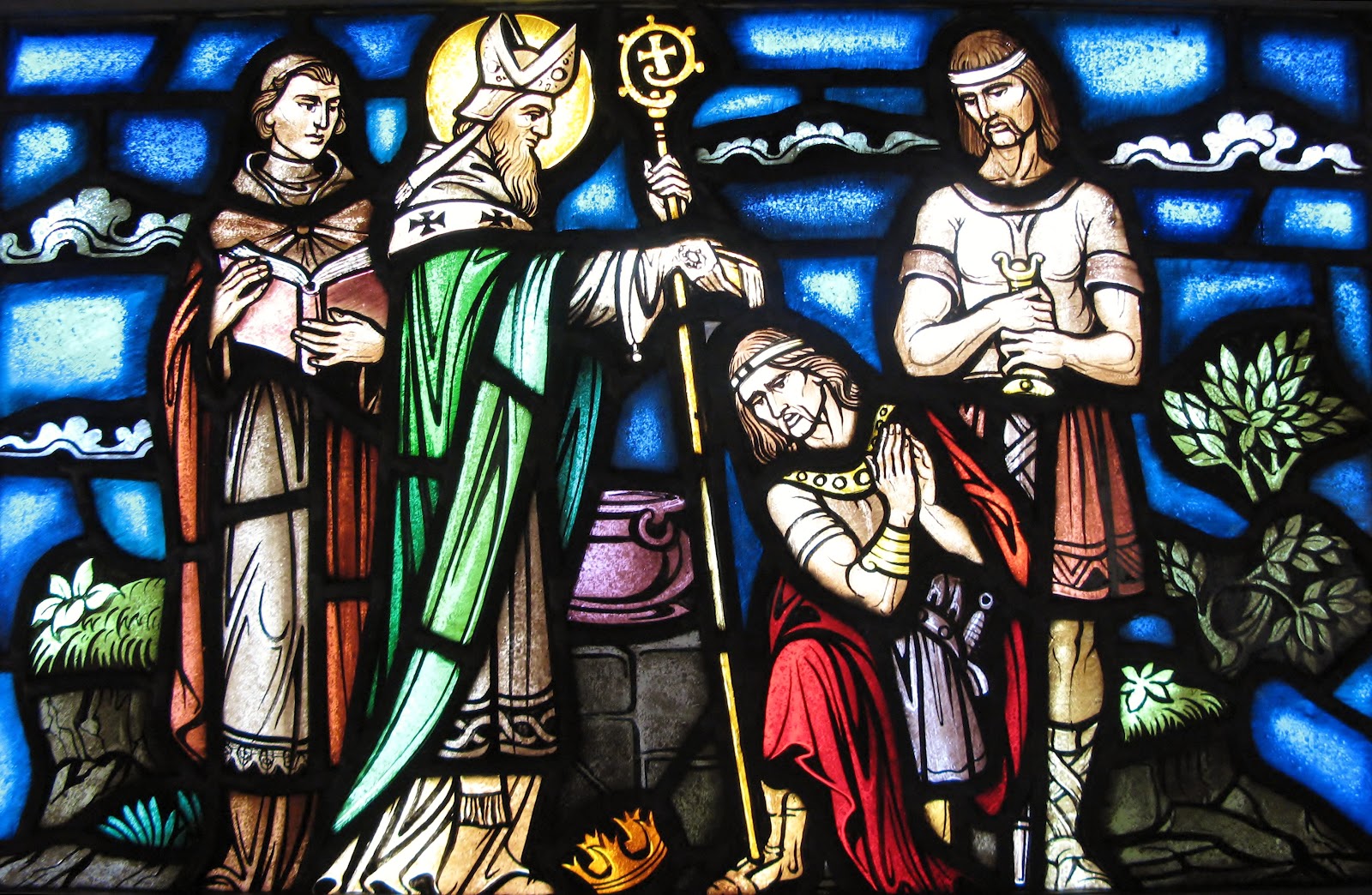
Image: stained glass window depicting St. Patrick baptising King Aengus. Author of photo unknown.

"The royal foot transfixed, the gushing blood
Enrich'd the pavement with a noble flood."


I find it interesting that the name 'Aengus' originates from the Proto-Celtic words  oino "one" and gus "strength" (or possibly "choice").  May we all be as strong and courageous in our faith as the King of Munster.

The saint stayed for some time in the province, for  the ancient Life of St. Patrick states:

"After Patrick had founded cells and churches in Munster, and had ordained persons of every grade, and healed the sick, and resuscitated the dead, he bade them farewell, and imparted his blessing to them." 

The same record also gives us the words of his blessing, which he gave from the hills of Tipperary:

A blessing on the Munster people —
Men, youths, and women;
A blessing on the land
That yields them fruit.

A blessing on every treasure
That shall be produced on their plains,
Without any one being in want of help,
God's blessing be on Munster.

A blessing on their peaks,
On their bare flagstones,
A blessing on their glens,
A blessing on their ridges.

Like the sand of the sea under ships,
Be the number in their hearths;
On slopes, on plains,
On mountains, on hills, a blessing.


Happy St. Patrick’s Day!


(Source for the information on on St. Patrick in Munster: 
www.newadvent.org/cathen/11554a.htm)

***

***
 
If you like my blog, you may LOVE my books!


Tuesday, 1 March 2016

O'Leary the Leering Leprechaun


By now, we all have seen,
That little eejit on the shelf,
The naughty, spying git,
The smug Christmas Elf.

We forget he’s sitting there,
He stares all day without a flinch,
Then, when all are fast asleep,
Comes alive to play the Grinch.

He flies to Santa the tattletale
With all the good and bad we’ve done,
Then, plays the downright hypocrite,
He spends the night in mischievous fun.

Well, if you think the Elf is creepy,
Have I got some news for you!
Let me introduce his cousin,
Leering Leprechaun O’Leary.

One bright St. Patrick’s Day
O’Leary came up with something new:
He thought long and hard upon his life,
How things had gone askew.

He and all his merry kin,
Once wee angels in the sky,
But swayed by Lucifer’s horrid sin,
From Heaven were forced to fly.
Not yet so bad to be sent to Hell,
But not good enough to stay On High,
Down to earth they were flung,
Banished from their angelic home
Soaring in the sky.

Now they wander Eire
Waiting for the end,
For when the Trumpets blow,
The Pit will receive them then.
Before their time will come, they figured,
“Why always be so glum?
While we trot about this earth,
We’ll have our share of fun.”

So, for eons they danced and played,
Enjoyed their gold, revelled and fought,
Drank and partied millenniums away,
Heaven? Nary a thought!

Then the light for a moment dawned
In Little O’Leary’s brain.
“Sakes! What’s the point of this,
If we can’t see Heaven again?
Hell is not the place to be,
I can see that clearly.”
So, the wheels began to turn,
In the crafty mind of O’Leary.

He noted his jingly cousin
That little eejit Elf,
Was on to something good,
By sitting, staring on the shelf.
“If me daft cousin can be a snoop
And spy for someone saintly,
Sure, I can do the same,
It might work, just maybe!”

It didn’t take him long at all
To think who he could aid,
Why, St. Patrick could use a hand,
And then, he’d have it made!

That saint had earned a special grace,
A blessed gift from above:
That he could greet the Irish,
The people that he loved.
He would get to judge them first,
Then, send their souls to God.

What?  How could so great a task
Be done by just one saintly man?
O’Leary could help keep track,
Of those Paddies in every land!
Spying on all the Gaels and Celts,
Now that’s a master plan!

He could easy creep them out,
With all his leery looks,
Freaking them into being good,
Or mark them in his books.

So many Paddies make a hames
Of St. Paddy’s special day,
O’Leary thought he’d make sure,
They’d spend it the right way.

A smithereen o’green,
Did ye forget to wear?
Ah, look out me friend,
Cead mille pinches beware!
Did ye go to Holy Mass,
Did ye say all ye’re prayers?
Or like ing-uns are ye’re sins and faults
Piled up in multi-layers?
Did ye go and take the time
To unload them in confession?
Or are ye just wasting time,
With all ye’re larkin’ and ye’re messin’?
Did ye think to thank the saint?
Nay! Ye’re  a gluttin’ on corned beef!
Ah, more’s the pity,
Ah, more’s the grief!
A drinking ye love to do,
The stout and whisky flows,
The Pledge is gone, the bottle remains,
Oh yes, O’Leary knows.

The list goes on and on,
What keeps us from the pearly gates,
O’Leary marks it down,
He and all his tiny mates,
For now every leprechaun,
Has latched to his bright idea,
If they help him out they figure,
They too will have no Hell to fear!

We know not what St. Patrick thinks,
O’Leary lacked the stout to ask him,
The leprechauns thought they’d save them up,
And all the records hand him.

How successful will they be?
‘Tis difficult to tell,
For they are all as cheeky,
As the family Christmas Elves.
At night they resume their auld ways,
It’s hard to stay so good!
Drinking, fighting and hoarding gold,
Divilment is in the blood.

But by day if they are caught,
You may see what they have done,
Poking in all your cupboards,
Or making sure your work’s undone.

Ah, ye little hypocrites,
To spy on us so sorely!
Then to find ye’re just as weak,
Ye’re virtues are sure poorly!

So beware, all ye who boast,
Irish ancestry in ye’re blood,
O’Leary and all his puckish mates
Know when ye’re up to no good.


Other St. Patrick Day Blog posts you may like:


When St. Patrick Impaled a Convert 
***
 
Like my blog? You'll LOVE my books!


Wednesday, 2 September 2015

St. Patrick's Purgatory

(Post originally published March 16, 2013)

description St. Patrick, the patron saint of Ireland, was famed for his strict fasts and his practise of extreme bodily mortification, not only for the conversion of Ireland but also to atone for his own sins.

Why was fasting and penance so important to him? According to Catholic teaching, if you do not make reparation for your sins, even if you are saved, you must still make satisfaction for them in the next life in Purgatory where your sins are ‘purged’ from your soul before you may enter Eternal bliss. Saints and mystics who had been granted visions of the dreaded place of cleansing described the various torments endured there, each torture depending on the nature of the sins committed. One poor soul who had been granted permission to come back and tell of his sufferings said the pains were so bad that minutes felt like hours if not whole days. Also, there were many poor souls there with years, even centuries, left to serve on their sentences in that woeful prison. In all, the soul warned it was far better to do penance on earth than see what may await you in Purgatory.

Returning to St. Patrick, Station Island situated on Lough Derg, County Donegal became famed for his teaching on the subject. According to one story, he gave a sermon on Hell and Purgatory to the locals, but they remained sceptical about the existence of these places saying they would not be so doubtful if one of them could be permitted to descend, see what was there, and return to tell the tale. The saint was so upset by this lack of faith he wondered how he could convince the Irish and prayed to God for assistance. Christ appeared and showed the entrance to a cave on the island which led to Purgatory and Hell. A man was sent down to see these strange abodes, and according to the story, returned to describe what he had seen. In other stories, St. Patrick ordered a pit to be dug into which the man descended. Medieval accounts describe the ‘pit’ as a shaft that was a low and narrow kiln. Ever since, the island has sometimes been referred to as ‘St. Patrick’s Purgatory’.
description

Illustration of Station Island by Thomas Carve, (1666). 'Caverna Purgatory' marks the site of the cave.


Was it just a legend? There is in a fact a cave on the island, which has been closed to the public since October 25, 1632. Some authorities claim it received the name ‘purgatory’ from the Latin medical term of ‘purgatorium’, a room to purge the body of all ailments and impurities, further pointing out that the ancient druids would often use caves to smoke medicinal herbs to cleanse the body through sweating similar to modern saunas. In addition, historians note that the ‘purgatorial’ nature of the cave was not attached to St. Patrick and the Christian doctrine of Purgatory until much later in medieval documents. Despite these observations, the old texts are still fascinating. They tell of other brave souls who wished to follow in that first adventurer’s footsteps and see the gloomy realms of the Christian underworld for themselves. By the time the monastery was built on the island, the brave pilgrims had to seek the permission of its founder, St. Dabheog, who was one of St. Patrick’s disciples, before they could venture into the pit, or a series of nine ‘pits’, after which they were lowered into the final dreaded shaft.


description
Picture of the chapel, bell tower, and 'penential pits' or 'beds of the saints'on Station Island. The cave lies under the bell tower.


What did the penitents endure?
Here legend becomes blurred. One story relates that St. Patrick was attacked by demons in the shape of black crows for forty days on the island as a penance, and that those who came to the island were assaulted by the same bird-like demons. If they survived, they had accomplished their purgatory. The text by the famed medieval chronicler of Ireland, Giraldus Cambrensis, relates a different description. According Giraldus, the island was occupied by the monks on one side and a hoard of demons on the other that continued to cause an uproar and disrupt the monks’ peace with their pagan festivities. By then, the pilgrimage had developed a set ritual. Before they were permitted on the island, the pilgrims had to seek permission of the local bishop whose duty it was to dissuade them from undertaking this perilous journey. First they would be reminded of the horrific torments they would endure, then learn about the fate of those penitents who had never been seen again. Tales abounded of those reprobates who were not worthy of salvation and were dragged body and soul to hell instead. If the pilgrims persisted in performing the penance, they were conducted to the shaft with all due ceremony and lowered down by means of a rope with nothing but a loaf of bread and a vessel of water to sustain them in their fight against the evil demons. The pilgrims spent a night in each of the nine ‘pits’ and were tormented in a thousand different ways by devils for those nine nights before being lowered into the cave. At the end of each night, if the pilgrim survived, he was taken to the church in a joyous procession bearing the cross and chanting psalms. If a pilgrim was not to be found, the sacristan simply closed the doors to the church, that soul was lost for all time.

In some texts there is evidence the ritual of the pilgrimage had changed in the later Medieval period, that the penitents were allowed only one drink a day from the sacred lake, but were not expected to go into the nine ‘pits’. Instead, they took part in procession and prayed at the ‘stations’, or ‘penitential beds of the saints’ for nine days. On the ninth day they listened to sermons telling them of the danger they were about to undergo by venturing into the cave, and if they still wished to undertake the penance of staying a full day and night in the kiln, they forgave their enemies and said farewell to each other before they were lowered into the cave in case they might never be seen again.

The various legends state that several people returned to bear witness of the terrible sights they had seen of Purgatory and sometimes Hell. The place was so terrifying they could laugh no more and could no longer take part in anything mirthful on earth. The reputation of the island became so great during the Middle Ages that it was a continual point of reference for preachers when people doubted the existence of Purgatory. Many flocked there to perform penance, and perhaps, to see what awaited them in the next world. A ‘Knight Owen’ supposedly made a descent in 1153 and came back to tell of his experiences. In 1358 Edward III gave a Hungarian nobleman letters patent attesting that he had indeed ‘undergone his purgatory’.

Believe it or not, the island is still a popular place of penance and is often booked out. For three days pilgrims ‘undertake their purgatory’ by going barefoot and saying prayers, walking around to the famous ‘prayer stations’ or ‘beds of the saints’ in all weather be it rain or shine. On the first day, a twenty-four hour prayer vigil is commenced, only on the second day are they allowed to sleep. Until then, each pilgrim must watch out for their neighbours and prod them awake if they happen to nod off. Mass is also celebrated, and of course, penitents participate in the sacrament of confession. Furthermore, a strict fast of one meal a day is observed and consists of dry toast, oatcakes and black weak tea or coffee. If this is too unbearable, I have heard that the staff will provide a bowl of broth, but don’t expect it to be fancy! The penitential soup is so watery that the poor pilgrim is wondering what was boiled in it, if indeed, anything made it into the pot at all besides a dash of salt and pepper. Lough Derg is considered the toughest Christian pilgrimage sites in all of Europe if not the world, and not recommended for anyone under the age of fifteen or who has health issues. At least the ordeal now lasts only three days instead of nine!

Interested in booking a pilgrimage? Visit: http://www.loughderg.org

For those who are curious about Purgatory, this is one of my favourite books on the subject:

Purgatory  Explained by the Lives and Legends of the Saints by F.X. Schouppe


(Commentary for this blog post about the medieval legends of St. Patrick’s Purgatory taken from: ‘The Poetry of the Celtic Races’ by Ernest Renan (1823-1892), The Harvard Classics, Vol. 32, pp. 177-178.)


***
 
Like my blog? You will LOVE my books!


The Shamrock Purist

(Post originally published March 17, 2012)

description
Happy St. Patrick's Day!

According to Tradition, when asked by the Irish people to explain how the Trinity of the Father, Son and Holy Ghost could exist as three Divine Persons yet remain one God, St. Patrick plucked a shamrock growing at his feet and showed that the humble little green sprig had three leaves on a single stem.

The Irish have always said that the shamrock will only grow in Ireland, but we have dicovered otherwise here in Fatima. When we first arrived in Portugal, my mother and I were surprised to find shamrocks growing in abundance here, enormous sprays are spreading beside our house. It is wonderful that we don't have to go without St. Patrick's special plant on his feast day. We have also heard that Irish pilgrims to France have discovered shamrock growing on the ground where St. Joan of Arc mustered the troops before heading into battle. The shamrock is considered a blessed sign of faith.

Although Wikipedia says shamrock is from the “clover family” because the word “shamrock” is derived from the diminutive of the Irish word for clover, the Irish members of my family, and everyone I have ever met in Ireland who are “Shamrock Purists”, have emphatically told me the true shamrock is not considered a “clover” at all by the people, despite the Irish word and the scientific classification. If you even dared to say it is related to clover, you would be considered daft!

Today we see shamrocks being used by the media in all shapes and sizes, but not all are what the purists would call a “true” shamrock. In fact, it is astounding that these shapes are also being used by many Irish in Ireland! It is no wonder a considerable number of people have no idea what it should look like. So on this auspicious day, I am taking the opportunity to give you a few tips on recognizing what is and isn't a St. Patrick shamrock according to the purist.

What should an authentic St. Patrick's shamrock look like?

description

It has three round-topped leaves that have no white ring at all showing in the middle. Anything that has even the slightest hint of a white ring in the centre of the three-leaf part is “clover”. The plant also grows from a single stalk, not in separate tufts or individual stalks like the common clover you see in lawns that have the white or white-pinkish flowers. Shamrock spreads flat on the ground as a spray, and never grows upward like a clover. No doubt the shamrock was the inspiration for the trefoil or “three leaf” window that also represented the Trinity in Gothic architecture.

description


Therefore, the real St. Patrick's shamrock to the purists is distinct from other “three leaf” or “trefoil / trefolium” plants, but according to Wikipedia, the "trifolium repens" is “sometimes” used as shamrocks. What! Are ye daft?! The "Trifolium repens” should not be considered a St. Patrick shamrock at all because it has a white ring in it. The Irish also refer to this “T-repens” interloper separately as “white clover” ~ “ seamair bhán” and not “seamróg” or shamrock. This image below is a “repens”, notice the white ring:


description


Also, anything that is a hybrid with flat-topped leaves, black or purple colours in the centre is not a true St. Patrick's shamrock. The most common shape for the shamrock symbol used today is the heart shaped variety, even the Irish national airline Aer Lingus uses it ~ ah, the shame! This is the common wood sorrel! Just because it has three leaves, do not assume it is an honest-to-goodness St. Patrick shamrock:


description

Perhaps the most “blasphemous” form of the plant is the four-leafed heart-shaped variety ~ definitely a deviation from St. Patrick's holy three-leaf. To think they use four-leaf clovers and “shamrocks” for St. Patrick's Day decorations, alack!

In case you are wondering where the “lucky” four-leaf clover tradition came from, it was not a luck charm at all. According to an old superstition held among the Irish peasantry, a four-leafed clover was a charm against witchcraft and spells. In the book Treasury of Irish Myth, Legend & Folklore edited by W.B. Yeats and Lady Gregory, Yeats called this old charm a four-leaf shamrock hence the possible cause for the confusion between the old clover and a “lucky shamrock”.

A word to the wise, the Irish were never “lucky”, but always blessed when they remain true to the faith St. Patrick taught them.

***
 
Like my blog? You will LOVE my books!