Whatever curious and interesting subject strikes my fancy, be it silly or serious, gets posted for your reading pleasure.
Showing posts with label ea bucchianeri. Show all posts

Thursday, 31 October 2019

When the World Gets a Hold of Your Darlings


Ah, the thrill of seeing something you have created out there in the world for all to enjoy - until you see what the world does once it gets a hold of it.

I wonder what the creative greats like Mozart or Tchaikovsky would have thought if they knew their masterpieces would one day be used as jingles selling everything from washing soap to dog food. 

 For instance, never in a million years would Beethoven had known let alone thought that 'Für Elise' would be used in the 1980s to advertise the greasy glory of fries and hamburgers to the point that every kid in America who wasn't taking piano lessons came to know the piece solely as 'The McDonald's Song'.


Remember that ad?  If you don't, I'm certainly getting old! 

(By the way, I found it on YouTube.  You're welcome.)  


Anyway ....

I'm no Mozart, but it seems writers suffer a similar fate.

We slave over our rough drafts and manuscripts, doing our best to turn out polished phrases, only to see  some of our cherished darlings, aka our quotations, morphed into other colourful mutant creations beyond our imagination once they have been released out into the big wide world.


Regarding my own quotes, I've found a few repurposed by whoever found them, thankfully, they are not all mutilated.  People have become pretty inventive with them!  (Or not.)

Below are a few that have either made me laugh as well as groan to the point I just HAD to save them.  I hope they amuse you too.


This picture with this quote - utter genius.    (Quote from Brushstrokes of a Gadfly)


The next image below is a case of  'go home meme bot generator, you're drunk'.  

The quote is about the poetic spirit of the Eiffel Tower, and yet it has been plastered onto an image of an uninhabited wasteland, apparently by an AI program that doesn't deserve the 'I' for intelligence in its anagram.   *sigh!*    


This next quote is a favourite out there with the artists - here is an example of what they do to it:

(Also from Brushstrokes of a Gadfly)


 Below, another case of "go home meme bot, you're drunk".

Thanks for sticking a quote about PARIS, FRANCE on a picture of VENICE, ITALY you dingbit!  Give this meme bot some geography lessons!

(Quote from Brushstrokes of a Gadfly)


Next one, "Sesame Street" has turned into an urban jungle since I last saw the show.  LOL!

(Quote also from Brushstrokes of a Gadfly)


Another case of a meme bot not having a clue - this quote of Faust, the man from the 1500s who sold his soul to devil for knowledge and power, stuck on a picture of a modern day weightlifter?

 Um....okay.  And, the bot cut out the last part of the quote too!

(Quote from Faust: My Soul be Damned for the World, Vol. 1)


Then, to find people translating your quotes into other languages.


The real quote should read: "Errors do not cease to be errors simply because they’re ratified into law.”(Brushstrokes of a Gadfly)
 
I hope their translator got it right in Japanese in the first place, I have no idea what these poor people actually read! 


Next one .....


Well, whoever the happy camper is sitting in the bathtub, she is not finding life fun or meaningful.


Next!  An unexpected comparison - one of my quotes from Brushstrokes ... with one about people who aren't too keen on their personal hygiene.


How about this mismatch between artistic minds and ... Australian wildlife?     (Brushstrokes of a Gadfly)


Oooo!  Look out below!  Someone has given me a new name. 

You may now call me Eva.


Drum roll..... awesomeness coming up.....


 Wow, what a quote, and ---


IT'S NOT MINE.  

 Nope, I didn't write this one!  I have no idea how my name got stuck with this.


Also, I have no idea why this next picture was stuck with this quote .....


"Mad Magazine" moment!


And, below, the meme bot strikes again ... 


Hacking devices mashed up with a shipwreck on a tropical beach?  Drunk meme bot has really gotten sloshed this time.  Obviously it got a hold of Jack Sparrow's rum stash.


Whoa - this one was a nice surprise - someone put a quote up somewhere in the Big Apple, I have no idea where, possibly a bookshop or café sidewalk board,  but when you've made it to coffee shop sign in NYC ... that's got to be some kinda milestone!  

This next one though was a real scream ........


What a mismatch!  Although, I have to say, this bizarre pairing with 'The Scream' by Edvard Munch seems strangely apropos with the next novel in the series, Vocation of a Gadfly


Finally, the last quote meme ..... drum roll please .....


(Brushstrokes of a Gadfly)   LOL!


Thursday, 25 January 2018

IT's HERE! Brushstrokes of a Gadfly in PAPERBACK!

 
At long last, a PAPERBACK edition of Brushstrokes of a Gadfly is here!  A story brimming with art, thought-twisters, some slapstick comedy, and of course, romance. 

Entertaining and informative, it's a biting book you will love to hate, or hate to love, or perhaps love to love, or hate to hate. What will it be for you?


Extra! Extra!  Check out the NEW COVER!  

Paperback:  812 pages


ISBN:  978984231321

Size 6 x 9 inches

Width 1.8 inches 


Get your copy, click the links:

Amazon USA

Amazon UK

Amazon Canada


Katherine Walsingham, the only daughter of the CEO of Walsingham Industries, is an artist by calling and temperament, a lover of literature, a philosophical idealist and an animal rights activist unafraid to speak her mind. She also has a talent for leaping ahead with anything that seems like a good idea at the time, often landing in hot water with her sharp tongue and allegorical paintings to the amusement and consternation of everyone around her.


Setting her heart on opening her own gallery, life is good. She has no real worries that are usually the plague of struggling artists, but soon discovers wealth does not guarantee a smooth passage in life. Accomplishing her dream is not an easy task, and Katherine must quickly learn to balance art and business, demanding customers, brutal art critics and unexpected disappointments. With so much to do, romance is the last thing on her mind, and despite her best efforts to avoid any entanglements, has caught the eye of one of New York's most eligible bachelors. From her own reticence to become involved with anyone, to the dark rumours spread about his family, it is a relationship that seems doomed. Will Katherine be able to resist, allow love to blossom despite all the odds, or will his past history come to haunt them and keep them apart?

::::::::::


FREE PREVIEWS!
* Quotes from "Brushstrokes of a Gadfly"


Also, find out about the SEQUEL! -- "Vocation of a Gadfly" -  Click here!


Review of Brushstrokes of a Gadfly by Randall Radic on Blogcritics.org

According to Webster’s Unabridged Dictionary, a gadfly is "an insect that goads or stings cattle, as a horsefly. A person who annoys or irritates others." Supposedly, the Greek philosopher Socrates was a gadfly because he irritated others by causing them to analyze their thought processes. Inevitably, analysis revealed errors of not only reasoning but conclusions – mental boo boos. Rather than rejoicing over their newfound enlightenment, people became upset. People don’t like being told they are wrong or stupid or illogical. So they began avoiding Socrates like the plague, along with talking about him behind his back, saying nasty things about him. But Socrates didn’t care. He considered it his duty to be an irritant, a gadfly. So he kept doing it. In the end, he annoyed so many people so much that they decided to do something about it. It wasn’t pleasant.
Jesus was a gadfly too.

So is the protagonist of Brushstrokes of a Gadfly, a wonderful, walloping novel by E.A. Bucchianeri. 

Katherine Walsingham is the star of Brushstrokes. She is beautiful, talented, intelligent, sensual, and comes from an affluent, well-bred family in New York City. Kat’s only flaw is that she enjoys stirring the pot. She doesn’t believe in going along to get along. Thus, she utilizes her art to cause viewers to re-evaluate their conclusions about religion, cultural traditions, nuclear power, women’s rights, government corruption, and the true definition of freedom. Naturally, Kat receives lots of attention, while at the same time annoying lots of people, people who prefer the status quo to remain stationary.


The pedantry of Katherine is obvious, as she tries to set the world to rights. What’s funny is that while Kat is busy being a gadfly, the pedantry of Life wiggles in and disrupts Kat’s vision for her future. Determined to eschew romantic entanglements because of their destabilizing effects, Kat unexpectedly finds herself falling in love with one of New York’s most eligible bachelors. Because of a peculiar combination of circumstances – Kat’s reluctance, her paramour’s family, and gossip – the romance appears headed for disappointment.

Whether or not Life and Love find a way won’t be discussed. You’ll have to read the book to find out.

Essentially, Brushstrokes is a high literary romance novel. Imagine Roberto Bolano meets Nicholas Sparks: erudite and gracious with a saccharine undertone of romance and the unpredictability of life. In other words, it’s exaggerated, quaint, absurd, funny, touching, and very much like reality.

E.A. Bucchianeri guides the reader through all the twists and turns of the story with remarkable aplomb, utilizing what the reviewer calls "an informed literary style." Translation: easy to read, yet without all the dreary flatness that inhabits most ‘high literary’ novels. The story sparkles with various subplots and unique characters – stories within the story – that provide diversion and respite from the primary thread of romantic tension.

 The reviewer’s favorite is Kat’s grandfather, who, having avoided the psychological pitfalls of great wealth, speaks from his heart, which he wears on his sleeve.

Brushstrokes of a Gadfly is a big book, weighing in at a couple of pounds .... Just looking at it makes a potential reader pause and consider. However, any doubts may be set aside. After the first two pages, you’ll be pleased with your purchase. It’s long, but it has everything you’re looking for: humor, love, human interrelations, good writing, a plot that moves along, and emotional catharsis.


::::::::::::

Like my blog?  You'll LOVE my books!  Check them out! (Click here).


Monday, 20 February 2017

A Mad Mad Mad Mad Race to the White House

Considering how heated it still is out there after the "Great Presidential Race" of 2016, I thought we could try to have a laugh about reforming the election process (and therefore fulfil the 'babbly and blarney' part of my blog) by sharing another bleeding chunk from the novel Brushstrokes of a Gadfly.  

The scene: the conclusion of New Year's Day dinner. Action: the young ones start to clear the table....

....

Everyone had finished their dinner by the time she had satisfied the impulse to ruminate on her notions. Noticing the empty plates, Katherine announced it was time the whippersnappers pitched in to clear the table and prepare the coffee and dessert, a suggestion the elders graciously welcomed.

“Come on everyone, you too Gerry, and Steves, don’t think you can skip away this time.”

“I hear and obey.”

“You know Kathy, you’ve gone rather quiet all of a sudden.  Something on your mind?” Charlie wondered as they brought out the dishes.

“You could say that, I just got busy thinking about our conversation before we changed the subject, that’s all.”

“Well, now that it’s safe to come back to that, at least I hope so,” Gerry added, laying his stack of plates by the sink, “I’d love to hear your thoughts on ‘to vote or not to vote’.”

“Are you sure you’re ready for this? She can get a bit ‘irregular’ you know,” Steves wryly returned, lining his handful of glasses on the counter.

“You may regret it,” Charlie added, “her ideas can be quite revolutionary. We’re all used to it, well, almost.”

“Stop teasing you two,” Suzy jumped in, “not all of Kathy’s ideas are wacky.”

“Gee thanks. Was that supposed to be a compliment?”

“You know what I mean, I agree with many of your observations ...perhaps not with all your solutions,” she admitted.

“I know, they’re impractical at times, mostly idealistic or experimental,” Katherine conceded.
“Still, let’s hear your cogitations,” Gerry prompted.

“Oh, all right.” Katherine explained her reason for abstaining from the elections, they seemed to understand her point of view, until she suggested the nation could try an all-out boycott. Steves burst out laughing.

“What? Might as well do away with democracy altogether!”

Charlie and Gerry tried not to laugh, they didn’t want to hurt her feelings, but barely managed to conceal their humour at the improbability of her proposal, covering their mouths with their hands.

“I did warn you,” Charlie said, clearing his throat.

“Oh look,” she interjected, stopping in the midst of scraping off a plate, “I’m not saying we actually go out and start a ‘Non-Vote Movement’ or anything like that, but since we have the right to vote, we also have the right to abstain. I was just wondering what might happen if every citizen chose to exercise that right all at the same time. That would be the greatest non-violent protest ever, it would certainly catch the attention of our lawmakers, even Ghandi would have been impressed.”

“I know a better solution: boycott the Internal Revenue Service,” Steves interjected, “money talks, so they say.”

“Ew, Uncle Sam wouldn’t like that one bit,” Gerry said, shaking his head.

“No, but they can’t throw the whole nation into jail, or fine everyone if we all refuse to pay anyway,” Steves argued. “Then, we the people can declare the first ever fair and equal tax, something like ten percent across the board that everyone, no matter who they are, has to pay.”

“Oh, I think I’d like that,” Katherine replied.

“Everyone’s tax bracket would be automatically adjusted,” Gerry mused, “and ten percent is not a lot, but you would have to do away with deductions altogether to keep the country going.”

“You know, a flat rate does seem more fair,” Suzy nodded.

“It’s an interesting idea Steves, but it wouldn’t work because first of all, everyone would be too scared to try it,” Charlie noted, “the very letters IRS frighten most people have to death, no one would boycott their taxes to force the politicians to adopt your flat rate, and second, it would take too long to pass a bill for a flat rate, we’d have years of procrastination, so it’s a non viable solution.”

“Well, if everyone did participate in a tax boycott, with no money, you’d definitely have all the politicians on their knees,” Steves continued.

“And the country too,” Suzy noted.

“Yeah Steves, it’s one thing to boycott a vote, and while I love tax breaks, what if the whole country collapsed economically?” Katherine observed. “If people think they can just stop paying that one time, they’ll always try it even after they reach an agreement with the government. The country wouldn’t have a guaranteed source of revenue, and everything would just fall apart.”

“Hey, I know that. I’m not championing a Fire Sale. This was all supposed to be hypothetical,” Steves reminded them.

“It is interesting to think about, I mean, to imagine what would happen if you could get the whole nation to do something like that en masse, making a sweeping change without a shot being fired,” Gerry mused.
 
“Just, get rid of the whole government?” Steves asked rhetorically, placing the plates into the dishwasher.

“Right-o, just clear out the house,” Gerry replied. “The Portuguese did it, they just ousted their former communist government armed with carnations.”

“That’s a bit simplistic,” Steves replied, “but the people had the army on their side you know.”

“Why, even if we do ‘clean out’ the house, we might not have a successful outcome like that.  Suppose we did it peacefully using Kathy’s ‘boycott’ with no army involved, we could still end up with total anarchy couldn’t we?” Charlie pointed out.

“Exactly! Not ‘anarchy’ in the sense of having no government at all for the sake of chaos, but a ‘clearing of the decks’, ” Katherine pondered, “a clean slate to start anew and get rid of anything that isn’t working.”

“Still, we might end up with a civil war as the new government jostled for power,” Gerry noted.
“Just listen to us,” Steves said, “real kitchen sink philosophers.”

“Okay, what if we think out Kathy’s idea. Just for fun, say no one votes and the Capitol in Washington comes to a complete standstill. How do we choose new representatives, or a president for that matter?” Suzy piped up, she was curious to know what they would come up with.

“I don’t know, have a lottery?” Katherine laughed. “I have these great ideas, but then I don’t know what would happen, or how to carry them through.”

“A belling the cat situation,” Gerry agreed.

“Hmm, how would such a lottery be set up? Would every citizen get to buy a ticket?” Suzy wondered.

“Maybe. No, we’d still have problems, lotteries can always be fixed,” Katherine noted.

“And what would the price of each ticket be?” Gerry added. “You can’t charge a couple of bucks for something as important as the White House, or a seat in Congress or the Senate for that matter.”

“Hmm, it would be very expensive, and that would exclude your average citizen, so it would only be a government for and by the well-to-do who could afford to buy a ticket in the first place.” Charlie noted.

“Well, there’s nothing new there, isn’t the government geared to helping the rich anyway?” Katherine shrugged.

“Oh man, listen to us, you can’t just raffle off the government,” Steves interjected.

“Why not? Government leaders get bought and sold every day,”Katherine observed.

“Ouch!” Gerry laughed.

“Told you,” Steves replied.

“We’d have to come up with some way to make it equal, put everyone’s social security number into the lottery system perhaps,” Katherine suggested.

“Oh great, you could get anyone in the House, from druggies to mob leaders, that wouldn’t work,” Steves snickered.

“Well, you could screen numbers that have a criminal record,” Katherine rebuffed, “just take them out of the lottery system.”

“You would still have a number of problems,” Charlie noted, “you could end up selecting numbers of homeless people with no way to contact them, or people who have died and were never registered. Then you’d have to give those who can be reached the option to take the seat offered to them,  they could refuse, and you have to keep picking numbers. It would take months before this was all sorted out.”

“Yeah, real messy,” Steves agreed, “not to mention all the people who haven’t a clue how to manage  their own lives let alone a whole country. Do you want them running everything?”

“I think they are already,” Katherine wryly commented.

“Hey everyone, what other suggestions could we come up with to put in a whole new government after our Boycott Revolution?” Suzy enquired.

“Okay, we currently have a lottery suggestion, why not a marathon?” Steves quipped, “first one up the capitol steps and into the House or Senate gets a seat.”

“And the last one in is a rotten egg?” Charlie noted humorously.

“It would certainly give the term presidential race a whole new meaning,” Katherine noted, turning on the coffee machine.

“Crikey! Could you imagine watching something like that on the news? Everyone would be running all over Washington like lunatics, beating each other over the head trying to get up the stairs first,” Steves replied. “Forget all diplomatic immunity on that day.”

“It would definitely be a lot more entertaining than all those boring debates filled with hot air,” Katherine replied.

“And since voting would literally be done away with if you had a marathon every four years, no more annoying campaigners knocking on your doors,” Gerry laughed.

“Plus, it would be one way of getting people into shape, think of all the gyms that would open up getting the hopefuls ready for the big chase,” Charlie added.

“Hey, Walsingham Industries could end up having a boost in vitamin sales,” Steves joked, “not to mention our geriatric line.”

“Gosh, a marathon like that wouldn’t be funny in real life,” Suzy said, shaking her head, “good grief, that would be like the Oklahoma land rush in the 1800s, settlers literally killed each other and dropped dead as they raced their way to the best plots.”

“Oh I’ve got it! Everyone who wanted a seat would have to write an essay on why they think they are entitled to have it,” Katherine laughed.

“ ‘Why I Should Rule America’, five thousand words only please,” Gerry added.

“No plagiarism either, original works must be turned in, no borrowing from the speeches of past politicians,” Charlie continued.

“And who would get to judge or grade these essays? Tell me that one,” Steves piped. “If there’s no voting, how do you select the judges to evaluate the essays?”

“We’re belling the cat again,” Gerry nodded.

“Quick, we’re dallying, they’ll wonder what’s happened to us,” Katherine interjected, “and we can’t have Gramps checking in on us while we get dessert ready.”

“Right, is they key in the same place?” Charlie asked, “I’ll go get the cake for you.”

“Yeah, in the ivy plant,” Suzy affirmed.

“Oh, I might as well go too, we need the ice cream,” Katherine added.

“No, I’ll go,” Steves offered, “you serve the coffee, you’re pretty good at that.”

“Key?” Gerry wondered aloud.

“That’s right, you don’t know,” Katherine realized, “everything fattening is locked in the pantry, it’s for Gramp’s own good, doctor’s orders. He’s been hunting around for the thing for months, but still hasn’t figured out where it is.”

“My lips are sealed,” Gerry replied, running his finger across his mouth zipper fashion.

“Wow, this looks too good to eat,” Charlie said as he placed the cake on the island counter. “It’s huge, even with nine people, the slices are going to be enormous.”

“Thank Aunt Martha, she baked it,” Katherine replied. “Chocolate Strawberry ‘Paradise Cake’, it’s one of her specialties. Okay, who wants to cut it? How about you Suzy?”

“Oh, how do we cut a round cake? Eight pieces is easy, one line down the middle and divide each half by four, but I can’t figure out how to do it fast and equal at the same time for nine,” she noted.

“Think 'Mercedes', piece of cake,” Steves hinted. Suzy puzzled about it for a few seconds, then the light dawned.

“Oh for Heaven’s sake, how simple,” she said, placing the knife in the middle of the cake and drawing a three-pointed star before dividing each third into three smaller slices. “Well, it’s a good thing all the problems of our country aren’t up to me to solve if I couldn’t figure that out.”

“Our ideas weren’t any better, it’s a good thing none of us are running for office,” Katherine joked.
“And they say the future of the country is up to us younger generation,” Steves observed wryly, “the older generation better run and hide if that was the best we could come up with.”

(...)

“What was going on out there?” Gramps enquired.

“You don’t know the half of it,” Katherine replied.

“Just solving the problems of the nation, Monty Python style,” Charlie explained.

“Well, did you get anywhere?” Gramps chuckled.

“For the nation’s welfare, thankfully, no.”

****


Wednesday, 9 September 2015

The Oxford Guide to Writing: A Rhetoric and Handbook for College Students ~Book Review


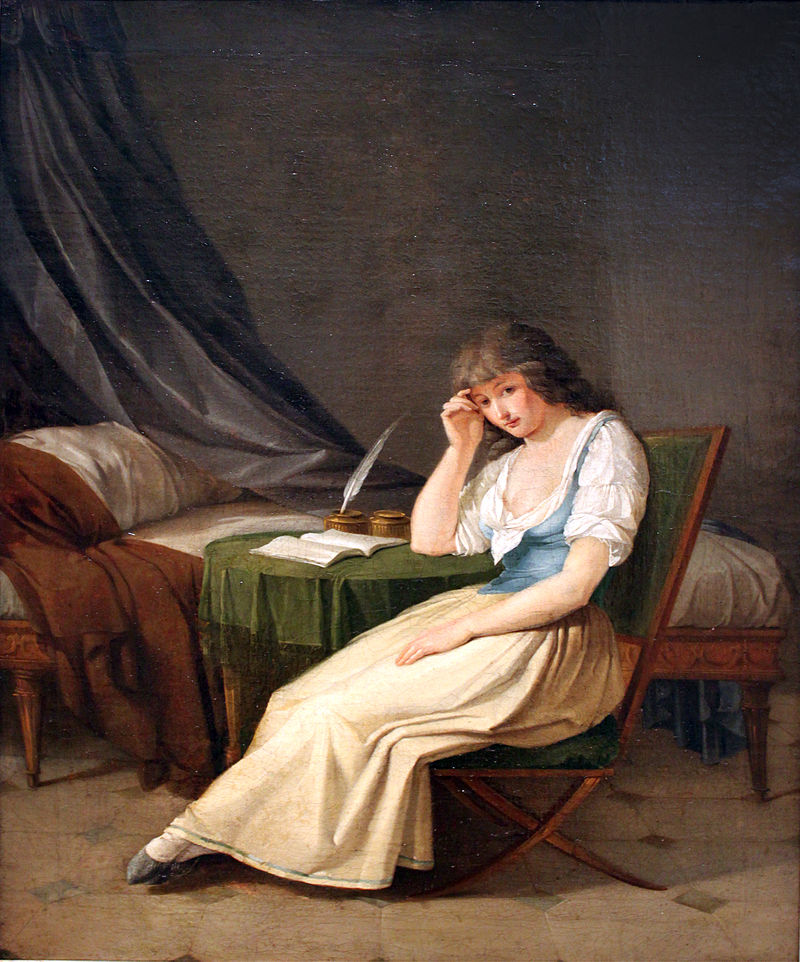
1799 Hetsch Junges Maedchen anagoria.JPGLately I was debating whether or not I should reveal my favourite secret writing tip for my next blog post...well, this isn't it, (I'm still wondering if I should reveal my secret!) but don't fret, until I finally weaken and spill the beans, for now I shall share with you what I believe is one of the best aids of the trade.  Okay, so I've already published it as a book review, but for those of you who may have missed it:

The Oxford Guide to Writing: A Rhetoric and Handbook for College Students by Thomas S. Kane   Hardcover: 848 pages    Publisher: Oxford University Press (February 3, 1983)   ISBN: 9780195032451

(Image: Young girl in morning dress, speculating sitting at a table by Philipp Friedrich von Hetsch, 1758-1839.)


For college students?  This is also for serious writers.

 Many have asked, "How do you learn how to write? Properly, that is?" By this they mean: how does one become a skilled artist of the craft, melding words into classic pieces of prose, fiction, non-fiction, or whatever the specific genre of choice might be. Practise, time, patience are the customary answers, yet the `how' of writing, the basic nuts and bolts are often elusive. Unless you have a firm grasp of the tools available, that is, the art of rhetoric, the development of your own style will flounder. What is rhetoric? It is the ability to write or speak persuasively and effectively, to use language gracefully and with maximum impact. Unfortunately, scuzzy politicians and their empty speeches have maligned the word `rhetoric', but the `Oxford Guide' admirably shows that wonders can be done with the English language with regards to writing when handled by an artist.

This book is an invaluable toolkit for the serious writer who wishes to develop their skills. I stumbled upon it while browsing the library shelves in college and immediately ordered my own copy. Do not be fooled by the title: this is not just for college students! This book continues to serve me well. Yes, it is a big tome, but the chapters and their various sections are beautifully expressed, enjoyable, concise, and most important of all, they are to the point. Sometimes they are quite humorous. Each section ranges from only a few sentences to a paragraph or a page. It is possible to read just a few pages a day with maximum benefit. While there is great attention given to writing essays and the research process for college purposes, the fiction writer will also profit greatly.

At first, the chapters sound horribly dull and technical as you skim through the table of contents, but it is surprising how interesting they are, filled with examples from the publications of famous writers, and other easy to understand diagrams and exercises.

 If you are already an accomplished author, this book is still for you, revision never goes astray. Writing is an ongoing learning process, you may be surprised at how your style may evolve after reading this handbook. You don't have to do the writing exercises if you don't want to, it is amazing the information you absorb, you may be forgiven if you skip them.

 On the other hand, if you are a teacher, this book gives you ample ammunition at the end of each chapter for creative writing assignments.

 To university students, this book is a `must-have', particularly if you are not studying English as a major or minor. Often you will be thrown into the deep end at college and be expected to know how to write essays and term papers on an academic level. Perhaps you may be offered an extra course to help brush up your writing skills for the expected requirements, but be prepared to develop these skills on your own. Let the `Oxford Guide' be your writing mentor.

The amount of information compiled is unbelievable. In addition to a handy reference index in the front of the hard cover for important chapters, there are full indexes in the back, including one for the authors mentioned and the examples taken from their works, not to mention a nifty `Correction Symbols' key inside the back cover explaining all the red ink marks your professor or publishing editor may scrawl over your work during the correction process.

This is an extremely useful book, the only information that is lacking concerns the Internet as a research tool since the `Oxford Guide' was published in the days before the World Wide Web. To conclude, I shall let the Table of Contents speak for itself and recommend that every serious writer whether they be a student, a poet, essayist or novelist, invest in a copy.  It is out of print, but if you take the time to hunt around for a copy, you will be glad that you did.

Introduction
Chapter 1: Truths and Misconceptions about Writing
You Can Learn to Write
Writing is Worth Learning
Good Prose is Recognizable
Correctness Is Not the Essence of Good Writing
Writing Is Different from Talking
Writing Is More Than Simply Finding Words to Fit Ideas
Everybody Has Things to Say

Chapter 2: Basic Considerations: Purpose
Introduction
Subject
Reader
Purpose and Types of Prose

Chapter 3: Basic Considerations: Strategy and Style
Style

Chapter 4: Basic Considerations: Grammar, Usage, and Mechanics
Grammar
Usage
Mechanics
Grammar, Usage, and Style

Part One-The Writing Process
Introduction

Chapter 5: Invention: Gathering
The Commonplace book
The Journal

Chapter 6: Invention: Exploring Ideas
Free Writing
The Analytical Approach
Conclusion

Chapter 7: Outlining
Introduction
The Formal Outline
The Scratch Outline
A Simple Outline
From an Outline Essay

Chapter 8: Drafting and Revising
Drafting
Revising
Final Copy
Conclusion

Part Two-The Essay

Chapter 9: Structure of the Essay: Beginning
Introduction
Announcing the Subject
Limiting the Subject
Indicating the Plan of the Essay
Interesting the Reader
A Word about Titles
Conclusion

Chapter 10: Structure of the Essay: Closing
Summary and Conclusion
Termination
Conclusion

Chapter 11: Structure of the Essay: Organizing the Middle
Signposts
Inter-Paragraph Transitions

Chapter 12: Tight and Loose Organization
Introduction
Tight Organization
Loose Organization

Chapter 13: Point of View, Persona, and Tone in the Essay
Point of View
Persona
Tone

Part Three- The Expository Paragraph
Introduction

Section I - Basic Structure

Chapter 14: The Sentence in the Paragraph

Introduction
The Topic Sentence
Sentences as Analytical Elements

Chapter 15: Paragraph Unity
Introduction
Coherence
Paragraph Flow

Section II- Methods of Development

Chapter 16: Paragraph Development: Illustration

Introduction
Illustration

Chapter 17: Paragraph Development: Restatement
Simple Restatement
Negative-Positive Restatement
Specification

Chapter 18: Paragraph Development: Comparison and Contrast
Focusing a Comparison or Contrast
Organizing a Comparison or Contrast
Developing the Comparison or Contrast
Conclusion

Chapter 19: Paragraph Development: Analogy
Introduction
Analogy as Clarification
Analogy as Persuasion
Conclusion

Chapter 20: Paragraph Development: Cause and Effect
Cause
Effects
Cause and Effects

Chapter 21: Paragraph Development: Definition
Kinds of Definition
Modes of Defining

Chapter 22: Paragraph Development: Analysis or Classification
Analysis of Abstractions
Analysis of a Process

Chapter 23: Paragraph Development: Qualification
Section III- Variations and Complexities

Chapter 24: Variations in the Topic Sentence and in Paragraph Unity
Delaying the Topic Sentence
Implying the Topic Sentence
Figurative Unity

Chapter 25: Paragraph Patterns
Introduction
The Lineal Paragraph
The Ramifying Paragraph
The Circular Paragraph
The Loose Paragraph

Chapter 26: Sentence Patterns in the Paragraph
Introduction
Similarity in sentence Pattern
Variety in Sentence Structure
Conclusion

Part Four - The Sentence
Introduction

Section I- The Grammatical Types of Sentences

Chapter 27: The Simple Sentence

Introduction
The Awkward Simple Sentence
The Effective Simple Sentence

Chapter 28: The Compound Sentence
Awkward Coordination
Overcoordination
Use Parataxis

Chapter 29: The Complex Sentence
Subordinate Ideas of Lesser Importance
Do Not Subordinate Ideas of Primary Importance
Reduce Subordination to the Briefest Form that Clarity Requires
Arrange Subordinate Constructions in Natural Order if Possible
The Compound-Complex Sentence

Chapter 30: The Fragment
The Detached Adverbial Clause
The Detached Participle
The Detached Adjectival Clause
The Verbless Statement

Section II - Sentence Style

Chapter 31: The serial Sentence

Introduction
The Segregating Style
The Freight-Train Sentence
The Cumulative Sentence

Chapter 32: Parallel and Balanced SentencesIntroduction
The Parallel Sentence
The Balanced Sentence
Summary

Chapter 33: Hierarchic Structure
Introduction
The Loose Sentence
The Periodic Sentence
The Convoluted Sentence
The Centered Sentence

Chapter 34: Sentence Patterns: Summary

Chapter 35: Concision in the Sentence
Introduction
Use Single Adverb or Adjective
Avoid Awkward Anticipatory Constructions
Use Colon or Dash
Use Ellipsis
Use Parallelism
Use Participles
Use Predicate Adjectives
Do Not Waste the Subject, Verb and Object

Chapter 36: The Emphatic Sentence
Introduction
Announcement
Balance
The Fragment
The Imperative Sentence
The Interrupted Sentence
The Inverted Sentence
Negative-Positive Restatement
The Periodic Sentence
The Rhetorical Sentence
Rhythm and Rhyme
The Short Sentence

Chapter 37: Emphasis within the Sentence
Adjectives
Ellipsis
Isolation
Mechanical Emphasis
Polysyndeton and Asyndeton
Position
Repetition

Chapter 38: Variety in Sentence
Introduction
Vary Length and Pattern
Fragments
Rhetorical Questions
Varied Openings
Interrupted Movement

Chapter 39: Rhythm in the Sentence
Introduction
Effective Rhythm
Awkward Rhythm
Metrical Runs
Rhythmic Breaks
Mimetic Rhythm
Rhyme
Summary

Part Five- Diction
Introduction

Section I .- The Question of Meaning

Chapter 40: Meaning

Words Are Not Endowed with Fixed `Proper' Meanings
Denotation and Connotation
Levels of Usage
Telic Modes of Meaning
Conclusion

Section II -Problems of Diction

Chapter 41: Wrong Words

Introduction
Too Abstract
Ambiguity
Barbarism
Clarity
Cliché
Colloquialism
Connotation
Denotation
Awkward Figure of Speech
Too General
False Hyperbole
Wrong Idiom
Jargon
Meaning?
Pretentious Diction
Repetitiousness
Awkward Sound

Chapter 42: Unnecessary Words
Introduction
Overlong Connective
Unnecessary Definition
Distinction without Difference
Word Is Too General
Obvious by Implication
Wordy Modification
Wordy Passive
Overqualification
Redundancy
Scaffolding
Undeveloped Ideas
Too Many Verbs

Section III - Figurative and Unusual Diction

Chapter 43: Figurative Language

Introduction
Similes
Metaphor
Personification
Allusions
Irony
Overstatement and Understatement
Puns
Zeugma
Imagery

Chapter 44: Unusual Words and Collocations
Introduction
Unusual Words
Unusual Collocations

Section IV - Improving Your Vocabulary

Chapter 45: Dictionaries and Thesauri

Introduction
General Dictionaries
Special Dictionaries: Thesauri

Part Six- Description and Narration

Chapter 46: Description
Introduction
Objective Description
Subjective Description
Process Description

Chapter 47: Narration
Introduction
Organizing a Narrative
Meaning of a Narrative
Point of View and Tone in a Narrative

Part Seven - Persuasion

Introduction
The Nature of Persuasion
Kinds of Persuasion

Chapter 48: Argument
Introduction
Deductive Argument
Induction
Refutation and Concession
Composing an Argument

Chapter 49: Persuasion: Nonrational Modes
Introduction
Satire
Eloquence
Pathos
Ethos, Style, and the Audience
Emotional Fallacies
Table of Fallacies

Part Eight - The Research Paper and the Discussion Answer

Chapter 50: Gathering, Quoting, and Citing Information
Introduction
Using the Library
Taking Notes
Incorporating Notes into Your Paper
Footnotes
The Bibliography

Chapter 51: A Sample Research Project
Choosing a Topic
Looking for Sources
Organizing Your Notes
Writing the Paper

Chapter 52: Answering Discussion Questions

Part Nine- Punctuation

Introduction
The Purpose of Punctuation
`Rules' of Punctuation
The Two Categories of Punctuation

Chapter 53: Stops

The Period
The Question Mark
The Exclamation Point
The Colon
The Semicolon
The Comma
The Dash

Chapter 54: The Other Marks
The Apostrophe
The Quotation Mark
The Hyphen
Parentheses
Brackets
The Ellipsis
Diacritics
Underlining
Capitalization

Reference Grammar

Reference Grammar Contents
Introduction

Parts of Speech: Verbs, Nouns, Pronouns, Adjectives, Adverbs, Prepositions, Conjunctions, Interjections

The Grammar of the Sentence
Definitions, Subjects, Complements, Objects of Propositions, Adjectivals, Adverbials, Absolutes, Murky Modifiers, Problems in Agreement


***
 
Like my blog? You will LOVE my books!


Wednesday, 2 September 2015

What is that Question Again?


  (Post originally published May 3, 2012)
descriptionShakespeare: the very name strikes a deep chord. For 
four hundred and forty-eight years, the masterpieces penned by this paragon of playwrights has captivated the world. As someone once observed, Shakespeare no longer belongs to the British, he belongs to every nation.

In honour of his birthday, and to celebrate the 2012 Olympics, the Globe Theatre in London is presenting a marathon festival featuring a host of international drama companies presenting his plays in their native languages. Anyone up for The Merry Wives of Windsor in Swahili?

To highlight the event, BCC World News aired a news feature with actors from the numerous companies delivering in their own language one of Shakespeare’s most memorable lines: “To be, or not to be: that is the question.”

As I watched the news clip, I was struck by that famous cogitation of Hamlet, the mad, melancholic Prince of Denmark as he ponders upon the philosophical conundrums of life, death, existence or non-existence, and how important a topic it was in the philosophical circles of Shakespeare's era. Many famous thinkers and playwrights grappled with the issue of how we perceive the very essence of existence, of being alive, and in the process invented their own famous one-liners. The French philosopher, writer and mathematician René Descartes concluded: Cogito ergo sum ~ “I think, therefore I am.” The author Kurt Vonnegut also reminds us of this philosophical conundrum albeit with humour by quoting Socrates, Sartre and Frank Sinatra in succession: “To be is to do,” “To do is to be,” “Do Be Do Be Do”.

Other playwrights of Shakespeare's time also dissected the issue, although their attempts at exploring “To be or not to be,” may not have become as well-known as their contemporaries' succinct phrases. In this instance, Christopher Marlowe and his drama,The Tragical History of Doctor Faustus . In lieu of describing the point of existence, Marlowe, through the doomed character of Faustus who sells his soul to Hell, mocks the entire system of philosophical disputation used to explore the question vis the academic policy in the universities of strict adherence to Aristotle's reasoning methods. The philosopher Aristotle was so highly regarded that students were forbidden to disagree with Analytics, his treatise on logic: students at Oxford were fined if they did! Thus the universities of Marlowe and Shakespeare's time paradoxically threw the whole point of open debate and disputation askew, the focal point of their esteemed philosophical and theological curriculum.

How does Marlowe satirize the issue?

With the enigmatic line: “Bid Oncaymaeon farewell.”

Below I have included a excerpt from Faust: My Soul Be Damned for the World Volume 1 unravelling the meaning of that cryptic statement:


“Act I opens with Faustus alone in his study restlessly contemplating the subjects he studied, initially focusing his attention on Aristotle and logic:

Settle thy studies, Faustus, and begin
To sound the depth of that thou wilt profess.
Having commenced, be a divine in show,
Yet level at the end of every art,
And live and die in Aristotle’s works. […]

[I. i. 1–5]

Faustus has recently attained his MA degree. Although the Chorus relates Faustus earned the title of “Doctor”, in Act I he is deciding which of the subjects he will “profess” to continue his advanced studies. According to Harrison in Holinshed’s Chronicles, an English MA student could be referred to as “doctor” should they profess one or be generally skilled in all of the liberal sciences they previously studied during the BA and MA years. From thence, they could elect to study divinity, law or medicine for their Doctorate. Faustus sarcastically muses he may as well continue with the divinity studies he started, as a respectable front, while he decides to “level”, or find the purpose of each subject, to discover which is worthy of his time and effort, and yield substantial rewards. We detect here Marlowe’s resentment with the Parker Scholarship stipulation stating the prerequisite for recipients to express an interest in receiving Holy Orders before they could continue with their education.

Faustus declares he will “live” and “die” with Aristotle’s works, and then amusingly exclaims: “Sweet Analytics,‘tis thou hast ravished me!” [I. i. 6] (Analytics was the name applied to two of Aristotle’s works on the nature of proof in argument.) — Marlowe in his BA years may have submissively “lived” for nothing else and figuratively “died” with his extensive disputation course grounded on logic and rhetoric. In this instance “ravished” could also signify being “seized” and academically molested. Taking up Aristotle’s Analytics, a single sentence claims his attention and he ponders upon its significance:

[He reads] Bene disserere est finis logices.
(‘To dispute well is the end of logic’.)
Is to dispute well logic’s chiefest end?
Affords this art no greater miracle?
Then read no more; thou hast attained that end.
A greater subject fitteth Faustus’ wit.
Bid Oncaymaeon farewell. […]

[I. i. 7–12]

Faustus discovers that logic simply prepared him to dispute and argue a topic, that is all. He then dismisses logic, which he terms “being and not being” (On kai me on), considering he has already become a master in this art. We also detect a phonetic sound-game with ‘Organon’, the logic treatise by Aristotle that Oxford students were not permitted to disagree with! Ironically, these two quotations are not from Aristotle. “Bene dissere” was Cicero’s definition of logic, later assumed by the French dialectician Petrus Ramus (1515–1572) whose attempt to reform Aristotelian logic was received with hostility, his detractors considered he had reduced Aristotle’s work to superficialities. “On kai me on” is a diminutive synopsis of Gorgias’ (c. 485–380 B.C.) tripartite nihilistic philosophy — nothing exists. If anything exists, it cannot be known; if it exists and can be known, it cannot be explained. Marlovian commentators are generally puzzled why Faustus, an intellectual, should quote his sources incorrectly. We might assume he is an inept scholar, but he is supposedly reading directly from university texts on the table in front of him. Is he actually comprehending the material he is reading? Marlowe may be stabbing at a paradox in the Elizabethan third-level course on logic. His lecturers failed to practise Aristotle’s reason for disputation, i.e. to question an issue in order to discover what is true or false in philosophy, not to simply dispute well for the sake of argument whereby error can be persuasive and accepted as truth. Faustus ‘fails’ to “sound logic to its depths” for he should have immediately raised the question: if disputing well is the end of logic, then what is the purpose of argument but to find or to conclude upon an answer? Disputing well with no tangible result but to dispute, is similar to making the pointless query whether we truly exist or not, rather than asking why we exist and attempt to discover the answer. To be, or not to be: what a question! Marlowe highlights the illogical nature of his lessons in dialectic through Faustus’ apparent ignorance. Having spent years mastering the art of incessant argument, Marlowe’s mind was truly “ravished”. (…)”


Examining each subject taught at the university and disillusioned with their shallow depths, Faustus is eventually swayed by the dark allure of occult studies and decides to sell his soul for the power and knowledge he craves. How does this come about? You will have to read Faust: My Soul Be Damned for the World Volume 1 to find out!

Faust  My Soul Be Damned for the World Volume 1 by E.A. Bucchianeri

Tuesday, 1 September 2015

Brushstrokes of a Gadfly ~ Book Review

(Post originally published December 20, 2011)

A big thank you to Randall Radic for the following review published on Blogcritics.org.
What a wonderful Christmas gift!

(Following review published December 19, 2011.)

"According to Webster’s Unabridged Dictionary, a gadfly is “an insect that goads or stings cattle, as a horsefly. A person who annoys or irritates others.” Supposedly, the Greek philosopher Socrates was a gadfly because he irritated others by causing them to analyze their thought processes. Inevitably, analysis revealed errors of not only reasoning but conclusions – mental boo boos. Rather than rejoicing over their newfound enlightenment, people became upset. People don’t like being told they are wrong or stupid or illogical. So they began avoiding Socrates like the plague, along with talking about him behind his back, saying nasty things about him. But Socrates didn’t care. He considered it his duty to be an irritant, a gadfly. So he kept doing it. In the end, he annoyed so many people so much that they decided to do something about it. It wasn’t pleasant.

Jesus was a gadfly too.

So is the protagonist of Brushstrokes of a Gadfly, a wonderful, walloping novel by E.A. Bucchianeri. Katherine Walsingham is the star of Brushstrokes. She is beautiful, talented, intelligent, sensual, and comes from an affluent, well-bred family in New York City. Kat’s only flaw is that she enjoys stirring the pot. She doesn’t believe in going along to get along. Thus, she utilizes her art to cause viewers to re-evaluate their conclusions about religion, cultural traditions, nuclear power, women’s rights, government corruption, and the true definition of freedom. Naturally, Kat receives lots of attention, while at the same time annoying lots of people, people who prefer the status quo to remain stationary.


Brushstrokes of a Gadfly
The pedantry of Katherine is obvious, as she tries to set the world to rights. What’s funny is that while Kat is busy being a gadfly, the pedantry of Life wiggles in and disrupts Kat’s vision for her future. Determined to eschew romantic entanglements because of their destabilizing effects, Kat unexpectedly finds herself falling in love with one of New York’s most eligible bachelors. Because of a peculiar combination of circumstances – Kat’s reluctance, her paramour’s family, and gossip – the romance appears headed for disappointment.


Whether or not Life and Love find a way won’t be discussed. You’ll have to read the book to find out.

Essentially, Brushstrokes is a high literary romance novel. Imagine Roberto Bolano meets Nicholas Sparks: erudite and gracious with a saccharine undertone of romance and the unpredictability of life. In other words, it’s exaggerated, quaint, absurd, funny, touching, and very much like reality.

E.A. Bucchianeri guides the reader through all the twists and turns of the story with remarkable aplomb, utilizing what the reviewer calls “an informed literary style.” Translation: easy to read, yet without all the dreary flatness that inhabits most ‘high literary’ novels. The story sparkles with various subplots and unique characters – stories within the story – that provide diversion and respite from the primary thread of romantic tension. The reviewer’s favorite is Kat’s grandfather, who, having avoided the psychological pitfalls of great wealth, speaks from his heart, which he wears on his sleeve.

Brushstrokes of a Gadfly is a big book, weighing in at a couple of pounds and 1040 pages. Just looking at it makes a potential reader pause and consider. However, any doubts may be set aside. After the first two pages, you’ll be pleased with your purchase. It’s long, but it has everything you’re looking for: humor, love, human interrelations, good writing, a plot that moves along, and emotional catharsis."

Brushstrokes of a Gadfly


Download Free Preview from Scribd

Where to get your copy, click here.

The First Novel (Part 1)~Lessons I Have Learned Along the Way

(Post originally published June 4, 2011)

We accept writers love to write, others assert it's a compulsion, even when the dreaded curse of “Writer's Block” threatens to charge out of the murky recesses of the mind at times and seize control, until held at bay once more by the Knight of Inspiration with his sword—the mighty pen.

But changing genres? That is a daunting step to take. Until now, I have written non-fiction books and have felt quite comfortable in this familiar sphere, that is, until I completed Volume 2 on “Faust”, which literally wore me out. So much data to process! A break was needed to cool the over-heated mind and a novel was the perfect solution.  Here it is:


11418420
(Batalha Publishers, May 2011)


At first, writing a novel was easier said than done; the last fictional works I wrote, other than a short story in college, were my English compositions for high school. Was it possible for me to switch back after all this time? Why not? If I dared to analyse other authors, it was high time I wrote my first book. While working on Brushstrokes of a Gadfly I discovered many of the old clichés and quotes by famous authors about writing were true, or half true, and thought I would share them.

* “The scariest moment is always just before you start.” ~ Stephen King

True. There are many doubts, or at least, niggling insecurities that try to hold you back, especially with a first novel. Stephen King no longer has to worry about building a fan base, but for a new novelist, staring at a blank page can be intimidating, even when you have a story just waiting to be put on paper, or the hard drive, whatever the case may be. Can I write an entire book people will find interesting to read? Develop believable characters? Construct a decent plot? Write scenes that have action and movement, even if the book is not a crime novel or a thriller? Set my story in a city I have never visited past the airport during flight changes and rely on research? You can only try, there comes a time you have to stop worrying what people might think, and concentrate on what is important for your story. If you try and please the readers first, or write just what you think will sell, the story will not ring true. Deep down people want something truthful, believable, perhaps just entertaining, or something that makes them observe life in a way they didn't before. They can tell if something is geared for their pocketbook rather than their sensibilities. Even if they don't like your book or agree with everything you have written, at least they may have read something new. Reading is supposed to broaden horizons, not narrow them.

* Your opening paragraph or scene must be a “Grabber” and hook your readers at the very beginning.

This I would say is half or two-thirds true. Yes, it is important to write a vivid introduction to draw the reader into your story, but it is only an introduction after all. In a few of the old classics, I've read some opening paragraphs or first chapters that seem pretty boring in my view, it's after those sections we really see the tale and characters unfold that in the end made these books classics. Today, some writers are so adamant on hooking the reader with searing barbs that it smacks of desperation. “Read me!” “Read me!” It's like being introduced to someone, and instead of a nice firm handshake, they grab your hand and crunch your knuckles while screaming their name, just to make sure you know who they are. Or, authors put so much information into their opening chapter with a bewildering amount of graphic description they can't continue the momentum and the action slows to a crawl until you reach some pivotal moments of the plot. That nearly turns me off a book! In answer to this, I tried to achieve a balance between introducing several of my key characters at an important event that I could carry through the rest of the novel, yet not do anything so shocking in the first opening paragraphs that I've completely assaulted my readers. I wanted my first novel to blossom into a majestic oak, not shoot up like a weed only to be stepped on.


* The characters tend to write themselves. They become like living, breathing people.

So true, it's scary. How can people you invent in your imagination become so lifelike? Because authors draw their characters from life around them. Perhaps not exact characters, authors also experiment in combining different character traits, but authors use what they observe, and before long, characters do feel like real people that you have known all your life. I used to be sceptical of this old cliché until it felt like all my characters wanted to run away and do their own thing, and I had to lasso them back into place when and where I needed them at times! It became so natural to find myself saying, “No, Steves wouldn't say that, he would do this instead,” when I really wanted him to say something, but it didn't suit him. Or “I know what Aunt Martha's going to say when she finds this out! She'll have Katherine and the family in knots...”, thus the characters helped write the story and fill the blanks, I didn't have too much to say in the matter. One character refused to go in the direction I had originally planned for him, he rebelled entirely. The story completely changed course because of it, I can't give details without ruining the book for you, but if I forced him to go the way I had envisioned, it literally wouldn't have worked, the story would have sounded “artificial” if it wasn't true to the way the character had eventually developed. It went beyond my control, which leads us to another observation ...

* Doris Lessing said in an interview that none of her books turned out the way she expected them to.

Well, it happened with this novel, but that is a topic for another blog post. To be continued!


***
 
Like my blog, you will LOVE my books!