Whatever curious and interesting subject strikes my fancy, be it silly or serious, gets posted for your reading pleasure.
Showing posts with label Faust. Show all posts

Tuesday, 17 January 2017

Writer's 'Anti-Gel' and some Supernatural Assistance

A writer often is often asked: “What do you do when you are struck with Writer's Block?”

You know, that dreaded experience of trying to get the next project off the ground, but find yourself staring at the screen or notepad for hours because the words, story ideas or subject matter are nowhere in sight. Finding any inspiring idea just seems like trying to hunt and trap an extinct mythical creature that can no longer be caught and tamed. Frustrating!


That's your hard core definition of Writer's Block, not having something to write about.  However, believe it or not, in my experinece that's somewhat rare.  A 'block' also has its common variety of niggling frustrations that are more common.


How about the kind where you have your story or academic subject matter ready to put to page, depending on where your creativity is leading you, everything is all laid out in your notes or plot sketches, you have all the information you could ever want, but you still can't seem to start the thing? The first paragraph, not to mention the first page or three, is crucial because you know that's your opportunity to catch your reader's attention. You hope you nail it … but.....you could botch the whole thing and turn your reader off forever.


This expectation of making a good first impression can weigh a writer down, literately block them from starting because nothing sounds and feels right when you type or write it out, and then the anxiety sets in that convinces you're a hopeless mess-up, which makes it worse. Nothing seems to 'gel' together, so I will metaphorically call his icky place the dark paralysing world of “Writer's Anti-Gel”.


When starting the first chapter, of “Faust: My Soul Be Damned for the World, Vol.1”, guess who literally sat for two days a good half of the third staring at a blank screen coaxing the creative muse to appear with loads of coffee and chocolate until FINALLY the first introductory paragraphs 'gelled' into place. (And no, I wasn't goofing on the Internet, I wasn't connected at the time. I was off it several years in fact!)

Writers will tell you just hammer something out and then edit the crud out of it later: you won't get anywhere unless you force yourself to write and get a first draft together, because if you wait for inspiration, it'll take half a lifetime before you get a book together.


Yes, there is truth to that, I do hammer things out be it good or bad once I get into the actual draft and there's something to build on and then edit, but the first paragraphs, (and okay, I'll admit, a good portion of my texts), I like to make sure it sounds perfect in my head and I'll keep editing it as I write instead of just writing away without polishing as I go, so of course, I get stuck in the parallel non-creative gloopy gloopity glop slow-paced dimension that is “Writer's Anti-Gel” until it finally gels in the right direction.


The thing is, the last paragraphs and closing segments are just as tricky in their own way as the first. “Faust” is a historical academic epic so to speak, so naturally the end of the chapter has its own unique requirements. I needed a satisfying conclusion that gels in a way so it's not rambling but not abrupt either, something that makes a lasting impression regarding the vast amount of information just presented and that rounds the whole thing off just nicely in a page, preferably less, maybe with a memorable kick.


Well, when I was nearing the end of that first chapter I got stuck in the non-gelling “anti-gel” universe again. When you're writing about how a real historical individual may have sold his soul to the devil for knowledge, power and worldly glory, and you want to round off this gruesome history 'quite nicely' with a 'memorable kick', that's a tall order!

Of course, I knew I was going to be staring at the screen for days on end with this doozie, but rather than succumbing to staring and wasting time moaning in the Realm of Anti-Gel, or hammering out just anything until it was squished and prodded into place and still feeling like a product that was way below par even for a draft, I did what any desperate writer does ….


I prayed. 


Yes, seriously.

No, I'm not kidding.

I thought of my Guardian Angel, who often gets ignored even though I know he's there.


We never think of our invisible guardians enough or ask their assistance, even with our daily tasks. They don't just guard us from temptation and danger, they like us to involve them in our lives. They take a keen interest in everything we do and they like helping us in our work, (as long as it's not sinful of course!)


  So, I reached out to my neglected princely friend and told him what was needed to finish my first chapter and asked if he could enlighten me with an idea, maybe let me know how to polish it off ....


Then...'It' happened.


No sooner was the request made when the words started to interiorly flow so quickly like a bubbling
cascade it was like I was taking speed dictation. I was literally yelling in my head 'Not so fast! Not so fast!', my fingers tapping away trying to capture that miraculous flow as the text rolled out right to the very end...then, stopped.

This was so different from the 'running flash' of inspiration to where you don't want to stop writing because you're on a roll. I've had that too quite a few times, but when those 'running flashes' happen, it still feel like it's you and your ideas. This wasn't exactly like that. It was really was as if “someone else” was interiorly dropping the words and I was doing my best to keep up with their pace. Prayer answered!

So a word to the struggling writer: try giving prayer a chance, and while you're at it, don't forget you have an angel at your side.


Here it is, the final paragraph to the first chapter of “Faust: My Soul be Damned for the World Volume I”, which I cannot take credit for. I give it fully to my Guardian Angel:


“Faustus, who embraced evil and shunned righteousness, became the foremost symbol of the misuse of free will, that sublime gift from God with its inherent opportunity to choose virtue and reject iniquity. “What shall a man gain if he has the whole world and lose his soul,” (Matt. 16: v. 26) - but for a notorious name, the ethereal shadow of a career, and a brief life of fleeting pleasure with no true peace? This was the blackest and most captivating tragedy of all, few could have remained indifferent to the growing intrigue of this individual who apparently shook hands with the devil and freely chose to descend to the molten, sulphuric chasm of Hell for all eternity for so little in exchange. It is a drama that continues to fascinate today as powerfully as when Faustus first disseminated his infamous card in the Heidelberg locale to the scandal of his generation. In fine, a life of good or evil, the hope of Heaven or the despair of Hell, Faustus stands as a reminder that the choice between these two absolutes also falls to us.” 


::::::::::::::

If you find yourself stuck in a situation, no matter what it is -- don't forget to pray.

:::::::::::::

TABLE  OF CONTENTS -  See other posts on "Books, Babble and Blarney"

Wednesday, 2 September 2015

What Do We Do with a Bad Review?

(Post orginally published June 2012)

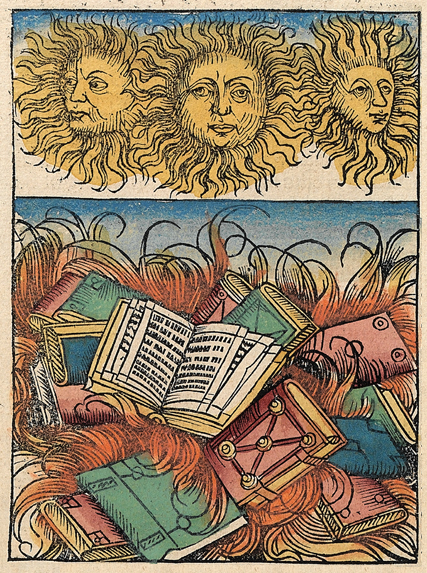
Nuremberg chronicles f 092v 1.png 
(Image from the Nuremburg Chronicle 1493, three suns observe a book-burning.


If you are an author, you will at one point or another be presented with a bad if not scorching review of your work. Quite possibly, you may receive an equal amount of negative criticisms and evaluations of your cherished creations in proportion to all the good reviews you receive. Hopefully, you will not receive more bad reviews than good!

How do we address the distressing reality of unjust criticism? The general rule has been to accept everyone is entitled to their opinions, be they good, bad, or incorrect, and simply ignore their bad comments. However, there are times when reviews are completely erroneous they leave us wondering if the reviewer had actually read the book and could comprehend its contents. Or, might we dare suggest, are deliberately condemning a work for some unknown ulterior motive? I have read reviews on other people's work that I had studied and the results were totally perplexing, (the reviewer reporting the author failed to address topics or issues when they had, or completely missed that author's point etc.), and now I too have fallen prey to the poison pen, or at least, a misguided one.

Must we authors stay silent, or are we entitled to defend our work and beat back the flames of unjust criticism?   In the case of an academic review, I think we may, since are academics are expected to be adept readers.  With your permission, I offer you an example below: a review of my work, Faust: My Soul Be Damned for the World Volume 1 , written by Nicholas Holland for Folklore, the Journal of the Folklore Society UK, published March / April 2012. My defense is presented in Italics.

~~~

“E.A. Bucchianeri's book, the first of a two-volume study, surveys works concerned with the famous magician Doctor Faustus from the earliest German notices to Christopher Marlowe's eponymous play. A short final section discusses seventeenth-century and eighteenth-century works before Goethe. The first chapter reviews German accounts of Faustus prior to the earliest known version of the German Faust Book, and places a particular emphasis on the search for biographical evidence about the historical Faustus. Bucchianeri surveys the various early accounts, including those of Trithemius, Melanchthon, and Weyer. The majority of the material covered will be familiar from other modern studies, but whereas the studies of Frank Baron, for example, draw out the complexities of the relationship between historical evidence and the subsequent fashioning of the legend, this study tends to place great emphasis on searching for insight into the biography of the historical Faustus; an approach that can be detrimental to the consideration of the sources surveyed in their historical context.”


(I tend to place more emphasis on the biography? Of course, we cannot see how the folklore developed without arriving at a clear picture of Faustus, this historical man of mystery. To all intents and purposes, I followed Baron's analytical example in discovering the historical Faustus, and offered additional findings / observations to the material Baron provided and discussed. The chapter dealing with Faustus' biography is only one quarter of Volume I, (125 pages) and roughly half of this chapter also examines the legend-formation process. The rest of Volume I (nearly 400 pages), features the Faust folklore / literature. Holland then declares in so many words it is 'detrimental' to piece together a biography of Faustus from the sources that exist and that I did not consider their historical context. Did Mr. Holland actually read and comprehend my work? ~ E.A.B.)


“For example, when considering the account of the famous abbot and philosopher Trithemius that Faustus declared himself the source of the necromancers, Bucchianeri's bewilderment that Faustus "would freely choose a profession that would utterly ruin his reputation" (p. 28) seemingly takes Trithemius's report at face value. Trithemius's opinions concerning Faustus surely demand more cautious consideration in the light of his own possible motivations, reputation, and interests; in particular since so little concerning the historical Faustus and his magical practices can confidently be corroborated using other sources. More generally, Bucchianeri's biographical focus in the early part of the book tends to direct the reader's attention away from what must be the most significant and astonishing aspect of the documentary legacy: the impact, durability, and openness to further interpretation of the legend of Faustus through the sixteenth and early seventeenth centuries, first in German and later in English culture. Whereas the historical Faustus is an almost invisible footnote in early modern intellectual history, the legend of Faustus became, in the hands of a number of important writers, a means of expressing early modern interest concerning both the potential power and also the potential dangers of magic.”


(I could find no evidence presented to date to doubt Trithemius' letter written to a friend and colleague, warning him to be wary of Faustus. The letter was reprinted during Faustus' lifetime, it could not be a bogus document. Trithemius may have aggrandized Faustus' claims concerning his magic skills, but this topic is discussed in detail. Faustus was known to declare himself a "necromancer" according to well-documented historical sources, therefore, according to the historical evidence, Trithemius was accurate in describing Faustus. I have examined the content of Trithemius' letter minutely from all aspects, similar to Frank Baron. To declare oneself a 'necromancer' was a serious matter in those times, Faustus could have been tried and executed. Why take such a risk? His motives had to be questioned, and these questions hypothetically answered. I find it curious Mr. Holland believes the biographical material in Volume I detracts from the efforts to describe the "impact" and the "openness to further investigation" of the legend: as I said, three quarters of Volume I (about 400 pages) explores the rich Faustian material inspired by his legend over the centuries and how it was used to deter people from studying magic in addition to admonishing people to live good Christian lives. Holland's conclusion that I digressed from explaining the "early modern" fascination and fear of black magic is erroneous. ~ E.A.B.)


“The remainder of the volume is mostly dedicated to substantial descriptive accounts of the German and English Faust books, and of Marlowe's Doctor Fautus. Bucchianeri's major new proposition concerning the latter is that the B-text shows that "Marlowe had regained a considerable measure of the defiant 'Machiavellian' optimism", which was absent from the A-Text (p. 368). Although precisely what she means by "Machiavellian" (or "liberal Epicurean," a phrase she applies to Marlowe's Faustus in the same passage) is unclear, her reading of the play evidently belongs to the school of interpretations which considers the overarching admonitory message of the play as being in some way questioned by the manner of its presentation. However, her core interest again is in trying to establish firm connections between biography and text. Her proposal is that the B-text of the play is a revision of the A-text chiefly undertaken by Marlowe himself in the light of personal experiences and historical events that enable it to be dated to 1592. This is an unusually precise stance concerning the genesis and authorship of this text, but ultimately fails to persuade. For example, some basic textual evidence seems to conflict with such a precise and confident dating. The author argues, in particular, that the references to the Anti-Pope Bruno in the B-Text are inspired by news of the arrest of Giordano Bruno in Venice in 1592. However, if a similar method is applied to the reading of two of the most striking points of similarity between the fictional Bruno and the historical Bruno, these events have no direct connection to 1592. The fictional Bruno undergoes excommunication, a punishment which the historical Bruno stated to his interrogators in Venice he knew had been imposed on him in absentia by a hearing convened by the Dominicans in Naples prior to this period in England (1583-5). The execution by burning for heresy, pronounced on the fictional Bruno by Faustus in disguise, was visited on the historical Bruno as late as 1600, seven years after Marlowe's death. While there is a case to be made for the influence of the historical Bruno's person and thought on Marlowe via the circle of Earl of Northumberland, there is in fact nothing tangible to link the scene in Doctor Faustus more strongly to the news of 1592 than to the news of any other year of a period spanning the whole of Marlowe's writing career. Furthermore, by attempting to bind the play's genesis too tightly to Marlowe's biography, the author underestimates not only the imaginative capacities of Marlowe himself and of the other writers who most probably had a hand in the B-Text, but also the uncertainties that cloud our understanding of Marlowe's personal beliefs. Such an approach also fails to place sufficient emphasis on the need to understand the contents of Doctor Faustus in the context of the early modern performance traditions upon which it draws.”


(The terms "Machiavellian" and "Epicurean" may be on the same page, but not in the same paragraph. From the context of the study, Holland should have understood the term "machiavellian" to mean Faustus' thirst for power and his determination to acquire it by whatever means or cost. The philosophical term Epicurean was explained in the first chapter, but possibly Holland forgot: "... pleasure is the supreme goal one should aim for in life, particularly intellectual pleasures above those of sensual ones. Epicurus taught that one could only acquire true happiness and serenity by conquering one’s fear of the gods, death, and the afterlife. He also believed that humans ceased to exist after death, declaring the soul died with the body." The term was referred to in this philosophical context throughout the chapter on Marlowe, and we note Faustus in Marlowe's play begs his soul to dissolve at death. The context of Epicurean should have been clear from the beginning.

I am sorry if my argument concerning the dating of the A and B Texts "failed to persuade" Mr. Holland, but I notice he discussed only one piece of evidence I presented, and omitted to mention all other observations pertaining to the 1592 date. If it was a matter of that one detail, Bruno's arrest, then there would not be enough evidence, but a good detective should look at all the evidence presented.

I also notice Mr. Holland points out every historical detail of the the real Bruno, and how this factual information does not match the action of Marlowe's play: must everything in the drama display historical fact? Surely, Marlowe had the creativity to imagine the scene of Bruno's arrest and make artistic predictions concerning the possible outcome of that event, even if they proved incorrect in the future. In this instance, Holland has failed to follow his own conclusion and has committed the same supposed 'error' he condemns me for, that is, trying to find the historical details that correspond with Marlowe's biography and are included in the play ~ let us note that Holland's states "by attempting to bind the play's genesis too tightly to Marlowe's biography, the author underestimates not only the imaginative capacities of Marlowe himself and the other writers who most probably had a hand in the B Text". In so many words, Holland has proposed that authors, playwrights and artists are uncreative and unimaginative when they draw upon their life experiences, (and therefore, contemporary history), for their material. Interesting observation, Mr. Holland.

He also says by binding the play´s genesis too closely to Marlowe's biography, I also "underestimated the uncertainties" that cloud everyone's understanding of Marlowe's personal beliefs. Not so. It was due to these uncertainties I conducted a close reading of Doctor Faustus with Marlowe's known biography. I simply examined the claims Marlowe was an "atheist" in that he did not believe in the established Christian religions, and noted how these claims may have a basis in fact through a close reading of Doctor Faustus. I endeavoured to shed some light on the accusations levied against Marlowe, and if possible, display how close the creative soul of the writer is to his work. ~ E.A.B)


“The stated aim of this study is to provide a "comprehensive exploration" of Faustus and his legacy. It provides lengthy descriptive discussion of the contents of the texts surveyed and, to some extent, it offers a useful single point of reference for them, although it must also be noted that the author's digressive style makes it relatively hard to read. As a work of analysis, however, its most serious failing is that it does not examine more fully and in a more systematic way the complex forces that worked to shape the legend of Faustus within a wider cultural context, and instead places its primary focus on an attempt to find close relationships between biography and text. As a consequence, it fails to offer readings of the material under consideration which have the depth of insight or nuance of the most valuable works already written on the various works it surveys.”


(The aim of this study was to provide "a comprehensive exploration of Dr. Faustus, the man who sold his soul to the devil, and those who lived to tell his tale" ~ so yes, providing detailed explanations of the texts and why each author presented the Faust material as they did was the object of the work. I do not see how Holland thinks this does not present the "complex forces" that shaped the legend of Faustus, when everything from religious intolerance, the Reformation, academic competition, fear of black magic, the scientific discoveries of the day such as the Copernican / Galileo controversy, folklore and history, and how they were included in the Faustian tales, are discussed. Can the "cultural context" become any wider? If this study lacks "the depth of insight or nuance of the most valuable works" already written on the subject of Faust and Faustian literature, I shall leave it to you, the reader, to discover if this be true or not. I thank Mr. Holland for his review, albeit it took nearly four years for it to appear from the time the paperback edition was published and sent in for review. E.A.B.)

~~~

Faust  My Soul Be Damned for the World Volume 1 by E.A. Bucchianeri 

What is that Question Again?


  (Post originally published May 3, 2012)
descriptionShakespeare: the very name strikes a deep chord. For 
four hundred and forty-eight years, the masterpieces penned by this paragon of playwrights has captivated the world. As someone once observed, Shakespeare no longer belongs to the British, he belongs to every nation.

In honour of his birthday, and to celebrate the 2012 Olympics, the Globe Theatre in London is presenting a marathon festival featuring a host of international drama companies presenting his plays in their native languages. Anyone up for The Merry Wives of Windsor in Swahili?

To highlight the event, BCC World News aired a news feature with actors from the numerous companies delivering in their own language one of Shakespeare’s most memorable lines: “To be, or not to be: that is the question.”

As I watched the news clip, I was struck by that famous cogitation of Hamlet, the mad, melancholic Prince of Denmark as he ponders upon the philosophical conundrums of life, death, existence or non-existence, and how important a topic it was in the philosophical circles of Shakespeare's era. Many famous thinkers and playwrights grappled with the issue of how we perceive the very essence of existence, of being alive, and in the process invented their own famous one-liners. The French philosopher, writer and mathematician RenĂ© Descartes concluded: Cogito ergo sum ~ “I think, therefore I am.” The author Kurt Vonnegut also reminds us of this philosophical conundrum albeit with humour by quoting Socrates, Sartre and Frank Sinatra in succession: “To be is to do,” “To do is to be,” “Do Be Do Be Do”.

Other playwrights of Shakespeare's time also dissected the issue, although their attempts at exploring “To be or not to be,” may not have become as well-known as their contemporaries' succinct phrases. In this instance, Christopher Marlowe and his drama,The Tragical History of Doctor Faustus . In lieu of describing the point of existence, Marlowe, through the doomed character of Faustus who sells his soul to Hell, mocks the entire system of philosophical disputation used to explore the question vis the academic policy in the universities of strict adherence to Aristotle's reasoning methods. The philosopher Aristotle was so highly regarded that students were forbidden to disagree with Analytics, his treatise on logic: students at Oxford were fined if they did! Thus the universities of Marlowe and Shakespeare's time paradoxically threw the whole point of open debate and disputation askew, the focal point of their esteemed philosophical and theological curriculum.

How does Marlowe satirize the issue?

With the enigmatic line: “Bid Oncaymaeon farewell.”

Below I have included a excerpt from Faust: My Soul Be Damned for the World Volume 1 unravelling the meaning of that cryptic statement:


“Act I opens with Faustus alone in his study restlessly contemplating the subjects he studied, initially focusing his attention on Aristotle and logic:

Settle thy studies, Faustus, and begin
To sound the depth of that thou wilt profess.
Having commenced, be a divine in show,
Yet level at the end of every art,
And live and die in Aristotle’s works. […]

[I. i. 1–5]

Faustus has recently attained his MA degree. Although the Chorus relates Faustus earned the title of “Doctor”, in Act I he is deciding which of the subjects he will “profess” to continue his advanced studies. According to Harrison in Holinshed’s Chronicles, an English MA student could be referred to as “doctor” should they profess one or be generally skilled in all of the liberal sciences they previously studied during the BA and MA years. From thence, they could elect to study divinity, law or medicine for their Doctorate. Faustus sarcastically muses he may as well continue with the divinity studies he started, as a respectable front, while he decides to “level”, or find the purpose of each subject, to discover which is worthy of his time and effort, and yield substantial rewards. We detect here Marlowe’s resentment with the Parker Scholarship stipulation stating the prerequisite for recipients to express an interest in receiving Holy Orders before they could continue with their education.

Faustus declares he will “live” and “die” with Aristotle’s works, and then amusingly exclaims: “Sweet Analytics,‘tis thou hast ravished me!” [I. i. 6] (Analytics was the name applied to two of Aristotle’s works on the nature of proof in argument.) — Marlowe in his BA years may have submissively “lived” for nothing else and figuratively “died” with his extensive disputation course grounded on logic and rhetoric. In this instance “ravished” could also signify being “seized” and academically molested. Taking up Aristotle’s Analytics, a single sentence claims his attention and he ponders upon its significance:

[He reads] Bene disserere est finis logices.
(‘To dispute well is the end of logic’.)
Is to dispute well logic’s chiefest end?
Affords this art no greater miracle?
Then read no more; thou hast attained that end.
A greater subject fitteth Faustus’ wit.
Bid Oncaymaeon farewell. […]

[I. i. 7–12]

Faustus discovers that logic simply prepared him to dispute and argue a topic, that is all. He then dismisses logic, which he terms “being and not being” (On kai me on), considering he has already become a master in this art. We also detect a phonetic sound-game with ‘Organon’, the logic treatise by Aristotle that Oxford students were not permitted to disagree with! Ironically, these two quotations are not from Aristotle. “Bene dissere” was Cicero’s definition of logic, later assumed by the French dialectician Petrus Ramus (1515–1572) whose attempt to reform Aristotelian logic was received with hostility, his detractors considered he had reduced Aristotle’s work to superficialities. “On kai me on” is a diminutive synopsis of Gorgias’ (c. 485–380 B.C.) tripartite nihilistic philosophy — nothing exists. If anything exists, it cannot be known; if it exists and can be known, it cannot be explained. Marlovian commentators are generally puzzled why Faustus, an intellectual, should quote his sources incorrectly. We might assume he is an inept scholar, but he is supposedly reading directly from university texts on the table in front of him. Is he actually comprehending the material he is reading? Marlowe may be stabbing at a paradox in the Elizabethan third-level course on logic. His lecturers failed to practise Aristotle’s reason for disputation, i.e. to question an issue in order to discover what is true or false in philosophy, not to simply dispute well for the sake of argument whereby error can be persuasive and accepted as truth. Faustus ‘fails’ to “sound logic to its depths” for he should have immediately raised the question: if disputing well is the end of logic, then what is the purpose of argument but to find or to conclude upon an answer? Disputing well with no tangible result but to dispute, is similar to making the pointless query whether we truly exist or not, rather than asking why we exist and attempt to discover the answer. To be, or not to be: what a question! Marlowe highlights the illogical nature of his lessons in dialectic through Faustus’ apparent ignorance. Having spent years mastering the art of incessant argument, Marlowe’s mind was truly “ravished”. (…)”


Examining each subject taught at the university and disillusioned with their shallow depths, Faustus is eventually swayed by the dark allure of occult studies and decides to sell his soul for the power and knowledge he craves. How does this come about? You will have to read Faust: My Soul Be Damned for the World Volume 1 to find out!

Faust  My Soul Be Damned for the World Volume 1 by E.A. Bucchianeri