Whatever curious and interesting subject strikes my fancy, be it silly or serious, gets posted for your reading pleasure.
Showing posts with label bucchianeri. Show all posts

Thursday, 31 October 2019

When the World Gets a Hold of Your Darlings


Ah, the thrill of seeing something you have created out there in the world for all to enjoy - until you see what the world does once it gets a hold of it.

I wonder what the creative greats like Mozart or Tchaikovsky would have thought if they knew their masterpieces would one day be used as jingles selling everything from washing soap to dog food. 

 For instance, never in a million years would Beethoven had known let alone thought that 'Für Elise' would be used in the 1980s to advertise the greasy glory of fries and hamburgers to the point that every kid in America who wasn't taking piano lessons came to know the piece solely as 'The McDonald's Song'.


Remember that ad?  If you don't, I'm certainly getting old! 

(By the way, I found it on YouTube.  You're welcome.)  


Anyway ....

I'm no Mozart, but it seems writers suffer a similar fate.

We slave over our rough drafts and manuscripts, doing our best to turn out polished phrases, only to see  some of our cherished darlings, aka our quotations, morphed into other colourful mutant creations beyond our imagination once they have been released out into the big wide world.


Regarding my own quotes, I've found a few repurposed by whoever found them, thankfully, they are not all mutilated.  People have become pretty inventive with them!  (Or not.)

Below are a few that have either made me laugh as well as groan to the point I just HAD to save them.  I hope they amuse you too.


This picture with this quote - utter genius.    (Quote from Brushstrokes of a Gadfly)


The next image below is a case of  'go home meme bot generator, you're drunk'.  

The quote is about the poetic spirit of the Eiffel Tower, and yet it has been plastered onto an image of an uninhabited wasteland, apparently by an AI program that doesn't deserve the 'I' for intelligence in its anagram.   *sigh!*    


This next quote is a favourite out there with the artists - here is an example of what they do to it:

(Also from Brushstrokes of a Gadfly)


 Below, another case of "go home meme bot, you're drunk".

Thanks for sticking a quote about PARIS, FRANCE on a picture of VENICE, ITALY you dingbit!  Give this meme bot some geography lessons!

(Quote from Brushstrokes of a Gadfly)


Next one, "Sesame Street" has turned into an urban jungle since I last saw the show.  LOL!

(Quote also from Brushstrokes of a Gadfly)


Another case of a meme bot not having a clue - this quote of Faust, the man from the 1500s who sold his soul to devil for knowledge and power, stuck on a picture of a modern day weightlifter?

 Um....okay.  And, the bot cut out the last part of the quote too!

(Quote from Faust: My Soul be Damned for the World, Vol. 1)


Then, to find people translating your quotes into other languages.


The real quote should read: "Errors do not cease to be errors simply because they’re ratified into law.”(Brushstrokes of a Gadfly)
 
I hope their translator got it right in Japanese in the first place, I have no idea what these poor people actually read! 


Next one .....


Well, whoever the happy camper is sitting in the bathtub, she is not finding life fun or meaningful.


Next!  An unexpected comparison - one of my quotes from Brushstrokes ... with one about people who aren't too keen on their personal hygiene.


How about this mismatch between artistic minds and ... Australian wildlife?     (Brushstrokes of a Gadfly)


Oooo!  Look out below!  Someone has given me a new name. 

You may now call me Eva.


Drum roll..... awesomeness coming up.....


 Wow, what a quote, and ---


IT'S NOT MINE.  

 Nope, I didn't write this one!  I have no idea how my name got stuck with this.


Also, I have no idea why this next picture was stuck with this quote .....


"Mad Magazine" moment!


And, below, the meme bot strikes again ... 


Hacking devices mashed up with a shipwreck on a tropical beach?  Drunk meme bot has really gotten sloshed this time.  Obviously it got a hold of Jack Sparrow's rum stash.


Whoa - this one was a nice surprise - someone put a quote up somewhere in the Big Apple, I have no idea where, possibly a bookshop or café sidewalk board,  but when you've made it to coffee shop sign in NYC ... that's got to be some kinda milestone!  

This next one though was a real scream ........


What a mismatch!  Although, I have to say, this bizarre pairing with 'The Scream' by Edvard Munch seems strangely apropos with the next novel in the series, Vocation of a Gadfly


Finally, the last quote meme ..... drum roll please .....


(Brushstrokes of a Gadfly)   LOL!


Tuesday, 1 August 2017

Your "Mona Lisa" Quote - Author, Explain Yourself!

Everyone once in awhile someone sends me a question about my work, which is all part of being an author.  

However, I also get pleas for assistance, asking me what did I mean by such-and-such a quote?  "I'm writing an essay, or dissertation, would appreciate your additional comments  or an explanation why you wrote that!"

And yes, it is obvious they have not read the book the quote has come from, or they wouldn't need to ask me why a quote is in the book and what it means, or what page it is on.  Some people even say so!  "Sorry, I haven't read your book, I would LOVE to read it someday, but if you could help me with this quote, and if you could tell me the page number it's on..."

Oh well. Because I'm trying to be a good person and not flip out when someone is asking me to do their research for them, especially as I recall what it was like being a student with the insane pressure of numerous final exams bearing down like a hammer on an anvil, I sometimes give an answer.  (I know, I know, I shouldn't), but here goes, the latest e-mail I received was a request to please explain the "Mona Lisa" quote in "Brushstrokes of a Gadfly".

Here is my response:
 
***
Dear John / Jane Doe,

The book is a Kunstlerroman novel depicting an artist's coming of age and as such features a Masters student, how she makes her way in the world after she has graduated from an exclusive arts humanities and college in New Jersey State. 
 
As part of the graduation ceremonies and traditions there is a special art competition sponsored by the famous Sirrac Gallery of Fifth Avenue that awards an enviable exhibition opportunity to the Masters student whom the judges deem has rendered exceptional work in representing the subject or theme chosen for the competition each year by the gallery.

Katherine Walsingham, the main character of the novel, is disappointed in how her entry is received, while what she deems to be 'insipid' and 'predictable' has been given the greatest honours. To add injury to insult, her work for the contest is ripped to shreds by an infamous art critic of New York known as the “Art Hacker” who has been known to make or break careers, which is just intolerable! Since she has the mind of a 'Socratic gadfly', she questions everything that 'The Establishment' and 'The Gatekeepers' hail as 'fine art', especially modern art, which can be ugly and quite atrocious in her view, while dramatic and beautiful works are relegated to the side or completely ignored.

After seeing the review, (which throws her whole family into a tizzy, it's that controversial), Katherine questions how people such as the college professors, modern gallery owners, and critics like the “Art Hacker” are allowed to dictate what is the epitome of 'fine art' and what should be considered famous or not, and in the process has also questioned why the “Mona Lisa” of all art works holds power over people.

I shall gave some of the text before and after the quote so you can see the context, beginning with her younger brother Stephen, or 'Steves' as he's called, the brainy genius of the family who doesn't quite take art very seriously but more of a slacker's hobby that might make an income once in awhile, (which also peeves Katherine sometimes). He thinks the scathing review misinterpreting her work in a foul light is actually a good thing!


* Beginning of excerpt *


Let me see that article. Hmm, pretty good review, I think.”

“Steves! It’s not funny! How could you call it a good review? It’s horrible!”

“Now, sis, you shouldn’t have chosen art for a career if you can’t take the criticism, it’s part of the territory. Look, if you give a speech to fifty people in a room, they will repeat what they heard, not what you said. Art is in the eye of the beholder, and everyone will have their own interpretation. The review is good from the standpoint you have received some great publicity. Bad publicity is good publicity, after all.”

“Everyone is so upset, and I don’t want my work misinterpreted to this extent. I may not agree with everything that happens in the world, but I am not an anarchist or a religion-basher! Perhaps I should write a letter to the editor explaining the true symbolism, and make sure from now on I add a commentary to my works somehow … .”

Their mother nodded in agreement with this last suggestion.

“I wouldn’t, sis.”

“Why not?” the ladies chimed. Steves sighed with impatience.

“Well, you take away the thrill of discovery. If you explain everything for everyone, nobody will want to look further and study the work. It’s the unknown that draws people. Remember what you told us about the Mona Lisa, if da Vinci revealed why and how he painted it, would they still be gaping at it today, trying to figure it out?”

“No, I suppose not. That really is the ugliest portrait I’ve seen, the only thing that supposedly makes it famous is the mystery behind it,” Katherine admitted as she remembered her trips to the Louvre and how she shook her head at the poor tourists crowding around to see a jaundiced, eyebrow-less lady that reminded her of tight-lipped Washington on the dollar bill. Surely, they could have chosen a better portrait of the First President for their currency?

“Exactly. Take away the ambiguity, and nobody would pay two cents to see it. Let people try to fathom the meaning of something, and the mystery grows. So let certain misunderstandings and misinterpretations run wild, for there will always be those who want to see the work for themselves, and see it exactly as you intended. The more controversial a work is and talked about, the more famous it becomes.”

“How will I be able to handle the onslaught until they figure it out?” Katherine mused in dismay.” (…)

(End of Excerpt)


Katherine has visited the Louvre several times, and to see an eyebrowless woman that looks like she's suffering from jaundice get all the attention of all the crowding, oogling tourists that walk past all the other masterpieces as though they were only worth a footnote in the annals of Art galls her! Plus, the fact the most common note in their currency, the one dollar bill, has a unflattering portrait of President Washington that looks just like the “Mona Lisa” is another sore point!

 (C'mon, we've all thought about it!) 


(Washington can't even believe it.)


Of course Katherine will still continue on her personal philosophical quest to discover how the elements of “Mystery”, “Beauty” and “Truth” make a masterpiece, and at the same time do her best to battle against the strange paradox of how such 'ugly' pieces of work capture worldwide fame and attention simply because the 'Establishment' has made them famous.

She has some high-minded principles of her own, and the novel explores how she tries to put them into action in the 'real world' when she opens her own gallery and is confronted with 'Art as Business' and 'Art as Investment', paradoxes that clash with the philosophical ideals of 'Beauty' and 'Truth' associated with High Art. Yes, Katherine can be an annoying, but hopefully a lovable idealistic perfectionist, hence she stings like a gadfly. Sometimes, she is successful, other times she finds herself coming down off her high horse as the expression goes. (In the meantime, Life and Romance gets in the way of everything...which is a whole other ball game!)


Get your copy of Brushstrokes of a Gadfly today!


Monday, 20 February 2017

A Mad Mad Mad Mad Race to the White House

Considering how heated it still is out there after the "Great Presidential Race" of 2016, I thought we could try to have a laugh about reforming the election process (and therefore fulfil the 'babbly and blarney' part of my blog) by sharing another bleeding chunk from the novel Brushstrokes of a Gadfly.  

The scene: the conclusion of New Year's Day dinner. Action: the young ones start to clear the table....

....

Everyone had finished their dinner by the time she had satisfied the impulse to ruminate on her notions. Noticing the empty plates, Katherine announced it was time the whippersnappers pitched in to clear the table and prepare the coffee and dessert, a suggestion the elders graciously welcomed.

“Come on everyone, you too Gerry, and Steves, don’t think you can skip away this time.”

“I hear and obey.”

“You know Kathy, you’ve gone rather quiet all of a sudden.  Something on your mind?” Charlie wondered as they brought out the dishes.

“You could say that, I just got busy thinking about our conversation before we changed the subject, that’s all.”

“Well, now that it’s safe to come back to that, at least I hope so,” Gerry added, laying his stack of plates by the sink, “I’d love to hear your thoughts on ‘to vote or not to vote’.”

“Are you sure you’re ready for this? She can get a bit ‘irregular’ you know,” Steves wryly returned, lining his handful of glasses on the counter.

“You may regret it,” Charlie added, “her ideas can be quite revolutionary. We’re all used to it, well, almost.”

“Stop teasing you two,” Suzy jumped in, “not all of Kathy’s ideas are wacky.”

“Gee thanks. Was that supposed to be a compliment?”

“You know what I mean, I agree with many of your observations ...perhaps not with all your solutions,” she admitted.

“I know, they’re impractical at times, mostly idealistic or experimental,” Katherine conceded.
“Still, let’s hear your cogitations,” Gerry prompted.

“Oh, all right.” Katherine explained her reason for abstaining from the elections, they seemed to understand her point of view, until she suggested the nation could try an all-out boycott. Steves burst out laughing.

“What? Might as well do away with democracy altogether!”

Charlie and Gerry tried not to laugh, they didn’t want to hurt her feelings, but barely managed to conceal their humour at the improbability of her proposal, covering their mouths with their hands.

“I did warn you,” Charlie said, clearing his throat.

“Oh look,” she interjected, stopping in the midst of scraping off a plate, “I’m not saying we actually go out and start a ‘Non-Vote Movement’ or anything like that, but since we have the right to vote, we also have the right to abstain. I was just wondering what might happen if every citizen chose to exercise that right all at the same time. That would be the greatest non-violent protest ever, it would certainly catch the attention of our lawmakers, even Ghandi would have been impressed.”

“I know a better solution: boycott the Internal Revenue Service,” Steves interjected, “money talks, so they say.”

“Ew, Uncle Sam wouldn’t like that one bit,” Gerry said, shaking his head.

“No, but they can’t throw the whole nation into jail, or fine everyone if we all refuse to pay anyway,” Steves argued. “Then, we the people can declare the first ever fair and equal tax, something like ten percent across the board that everyone, no matter who they are, has to pay.”

“Oh, I think I’d like that,” Katherine replied.

“Everyone’s tax bracket would be automatically adjusted,” Gerry mused, “and ten percent is not a lot, but you would have to do away with deductions altogether to keep the country going.”

“You know, a flat rate does seem more fair,” Suzy nodded.

“It’s an interesting idea Steves, but it wouldn’t work because first of all, everyone would be too scared to try it,” Charlie noted, “the very letters IRS frighten most people have to death, no one would boycott their taxes to force the politicians to adopt your flat rate, and second, it would take too long to pass a bill for a flat rate, we’d have years of procrastination, so it’s a non viable solution.”

“Well, if everyone did participate in a tax boycott, with no money, you’d definitely have all the politicians on their knees,” Steves continued.

“And the country too,” Suzy noted.

“Yeah Steves, it’s one thing to boycott a vote, and while I love tax breaks, what if the whole country collapsed economically?” Katherine observed. “If people think they can just stop paying that one time, they’ll always try it even after they reach an agreement with the government. The country wouldn’t have a guaranteed source of revenue, and everything would just fall apart.”

“Hey, I know that. I’m not championing a Fire Sale. This was all supposed to be hypothetical,” Steves reminded them.

“It is interesting to think about, I mean, to imagine what would happen if you could get the whole nation to do something like that en masse, making a sweeping change without a shot being fired,” Gerry mused.
 
“Just, get rid of the whole government?” Steves asked rhetorically, placing the plates into the dishwasher.

“Right-o, just clear out the house,” Gerry replied. “The Portuguese did it, they just ousted their former communist government armed with carnations.”

“That’s a bit simplistic,” Steves replied, “but the people had the army on their side you know.”

“Why, even if we do ‘clean out’ the house, we might not have a successful outcome like that.  Suppose we did it peacefully using Kathy’s ‘boycott’ with no army involved, we could still end up with total anarchy couldn’t we?” Charlie pointed out.

“Exactly! Not ‘anarchy’ in the sense of having no government at all for the sake of chaos, but a ‘clearing of the decks’, ” Katherine pondered, “a clean slate to start anew and get rid of anything that isn’t working.”

“Still, we might end up with a civil war as the new government jostled for power,” Gerry noted.
“Just listen to us,” Steves said, “real kitchen sink philosophers.”

“Okay, what if we think out Kathy’s idea. Just for fun, say no one votes and the Capitol in Washington comes to a complete standstill. How do we choose new representatives, or a president for that matter?” Suzy piped up, she was curious to know what they would come up with.

“I don’t know, have a lottery?” Katherine laughed. “I have these great ideas, but then I don’t know what would happen, or how to carry them through.”

“A belling the cat situation,” Gerry agreed.

“Hmm, how would such a lottery be set up? Would every citizen get to buy a ticket?” Suzy wondered.

“Maybe. No, we’d still have problems, lotteries can always be fixed,” Katherine noted.

“And what would the price of each ticket be?” Gerry added. “You can’t charge a couple of bucks for something as important as the White House, or a seat in Congress or the Senate for that matter.”

“Hmm, it would be very expensive, and that would exclude your average citizen, so it would only be a government for and by the well-to-do who could afford to buy a ticket in the first place.” Charlie noted.

“Well, there’s nothing new there, isn’t the government geared to helping the rich anyway?” Katherine shrugged.

“Oh man, listen to us, you can’t just raffle off the government,” Steves interjected.

“Why not? Government leaders get bought and sold every day,”Katherine observed.

“Ouch!” Gerry laughed.

“Told you,” Steves replied.

“We’d have to come up with some way to make it equal, put everyone’s social security number into the lottery system perhaps,” Katherine suggested.

“Oh great, you could get anyone in the House, from druggies to mob leaders, that wouldn’t work,” Steves snickered.

“Well, you could screen numbers that have a criminal record,” Katherine rebuffed, “just take them out of the lottery system.”

“You would still have a number of problems,” Charlie noted, “you could end up selecting numbers of homeless people with no way to contact them, or people who have died and were never registered. Then you’d have to give those who can be reached the option to take the seat offered to them,  they could refuse, and you have to keep picking numbers. It would take months before this was all sorted out.”

“Yeah, real messy,” Steves agreed, “not to mention all the people who haven’t a clue how to manage  their own lives let alone a whole country. Do you want them running everything?”

“I think they are already,” Katherine wryly commented.

“Hey everyone, what other suggestions could we come up with to put in a whole new government after our Boycott Revolution?” Suzy enquired.

“Okay, we currently have a lottery suggestion, why not a marathon?” Steves quipped, “first one up the capitol steps and into the House or Senate gets a seat.”

“And the last one in is a rotten egg?” Charlie noted humorously.

“It would certainly give the term presidential race a whole new meaning,” Katherine noted, turning on the coffee machine.

“Crikey! Could you imagine watching something like that on the news? Everyone would be running all over Washington like lunatics, beating each other over the head trying to get up the stairs first,” Steves replied. “Forget all diplomatic immunity on that day.”

“It would definitely be a lot more entertaining than all those boring debates filled with hot air,” Katherine replied.

“And since voting would literally be done away with if you had a marathon every four years, no more annoying campaigners knocking on your doors,” Gerry laughed.

“Plus, it would be one way of getting people into shape, think of all the gyms that would open up getting the hopefuls ready for the big chase,” Charlie added.

“Hey, Walsingham Industries could end up having a boost in vitamin sales,” Steves joked, “not to mention our geriatric line.”

“Gosh, a marathon like that wouldn’t be funny in real life,” Suzy said, shaking her head, “good grief, that would be like the Oklahoma land rush in the 1800s, settlers literally killed each other and dropped dead as they raced their way to the best plots.”

“Oh I’ve got it! Everyone who wanted a seat would have to write an essay on why they think they are entitled to have it,” Katherine laughed.

“ ‘Why I Should Rule America’, five thousand words only please,” Gerry added.

“No plagiarism either, original works must be turned in, no borrowing from the speeches of past politicians,” Charlie continued.

“And who would get to judge or grade these essays? Tell me that one,” Steves piped. “If there’s no voting, how do you select the judges to evaluate the essays?”

“We’re belling the cat again,” Gerry nodded.

“Quick, we’re dallying, they’ll wonder what’s happened to us,” Katherine interjected, “and we can’t have Gramps checking in on us while we get dessert ready.”

“Right, is they key in the same place?” Charlie asked, “I’ll go get the cake for you.”

“Yeah, in the ivy plant,” Suzy affirmed.

“Oh, I might as well go too, we need the ice cream,” Katherine added.

“No, I’ll go,” Steves offered, “you serve the coffee, you’re pretty good at that.”

“Key?” Gerry wondered aloud.

“That’s right, you don’t know,” Katherine realized, “everything fattening is locked in the pantry, it’s for Gramp’s own good, doctor’s orders. He’s been hunting around for the thing for months, but still hasn’t figured out where it is.”

“My lips are sealed,” Gerry replied, running his finger across his mouth zipper fashion.

“Wow, this looks too good to eat,” Charlie said as he placed the cake on the island counter. “It’s huge, even with nine people, the slices are going to be enormous.”

“Thank Aunt Martha, she baked it,” Katherine replied. “Chocolate Strawberry ‘Paradise Cake’, it’s one of her specialties. Okay, who wants to cut it? How about you Suzy?”

“Oh, how do we cut a round cake? Eight pieces is easy, one line down the middle and divide each half by four, but I can’t figure out how to do it fast and equal at the same time for nine,” she noted.

“Think 'Mercedes', piece of cake,” Steves hinted. Suzy puzzled about it for a few seconds, then the light dawned.

“Oh for Heaven’s sake, how simple,” she said, placing the knife in the middle of the cake and drawing a three-pointed star before dividing each third into three smaller slices. “Well, it’s a good thing all the problems of our country aren’t up to me to solve if I couldn’t figure that out.”

“Our ideas weren’t any better, it’s a good thing none of us are running for office,” Katherine joked.
“And they say the future of the country is up to us younger generation,” Steves observed wryly, “the older generation better run and hide if that was the best we could come up with.”

(...)

“What was going on out there?” Gramps enquired.

“You don’t know the half of it,” Katherine replied.

“Just solving the problems of the nation, Monty Python style,” Charlie explained.

“Well, did you get anywhere?” Gramps chuckled.

“For the nation’s welfare, thankfully, no.”

****


Monday, 21 September 2015

'La Dame de Fer' ~ An Eiffel Tower Poem


(Image: Gravure présentant une vue générale de l'Exposition. 1889)


'La Dame de Fer'


When Hitler marched
across the Rhine
To take the land of France,
La dame de fer decided,
‘Let’s make the tyrant dance.’
Let him take the land and city,
The hills and every flower,
One thing he will never have,
The elegant Eiffel Tower.
The French cut the cables,
The elevators stood still,
‘If he wants to reach the top,
Let him walk it, if he will.’
The invaders hung a swastika
The largest ever seen.
But a fresh breeze blew
And away it flew,
Never more to be seen.
They hung up a second mark,
Smaller than the first,
But a patriot climbed
With a thought in mind:
‘Never your duty shirk.’
Up the iron lady
He stealthily made his way,
Hanging the bright tricolour,
He heroically saved the day.
Then, for some strange reason,
A mystery to this day,
Hitler never climbed the tower,
On the ground he had to stay.
At last he ordered she be razed
Down to a twisted pile.
A futile attack, for still she stands
Beaming her metallic smile.


Brushstrokes of a Gadfly***

If you liked the poem, you may love the novel it's from.

Get your copy today! 


Brushstrokes of a Gadfly ~ a biting novel of love and art.


Wednesday, 2 September 2015

Marie-Julie Jahenny~Stigmatist and Prophet


 (Post originally published July 19, 2015)
descriptionRecently I was requested to write an article for the Mystics of the Church website about the extraordinary life of Marie-Julie Jahenny, stigmatist and prophet from Blain, Brittany France, also known as the "Breton Stigmatist". 
One of the little-known approved mystics of the Catholic Church, she was granted an astounding number of visions concerning the future in addition to numerous miraculous events which science cannot explain.

Many of her predictions have come to pass, others are yet to occur: wars, famines, total destruction of the world, details about the Three Days of Darkness plus how to prepare, and a Great Renewal of the world and the Church that will be brought about by a Great Monarch together with an 'Angelic Pontiff'.  These promised events have been foretold for centuries by saints and mystics, but it appears Marie-Julie was granted additional visions on the subject and was given the mission to remind the faithful that these ancient propehcies will indeed come to pass.
According to Marie-Julie Jahenny, the Great Monarch has already chosen by Heaven ~ Henry (Henri) V, the Count of Chambord, the last and future king of France and that all of Christ's revelations to her about the Great Monarch refer to Henry V, the 'Miracle Child'.
For more information, you may read the article here: Marie-Julie Jahenny, the "Breton Stigmatist": Her Life and Prophecies

UPDATE: You can also visit my new blog: "Marie-Julie Jahenny: Prophecies for Our Times"


Interested in the identity of the Great Catholic Monarch of prophecy?  See my article about her revelations concerning HENRY V "The Miracle Child" here.

What Do We Do with a Bad Review?

(Post orginally published June 2012)

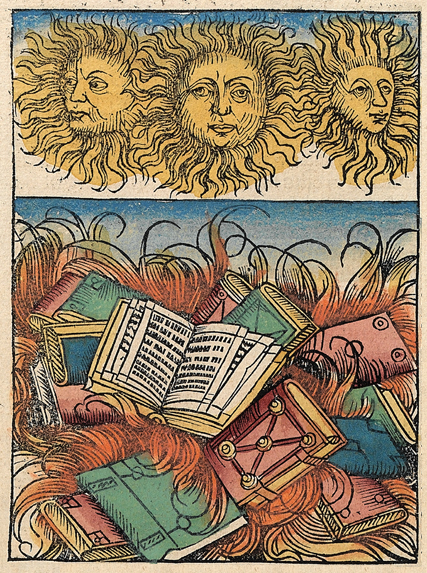
Nuremberg chronicles f 092v 1.png 
(Image from the Nuremburg Chronicle 1493, three suns observe a book-burning.


If you are an author, you will at one point or another be presented with a bad if not scorching review of your work. Quite possibly, you may receive an equal amount of negative criticisms and evaluations of your cherished creations in proportion to all the good reviews you receive. Hopefully, you will not receive more bad reviews than good!

How do we address the distressing reality of unjust criticism? The general rule has been to accept everyone is entitled to their opinions, be they good, bad, or incorrect, and simply ignore their bad comments. However, there are times when reviews are completely erroneous they leave us wondering if the reviewer had actually read the book and could comprehend its contents. Or, might we dare suggest, are deliberately condemning a work for some unknown ulterior motive? I have read reviews on other people's work that I had studied and the results were totally perplexing, (the reviewer reporting the author failed to address topics or issues when they had, or completely missed that author's point etc.), and now I too have fallen prey to the poison pen, or at least, a misguided one.

Must we authors stay silent, or are we entitled to defend our work and beat back the flames of unjust criticism?   In the case of an academic review, I think we may, since are academics are expected to be adept readers.  With your permission, I offer you an example below: a review of my work, Faust: My Soul Be Damned for the World Volume 1 , written by Nicholas Holland for Folklore, the Journal of the Folklore Society UK, published March / April 2012. My defense is presented in Italics.

~~~

“E.A. Bucchianeri's book, the first of a two-volume study, surveys works concerned with the famous magician Doctor Faustus from the earliest German notices to Christopher Marlowe's eponymous play. A short final section discusses seventeenth-century and eighteenth-century works before Goethe. The first chapter reviews German accounts of Faustus prior to the earliest known version of the German Faust Book, and places a particular emphasis on the search for biographical evidence about the historical Faustus. Bucchianeri surveys the various early accounts, including those of Trithemius, Melanchthon, and Weyer. The majority of the material covered will be familiar from other modern studies, but whereas the studies of Frank Baron, for example, draw out the complexities of the relationship between historical evidence and the subsequent fashioning of the legend, this study tends to place great emphasis on searching for insight into the biography of the historical Faustus; an approach that can be detrimental to the consideration of the sources surveyed in their historical context.”


(I tend to place more emphasis on the biography? Of course, we cannot see how the folklore developed without arriving at a clear picture of Faustus, this historical man of mystery. To all intents and purposes, I followed Baron's analytical example in discovering the historical Faustus, and offered additional findings / observations to the material Baron provided and discussed. The chapter dealing with Faustus' biography is only one quarter of Volume I, (125 pages) and roughly half of this chapter also examines the legend-formation process. The rest of Volume I (nearly 400 pages), features the Faust folklore / literature. Holland then declares in so many words it is 'detrimental' to piece together a biography of Faustus from the sources that exist and that I did not consider their historical context. Did Mr. Holland actually read and comprehend my work? ~ E.A.B.)


“For example, when considering the account of the famous abbot and philosopher Trithemius that Faustus declared himself the source of the necromancers, Bucchianeri's bewilderment that Faustus "would freely choose a profession that would utterly ruin his reputation" (p. 28) seemingly takes Trithemius's report at face value. Trithemius's opinions concerning Faustus surely demand more cautious consideration in the light of his own possible motivations, reputation, and interests; in particular since so little concerning the historical Faustus and his magical practices can confidently be corroborated using other sources. More generally, Bucchianeri's biographical focus in the early part of the book tends to direct the reader's attention away from what must be the most significant and astonishing aspect of the documentary legacy: the impact, durability, and openness to further interpretation of the legend of Faustus through the sixteenth and early seventeenth centuries, first in German and later in English culture. Whereas the historical Faustus is an almost invisible footnote in early modern intellectual history, the legend of Faustus became, in the hands of a number of important writers, a means of expressing early modern interest concerning both the potential power and also the potential dangers of magic.”


(I could find no evidence presented to date to doubt Trithemius' letter written to a friend and colleague, warning him to be wary of Faustus. The letter was reprinted during Faustus' lifetime, it could not be a bogus document. Trithemius may have aggrandized Faustus' claims concerning his magic skills, but this topic is discussed in detail. Faustus was known to declare himself a "necromancer" according to well-documented historical sources, therefore, according to the historical evidence, Trithemius was accurate in describing Faustus. I have examined the content of Trithemius' letter minutely from all aspects, similar to Frank Baron. To declare oneself a 'necromancer' was a serious matter in those times, Faustus could have been tried and executed. Why take such a risk? His motives had to be questioned, and these questions hypothetically answered. I find it curious Mr. Holland believes the biographical material in Volume I detracts from the efforts to describe the "impact" and the "openness to further investigation" of the legend: as I said, three quarters of Volume I (about 400 pages) explores the rich Faustian material inspired by his legend over the centuries and how it was used to deter people from studying magic in addition to admonishing people to live good Christian lives. Holland's conclusion that I digressed from explaining the "early modern" fascination and fear of black magic is erroneous. ~ E.A.B.)


“The remainder of the volume is mostly dedicated to substantial descriptive accounts of the German and English Faust books, and of Marlowe's Doctor Fautus. Bucchianeri's major new proposition concerning the latter is that the B-text shows that "Marlowe had regained a considerable measure of the defiant 'Machiavellian' optimism", which was absent from the A-Text (p. 368). Although precisely what she means by "Machiavellian" (or "liberal Epicurean," a phrase she applies to Marlowe's Faustus in the same passage) is unclear, her reading of the play evidently belongs to the school of interpretations which considers the overarching admonitory message of the play as being in some way questioned by the manner of its presentation. However, her core interest again is in trying to establish firm connections between biography and text. Her proposal is that the B-text of the play is a revision of the A-text chiefly undertaken by Marlowe himself in the light of personal experiences and historical events that enable it to be dated to 1592. This is an unusually precise stance concerning the genesis and authorship of this text, but ultimately fails to persuade. For example, some basic textual evidence seems to conflict with such a precise and confident dating. The author argues, in particular, that the references to the Anti-Pope Bruno in the B-Text are inspired by news of the arrest of Giordano Bruno in Venice in 1592. However, if a similar method is applied to the reading of two of the most striking points of similarity between the fictional Bruno and the historical Bruno, these events have no direct connection to 1592. The fictional Bruno undergoes excommunication, a punishment which the historical Bruno stated to his interrogators in Venice he knew had been imposed on him in absentia by a hearing convened by the Dominicans in Naples prior to this period in England (1583-5). The execution by burning for heresy, pronounced on the fictional Bruno by Faustus in disguise, was visited on the historical Bruno as late as 1600, seven years after Marlowe's death. While there is a case to be made for the influence of the historical Bruno's person and thought on Marlowe via the circle of Earl of Northumberland, there is in fact nothing tangible to link the scene in Doctor Faustus more strongly to the news of 1592 than to the news of any other year of a period spanning the whole of Marlowe's writing career. Furthermore, by attempting to bind the play's genesis too tightly to Marlowe's biography, the author underestimates not only the imaginative capacities of Marlowe himself and of the other writers who most probably had a hand in the B-Text, but also the uncertainties that cloud our understanding of Marlowe's personal beliefs. Such an approach also fails to place sufficient emphasis on the need to understand the contents of Doctor Faustus in the context of the early modern performance traditions upon which it draws.”


(The terms "Machiavellian" and "Epicurean" may be on the same page, but not in the same paragraph. From the context of the study, Holland should have understood the term "machiavellian" to mean Faustus' thirst for power and his determination to acquire it by whatever means or cost. The philosophical term Epicurean was explained in the first chapter, but possibly Holland forgot: "... pleasure is the supreme goal one should aim for in life, particularly intellectual pleasures above those of sensual ones. Epicurus taught that one could only acquire true happiness and serenity by conquering one’s fear of the gods, death, and the afterlife. He also believed that humans ceased to exist after death, declaring the soul died with the body." The term was referred to in this philosophical context throughout the chapter on Marlowe, and we note Faustus in Marlowe's play begs his soul to dissolve at death. The context of Epicurean should have been clear from the beginning.

I am sorry if my argument concerning the dating of the A and B Texts "failed to persuade" Mr. Holland, but I notice he discussed only one piece of evidence I presented, and omitted to mention all other observations pertaining to the 1592 date. If it was a matter of that one detail, Bruno's arrest, then there would not be enough evidence, but a good detective should look at all the evidence presented.

I also notice Mr. Holland points out every historical detail of the the real Bruno, and how this factual information does not match the action of Marlowe's play: must everything in the drama display historical fact? Surely, Marlowe had the creativity to imagine the scene of Bruno's arrest and make artistic predictions concerning the possible outcome of that event, even if they proved incorrect in the future. In this instance, Holland has failed to follow his own conclusion and has committed the same supposed 'error' he condemns me for, that is, trying to find the historical details that correspond with Marlowe's biography and are included in the play ~ let us note that Holland's states "by attempting to bind the play's genesis too tightly to Marlowe's biography, the author underestimates not only the imaginative capacities of Marlowe himself and the other writers who most probably had a hand in the B Text". In so many words, Holland has proposed that authors, playwrights and artists are uncreative and unimaginative when they draw upon their life experiences, (and therefore, contemporary history), for their material. Interesting observation, Mr. Holland.

He also says by binding the play´s genesis too closely to Marlowe's biography, I also "underestimated the uncertainties" that cloud everyone's understanding of Marlowe's personal beliefs. Not so. It was due to these uncertainties I conducted a close reading of Doctor Faustus with Marlowe's known biography. I simply examined the claims Marlowe was an "atheist" in that he did not believe in the established Christian religions, and noted how these claims may have a basis in fact through a close reading of Doctor Faustus. I endeavoured to shed some light on the accusations levied against Marlowe, and if possible, display how close the creative soul of the writer is to his work. ~ E.A.B)


“The stated aim of this study is to provide a "comprehensive exploration" of Faustus and his legacy. It provides lengthy descriptive discussion of the contents of the texts surveyed and, to some extent, it offers a useful single point of reference for them, although it must also be noted that the author's digressive style makes it relatively hard to read. As a work of analysis, however, its most serious failing is that it does not examine more fully and in a more systematic way the complex forces that worked to shape the legend of Faustus within a wider cultural context, and instead places its primary focus on an attempt to find close relationships between biography and text. As a consequence, it fails to offer readings of the material under consideration which have the depth of insight or nuance of the most valuable works already written on the various works it surveys.”


(The aim of this study was to provide "a comprehensive exploration of Dr. Faustus, the man who sold his soul to the devil, and those who lived to tell his tale" ~ so yes, providing detailed explanations of the texts and why each author presented the Faust material as they did was the object of the work. I do not see how Holland thinks this does not present the "complex forces" that shaped the legend of Faustus, when everything from religious intolerance, the Reformation, academic competition, fear of black magic, the scientific discoveries of the day such as the Copernican / Galileo controversy, folklore and history, and how they were included in the Faustian tales, are discussed. Can the "cultural context" become any wider? If this study lacks "the depth of insight or nuance of the most valuable works" already written on the subject of Faust and Faustian literature, I shall leave it to you, the reader, to discover if this be true or not. I thank Mr. Holland for his review, albeit it took nearly four years for it to appear from the time the paperback edition was published and sent in for review. E.A.B.)

~~~

Faust  My Soul Be Damned for the World Volume 1 by E.A. Bucchianeri 

Tuesday, 1 September 2015

Brushstrokes of a Gadfly ~ Book Review

(Post originally published December 20, 2011)

A big thank you to Randall Radic for the following review published on Blogcritics.org.
What a wonderful Christmas gift!

(Following review published December 19, 2011.)

"According to Webster’s Unabridged Dictionary, a gadfly is “an insect that goads or stings cattle, as a horsefly. A person who annoys or irritates others.” Supposedly, the Greek philosopher Socrates was a gadfly because he irritated others by causing them to analyze their thought processes. Inevitably, analysis revealed errors of not only reasoning but conclusions – mental boo boos. Rather than rejoicing over their newfound enlightenment, people became upset. People don’t like being told they are wrong or stupid or illogical. So they began avoiding Socrates like the plague, along with talking about him behind his back, saying nasty things about him. But Socrates didn’t care. He considered it his duty to be an irritant, a gadfly. So he kept doing it. In the end, he annoyed so many people so much that they decided to do something about it. It wasn’t pleasant.

Jesus was a gadfly too.

So is the protagonist of Brushstrokes of a Gadfly, a wonderful, walloping novel by E.A. Bucchianeri. Katherine Walsingham is the star of Brushstrokes. She is beautiful, talented, intelligent, sensual, and comes from an affluent, well-bred family in New York City. Kat’s only flaw is that she enjoys stirring the pot. She doesn’t believe in going along to get along. Thus, she utilizes her art to cause viewers to re-evaluate their conclusions about religion, cultural traditions, nuclear power, women’s rights, government corruption, and the true definition of freedom. Naturally, Kat receives lots of attention, while at the same time annoying lots of people, people who prefer the status quo to remain stationary.


Brushstrokes of a Gadfly
The pedantry of Katherine is obvious, as she tries to set the world to rights. What’s funny is that while Kat is busy being a gadfly, the pedantry of Life wiggles in and disrupts Kat’s vision for her future. Determined to eschew romantic entanglements because of their destabilizing effects, Kat unexpectedly finds herself falling in love with one of New York’s most eligible bachelors. Because of a peculiar combination of circumstances – Kat’s reluctance, her paramour’s family, and gossip – the romance appears headed for disappointment.


Whether or not Life and Love find a way won’t be discussed. You’ll have to read the book to find out.

Essentially, Brushstrokes is a high literary romance novel. Imagine Roberto Bolano meets Nicholas Sparks: erudite and gracious with a saccharine undertone of romance and the unpredictability of life. In other words, it’s exaggerated, quaint, absurd, funny, touching, and very much like reality.

E.A. Bucchianeri guides the reader through all the twists and turns of the story with remarkable aplomb, utilizing what the reviewer calls “an informed literary style.” Translation: easy to read, yet without all the dreary flatness that inhabits most ‘high literary’ novels. The story sparkles with various subplots and unique characters – stories within the story – that provide diversion and respite from the primary thread of romantic tension. The reviewer’s favorite is Kat’s grandfather, who, having avoided the psychological pitfalls of great wealth, speaks from his heart, which he wears on his sleeve.

Brushstrokes of a Gadfly is a big book, weighing in at a couple of pounds and 1040 pages. Just looking at it makes a potential reader pause and consider. However, any doubts may be set aside. After the first two pages, you’ll be pleased with your purchase. It’s long, but it has everything you’re looking for: humor, love, human interrelations, good writing, a plot that moves along, and emotional catharsis."

Brushstrokes of a Gadfly


Download Free Preview from Scribd

Where to get your copy, click here.