Whatever curious and interesting subject strikes my fancy, be it silly or serious, gets posted for your reading pleasure.
Showing posts with label medieval manuscripts. Show all posts

Friday, 11 March 2016

When St. Patrick Impaled a Convert


There are so many stories of St. Patrick, but one that sticks in my mind, (forgive the pun, you’ll see it in a minute), is the story of how the King of Munster bravely suffered for both no reason and for every reason.


The name of the King was Aengus, and after learning about the Christian faith, Aengus earnestly desired to be baptised.  St. Patrick travelled to the royal seat of Munster, the Rock of Cashel, where he was eagerly welcomed by the people circa 445 AD.  Apparently the baptismal ceremony took place at the famous Rock, for it is also known as the Rock of Patrick.


 Image: The Rock of Cashel, site of Prince Aengus' baptism.
Hardly any ancient ruins are artifacts remain.
 The structures seen here date from the 12th and 13th centuries.


Now, St. Patrick had a habit of driving his crosier into the ground when needed, allowing him to free his hands and prepare for whatever ceremony he was presiding at, and from one version of the story I heard, St. Patrick’s pastoral staff actually had a sharp iron spike at the end.  Well, as the good saint was getting ready, he wasn’t paying too much attention to where everyone’s feet were at, so you guessed it ~ he drove his crosier right through the foot of King Aengus, nailing him to the spot.

Lo and behold, the king never uttered a sound. In fact, he stood impaled for practically the whole ceremony.

When St. Patrick was nearing the end of the ritual, he finally saw the blood flowing and realised what he had done.  He immediately freed his royal highness and cried: “I’ve injured you! Why didn’t you say something?"

The king answered simply as his wound was tended: “I thought it was part of the ceremony.”

“Why no, it’s not!  Your Highness should have spoken out! I’ve injured you, and you may be made lame for life!”

Still, King Aengus was not ruffled in the least. According to the version I heard, he replied something like this:

“Since Christ shed all His blood and gave His Life to save my soul, it is fitting I should shed a little of my blood for Him for Eternal Life.”

So, the King suffered for 'no reason', and yet for every reason!

Admiring his courage, St. Patrick took the king's shield and inscribed a cross on it with the spear point of the same crosier, saying that this shield would stand as a sign  of countless spiritual and temporal triumphs.
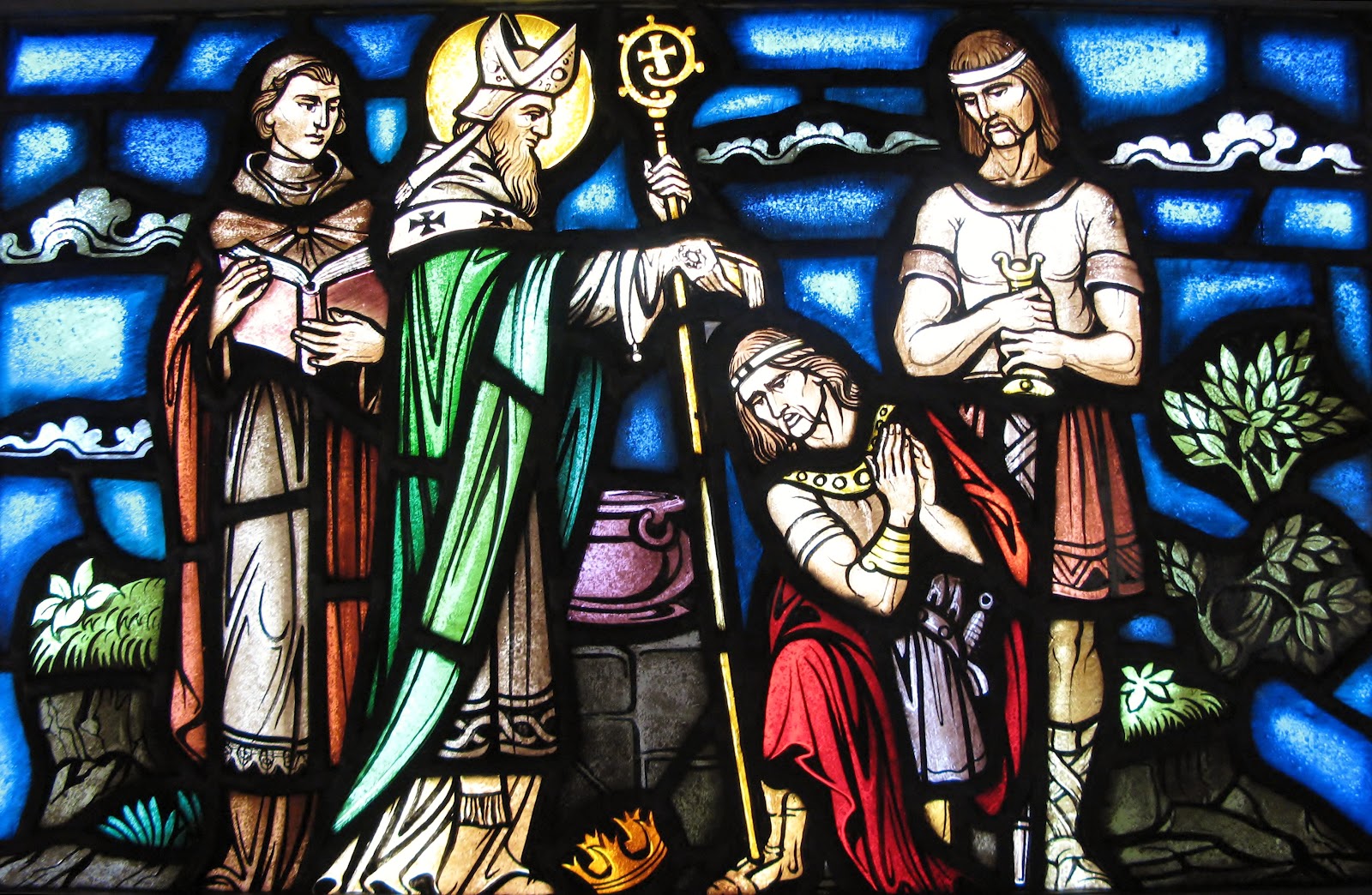
    

Image: stained glass window depicting St. Patrick baptising King Aengus. Author of photo unknown.

"The royal foot transfixed, the gushing blood
Enrich'd the pavement with a noble flood."


I find it interesting that the name 'Aengus' originates from the Proto-Celtic words  oino "one" and gus "strength" (or possibly "choice").  May we all be as strong and courageous in our faith as the King of Munster.

The saint stayed for some time in the province, for  the ancient Life of St. Patrick states:

"After Patrick had founded cells and churches in Munster, and had ordained persons of every grade, and healed the sick, and resuscitated the dead, he bade them farewell, and imparted his blessing to them." 

The same record also gives us the words of his blessing, which he gave from the hills of Tipperary:

A blessing on the Munster people —
Men, youths, and women;
A blessing on the land
That yields them fruit.

A blessing on every treasure
That shall be produced on their plains,
Without any one being in want of help,
God's blessing be on Munster.

A blessing on their peaks,
On their bare flagstones,
A blessing on their glens,
A blessing on their ridges.

Like the sand of the sea under ships,
Be the number in their hearths;
On slopes, on plains,
On mountains, on hills, a blessing.


Happy St. Patrick’s Day!


(Source for the information on on St. Patrick in Munster: 
www.newadvent.org/cathen/11554a.htm)

***

***
 
If you like my blog, you may LOVE my books!


Monday, 1 February 2016

February 13th ~ Hell's Birthday?

Two years ago, I came across an interesting piece of Medieval trivia ~ that scholars once believed God created Hell on February 13th.
(Image: Painting depicting Hell, c. 1516
 
 This was news to me.  The bafflement was mighty!  After studying the Faustian legend  and writing about it in-depth to the point of severe academic obsession, starting with the historical Faust in the late Medieval Period who allegedly sold his soul to the devil and working my way up to Goethe’s epic closet drama published in the 19th century,  I wondered how come I never heard about this before?

Naturally, I had to do so digging and satisfy my curiosity, and lately have decided this might make an interesting blog post.

I began my information treasure hunt with Google, (where else?), and discovered a post dated February 13, 2014 on a Benedictine website stating that this hellish event was marked in medieval calendars.  Considering we are looking into the Medieval Period, we must not forget that in those days theological scholars believed they had also pinpointed the First Day of Creation according to their Biblical calculations based on the Julian calendar, which is currently 13 days behind ours. (So, 'Hell Day' would be the 26th of February in our modern calculation of time assuming my online source hasn't already adjusted the date.)

My theory is, if you can understand how they calculated the First Day, it should be fairly simple to see where ‘Hell Day’ originated.  Right?

Don’t worry, I won’t bore you with too much history. (Hopefully!)


We already know that the early and Medieval Christians believed the First Day began on March 25, the day Julius Caesar set forth as New Year’s Day on the calendar he instituted, yes, the Julian Calendar.  He chose that day as it was the Spring Equinox, however, as his calendar was not astronomically accurate, the equinox shifted over the centuries.  

 In 1582, Pope Gregory XIII instituted a new way of reckoning the year to correct the astronomical discrepancies they crept in, changing New Year’s Day to January 1.  We continue to use the Gregorian calendar to this day, which as mentioned, has skipped forward almost two weeks due to the Julian discrepancies.

 However, it is the Julian Calendar that still is of interest to us, and indeed, is still used by Orthodox Christians.  Despite the shift in the spring equinox, March 25th continued to be regarded as the First Day of Creation in both the east and west during the Medieval period:  it seemed logical that Creation had to have taken place sometime within the life-giving season of springtime. The day was also mystically significant as it was the Feast of the Annunciation, the day of Christ’s conception.

Our information digging doesn’t stop there; the majority of the earliest Christians up until the Middle Ages believed that Creation began circa 5500 BC give or take a few years.  Yes, there were various calculations proposed, but for some time, this was the basic accounting of years according to calculations of the Septuagint.

Okay, enough of calendar history! 

According to the Medieval way of thinking, we have March 25 as the Day of Creation and also the year c. 5500 BC as the Anno Mundi to work with.  Some theologians believed that Hell had to have been created for the evil angels that fell before God turned to work on the rest of Creation, although there is Biblical evidence God had already created the physical earth already before Satan fell.  However, for those scholars who believed Hell was created first, it is logical to assume they thought Hell must have been created around or slightly before this date in March and about the same year ~ so that would be from February to March.

Curiously, we find that in Dante’s time it was  believed the First Day of Creation took place when the sun was in the constellation Aries, a belief he recorded in his poetic classic ‘The Divine Comedy’ (1308-1320):


“The hour was morning’s prime, and on his way
Aloft the sun ascended with those stars (Aries)
That with him rose when Love Divine first moved
Those fair works: (...)”

          ~ Canto I, The Divine Comedy, (Harvard Classics, Vol. 20)


 https://upload.wikimedia.org/wikipedia/commons/e/e2/Michelino_DanteAndHisPoem.jpg

(Image: Dante holding a copy of The Divine Comedy next to the entrance to Hell, the seven terraces of Mount Purgatory and the city of Florence, with the spheres of Heaven above.  Fresco by Michelino, 1465)


Thanks to modern astronomy technology, we can now test out this information with some stellar experimentation!

Looking at the sky with the Stellarium app, we find that around 5500 BC the sun was indeed in Aries, right in sync with Dante’s fine verses.

Using this year, we can also see why theologians and scholars thought Hell was created in February.

Not only is the sun in Aries in 5500 BC, it is above the constellation Cetus ~ right over the head of the evil sea monster of Greek mythology that was destroyed by Perseus.  Remember the movie Clash of the Titans? 


 (Image: 12 PM screenshot of the sun Cetus, 5500 BC, from the Stellarium App.   Assuming the date February 13th is according to the Julian calendar, I’ve set the date in the App to the 26th, taking into account that we are now 13 days ahead in the Gregorian Calendar.)
 

Now, get this...

Cetus is also called the ‘Whale’ ~ a beast that was considered a symbol of Hell.

How did they come up with that?

In the Gospel of Matthew 12: 38-40 we find the following:

“Then some of the scribes and Pharisees answered him, saying: Master we would see a sign from thee. Who answering said to them: An evil and adulterous generation seeketh a sign: and a sign shall not be given it, but the sign of Jonas the prophet.  For as Jonas was in the whale' s belly three days and three nights: so shall the Son of man be in the heart of the earth three days and three nights.” (Bible: Douay-Rheims edition.)

Using the symbol of Jonah and the whale, Christ was foretelling His death, his following decent to the Underworld and His resurrection that would happen three days later. 

In those days it was taught that both the Limbo of the just souls and the Inferno of the damned were part of ‘Hell’. 

 Christ descended to free the just souls, and it is also believed He entered Hell, commanding Satan and all the demons to bow before Him and acknowledge Him as the Lord God ~ the 'Harrowing of Hell'.  Of interest, when St. Jerome translated this passage of the Sacred Vulgate, he used the word ‘cetus’, the same word as the whale constellation.


(Image: the constellation Cetus as a fish-tailed monster published in 'Urania's Mirror', 1825)


I also found a Biblical Astronomy site online edited by Robert Scot Wadsworth that states the name Mira for the bright star in Cetus is from the ancient Hebrew ‘marah’ meaning ‘rebel’, ‘rebellious’, ‘disobedient’ ~ a fitting star to be found in the constellation representing Hell where Satan the rebel angel and all his followers are doomed to remain for all eternity.

In ancient texts it is common to see the gates of Hell depicted as a monster or whale swallowing up the damned.  You can find some incredible examples in the following  post published in the British Library Medieval Manuscripts blog: “Prepare to Meet You Doom”.  Oh heck, I'm borrowing one of their images... here it is:


Yates_thompson_ms_13_f142r

 (Image: detail of demons throwing sinner in to the mouth of hell from the 'Taymouth Hours', Yates Thompson MS 13, f. 142 r.)
Detail of a bas-de-page scene showing the casting of souls into Hell, from the ‘Taymouth Hours’, - See more at: http://britishlibrary.typepad.co.uk/digitisedmanuscripts/2014/02/prepare-to-meet-your-doom.html#sthash.4K2slu3g.dpuf
Detail of a bas-de-page scene showing the casting of souls into Hell, from the ‘Taymouth Hours’, Yates Thompson MS 13, f. 142r. - See more at: http://britishlibrary.typepad.co.uk/digitisedmanuscripts/2014/02/prepare-to-meet-your-doom.html#sthash.4K2slu3g.dpuf


There we have it!  So, if we use the theory that Hell was created for the devil and his angels before God turned His attentions to creating the physical cosmos, (although there is evidence in the Bible the devil actually fell to earth as well), and if we take 5500 BC and observe the sun’s position in Cetus in February, we can see how the scholars of those times arrived at their calculation, February being before March, the month some theologians believed God began his Great Work of Creation.  Even when adjusting the 5500 BC assumed date of Creation back and forth a decade or two, the sun is still in Cetus, the Mouth of Hell.  How they arrived at the date, the 13th, I’m not sure: that’s another mystery to unravel, which I shall leave to the experts in biblical astronomy.


Click to see other posts on my blog here -  TABLE OF CONTENTS


***
 
Like my blog?  You'll LOVE my books!