Whatever curious and interesting subject strikes my fancy, be it silly or serious, gets posted for your reading pleasure.
Showing posts with label St. Patrick's Day. Show all posts

Thursday, 14 March 2019

St. Patrick's Well – Clonmel Ireland, Co. Tipperary

Ireland's mystic Catholic history is steeped in the tradition of holy wells dotted throughout the island.


It is said that rather than negatively pointing out to the pagan Druid Celts what they were doing wrong by declaring certain spots sacred in their nature-worship, the early missionaries like St. Patrick realised encouragement is the key and told the people that yes, they were correct about the idea of holy wells and thereby dedicated them to the service of Christ, converting them into Christan baptismal fonts.


Outside Clonmel Co. Tipperary on the Cahir road near Marlfield you will find such a holy well.  It possibly one of the largest holy wells in Ireland, and it is said that it once was a  Druid site turned into a baptismal font by St. Patrick.


 However I've also heard of one story St. Patrick met St. Declan of Ardmore here, the Apostle of the Deise people, ie. the Ardmore / Waterford region.  Those who are not familiar with all of the ancient Catholic history of Ireland often presume St. Patrick was the first missionary, but there were others who came before him or just around the same time, St. Declan was one of those bishops. 

As he was travelling from Rome to Ireland, St. Declan met St. Patrick in Italy who was not yet made a bishop.  Then it appears when St. Patrick was travelling through the south of Ireland preaching and winning many converts to the faith, St. Declan met him again at St. Patrick's well, perhaps to converse on the matter of apostolic jurisdiction since Ardmore / Waterford was in St. Declan's area.    Apparently, there are little to no records or traditions passed down regarding St. Patrick evangelising in Waterford, so it appears he respected St. Declan's authority there as agreed, and it seems St. Declan granted to St. Patrick he could have this one well where he preached to and baptised the people.


It's quite possible it was also here at St. Patrick's Well where the two saints agreed to later meet at the Rock of Cashel, the seat of King Aengus of Munster, to formally finalise the matter.  St. Ailbe was also there at Cashel, another missionary bishop who had also arrived before St. Patrick to spread the Gospel.   Tradition states the three saints came to an agreement of archdiocese boundaries at Cashel with the King as witness.  St. Declan remained in the Waterford / Admore region, while St. Patrick was granted a few church in the Munster area, he agreed to return to the northern Kingdom of Ulster, his archdiocesean seat becoming Armagh where is buried.  (For St. Patrick's dramatic encounter with King Aengus of Cashel, click here.)


Apparently, the church at St. Patrick's Well at Clonmel was granted the grace of becoming a Plenary Indulgenced site by Pope John V in 1619. (Source: Pilgrimage in Medieval Ireland).  The Pope  declared all pilgrims visiting the church there on the feast of Pentecost or on the feast day of St Patrick, provided they went to confession and communion, would receive a plenary indulgence. (If you want to know what a plenary indulgence is, read my blog post, Remember Remember the Dead in November).


The well is reached by descending a small limestone cliff into a dell via some wide but steep steps, and it is a lovely, peaceful spot to visit.


 Some of the early photos I have discovered thanks to 'Medieval Pilgrimage in Ireland' are truly stunning in a time-capsule sort of way, showing what it looked like in the last turn of the century c. the 1900s.  

It still looked kind of 'druidy'  didn't it!  Sadly, that old tree with its roots wrapped around the well is no longer there. 


(Above: photo: Robert French (1841-1917) in The Lawrence Photograph Collection National Library of Ireland http://catalogue.nli.ie/Record/vtls000333667

Below:   the original landscape of St Patrick’s well. Taken by Robert French (1841-1917) in The Lawrence Photograph Collection National Library of Ireland http://catalogue.nli.ie/Record/vtls000339062) 


The old Celtic cross in the left foreground dates from circa the 6th century. It is still there.


Also, it is amazing the amount of water that still bubbles with some considerable force out of the spring straight from the ground. I remember the good old days when they used to play the Irish national anthem on the TV station RTE1 before it signed off for the night, the gushing stream from the well was one of the patriotic images shown.


The site was modernised in the late 50s early 60s I believe, the water now collects into a nearby pool which surrounds the cross.


The Cistercians came to the area in 1147 AD and moved on to Inishlounaght at Marlfield where they prospered for 400 years. The abbey there was founded by Donal O’Brien the King of Munster and dedicated to the Blessed Virgin. St. Patrick's Well was apparently also under their care, that is until Cromwell's arrival when their monastery in Inishlounaght was dissolved in the 16th century. Cromwell divided the monestary lands up between his friends. The abbey no longer exists but its site is located at the First Fruits Church of Ireland on the banks of the River Suir in Marlfield. 


The present remains of the church you see dates from circa the 15th century and is from the period before when the Cistercians were custodians.  Inside you can see the "White Altar" tomb and fragments of an earlier Cistercian Romanesque Church. To the right of the East window the large carved coat of arms of the White family can be viewed. Nicholas White died in August 1622. Today St. Patrick's Well is part of the present day parish of St. Mary's of the Assumption, Irishtown, Clonmel.


Cures continued to happen out there for quite some time.  My Irish mother from Clonmel remembers the days when there used to be crutches, wheelchairs and other similar things left hanging on the church as votive offerings of thanksgiving.  They're gone now, and one wonders what has happened to the the faith in Ireland, we don't hear of cures happening at the site any more.

Also, she remembers the days when there were truly holy processions to the well on St. Patrick's Day after High Mass and the whole town got involved, everyone marching out with bands playing and banners flying to pay respect to the national saint.  

Alas, I didn't get to see that either when we moved there: processions are gone in this modern Vatican II age, at least there were Masses in the churches, but no procession, only a secular booze up parade in town with a few reflective souls venturing out to see the well.

A sad state of affairs, however, we can be comforted with the prophecy that just when the flame of the Faith appears to be snuffed out in Ireland, it will one day flare up from the north and blaze throughout the land in a miraculous age of renewal. 


::::::::::::::::::::::::::::::::::::::::::::

If you liked this St. Patrick's Day post, you may like my past St. Patrick's Day / Irish posts: 


(*)  The Shamrock Purist - (How to spot the real one from the sham Shams!)


If you like my blog, you'll LOVE my books! Check them out! (Click here)


Saturday, 10 March 2018

St. Patrick and His Blessed Crozier


Exactly where did St. Patrick come from? Scotland, England, Wales and also Ireland have been proposed as the birthplace and homeland of the Emerald Isle's most beloved national saint, but the most likely of all contenders for St. Patrick's birthplace is France, and his childhood home, Brittany.  Ancient accounts suggest it is from here he received his blessed crozier, An Bachall Iosa, or the Staff of Jesus.


First, you may well ask ~ how do you know for certain St. Patrick was a Frenchman?

(Well, he was of Roman lineage with possibly some Hungarian in the mix, but we'll get into that!)


Among the books in our home is an old treasure entitled “The Life of Saint Patrick, Apostle of Ireland” published by John Murphy in 1863. Although an old source, Murphy lays out his argument in favour of France, and I for one find it very convincing, although trying to figure out what he was trying to say in his old academic way was a challenge! However, here is a concise account of Murphy's study.


Starting with St. Patrick's own account, we find the saint gave very few details about his life, but revealed he came from a respectable family. His father was called Calphurnius, and his grandfather was Potitus, (or Otide), and they both took holy orders. After the birth of his children, Potitus became a priest.   I may have missed this detail, but apparently Murphy's history of St. Patrick does not say how this came about.  Either Potitus was a widower, or he and his wife may have separated upon his decision to enter the priesthood: in the ancient days it was possible for a man to become a priest if he decided to separate from his wife with her consent.  Calphurnius became a deacon.  Both their names denote their Roman heritage.


St. Patrick's mother, Conchessa, apparently came from respectable Roman stock as well: she was the niece of St. Martin of Tours who was born in what is now Hungary, the son of a Roman solider who was destined to become a bishop.  Yes, the same St. Martin that cut his cloak in half and gave the other half to a beggar only to discover in a vision he had given it to Christ.


As we can see, St. Patrick hailed from a very pious family, one with a famous saintly member associated with Tours, France, and from hence we start our journey of discovery. 


Murphy highlights the importance of Tours in St. Patrick's family history, together with an analysis of the ancient Irish hymn written by one of the the saint's disciples, St. Fiech, first bishop of Sletty and afterwards the archbishop of Leinster. St. Fiech was a young poet under the tutelage of Dubtach, the poet-bard of the High King of Ireland. After the famous night when St. Patrick defied the royal decree and lit his holy fire across from the royal seat of Tara, St. Fiech was converted along with the rest of the King's court by the holy missionary's preaching.  In his ancient hymn, St. Fiech declares St. Patrick was actually born at 'nemThur', the Old Irish meaning 'Holy Tours'. Being his disciple, St. Fiech obviously heard this information from the man himself, and therefore Murphy declares in his book that Fiech's hymn is very convincing evidence indeed. St. Patrick was born in Tours, France.


As to St. Patrick's family home existing in Brittany, Murphy directs our attention to an early writer named Probus, who apparently lived in the 6th century according to Bollandus. Probus writes:


St. Patrick was a Briton, of the village of Banava, in the district of Tyburnia, adjacent to the the Western Ocean, which village we undoubtedly find to have been in the province of Neutria (Nuestria), which giants are represented to have formerly inhabited.”


It is easy to see why many historians think St. Patrick came from British Isles since 'Briton' means a native or inhabitant of Great Britain, and was also the name of the people in Southern Britain during Roman times, however....


'Briton' is also the ancient spelling of 'Breton', or a native of Brittany. That region of France received its name from the tribe of Britons who escaped the marauding hoards of Saxons ravaging Britain during the 5th and 6th centuries. Murphy notes that Brittany was one referred to as 'Little Britain' among the early writers because of its ancient British ancestors, hence it is easy to confuse.


Considering St. Patrick's Roman roots and the family connection to Tours, Brittany seems the more likely of the two. Murphy continues the connection to Brittany through the original Old Irish wording of St. St. Fiech's hymn relating St. Patrick's escape from slavery and his subsequent period of theological study:


Patrick stayed in the “Andeas an deiscort leatha / An-innsigh mara toirrian” …

Murphy declares this should be translated to:

Southward of the southenmost part of Letavia / In the islands of the Touronian sea”.


He points out that ancient scholars mistranslated the Old Irish words 'leatha' (also 'lethu' in verse IX), mistaking it for Italy, when Letavia is the correct translation, which in the Middle Ages was known as 'Amoric Gaul', aka the northwest of France.  Another mistake was made regarding the islands of the sea: “toirrian” into “Touronian” does sound more accurate than the Latin translation of the hymn “In insulis maris Tyrrheni”, the “In the islands of the Tyrrhenian” Sea.

Hence, Murphy shows that Probus had used the incorrect Latin translation of 'Tyrrhenian' and not the Irish wording in his chronicle of the saint, which makes quite a big difference:


The Western Ocean (…) is in another part (of Probus' work) called the Tyrrhenian, which designates, beyond all doubt, the Turonian Sea, at the mouth of the Loire, and opposite the country inhabited by the Turones, or, as now denominated, the people of Turaine, whose capital, Tours, was a great city, even in the times of the Romans, but more celebrated afterwards for being the residence of St. Martin, St. Gregory, and a multiplicity of other illustrious men.” (Murphy, p. 43)


Therefore, if Murphy's analysis of a misunderstanding regarding Tyrrhenian for 'Turonian' in the ancient text is correct, St. Patrick lived in the district that lay next to the Turonian Sea, which would be Brittany. It would make sense that Patrick's family stayed somewhere near Tours if he was born there, and Brittany certainly qualifies.   


Notice the ancient map of France below dating from the 1600s - Tours is listed as "Turonia" (under the 'Celtica' region to the top left).  It is situated on the 'Ligeris' or Loire River which flows through Nantes, Brittany into the Atlantic.


Is there any trace of his childhood home left? St. Patrick himself said in his Confession that his family owned an estate called "Bannavem Tiburniae".


Looking at the second word, Murphy notes that 'Tiburniae' refers to the ancient Roman usages of 'Tabernae' referring to Roman encampments dating from the time of Caesar's invasion of Gaul, the word also referring to 'taberna', or the temporary shelter formed of wooden matierals. So, this would point an ancient Roman settlement, and of course, St. Patrick's family had Roman roots.   In recent times Rev. Marcus Losack has presented an intriguing theory as reported by Sarah McDonald in the "Irish Times" (Oct 28, 2013):


Marcus Losack argues that Château de Bonaban in Brittany is Bannavem Tiburniae. The site on which Château de Bonaban was built reportedly contains remains that date from the Roman era. These remains were discovered in the basement of the château in the 1870s but unfortunately they have since been lost through renovations. Rev Losack hopes an archaeological dig can take place that may reveal other evidence of a Roman settlement and possibly provide confirmation for his theory of St Patrick’s origins.


 He is currently in negotiation with the new owners of the château to see if this  is possible."


Backtracking a bit, in clarifying of the meaning of the 'Tyrrhenian Ocean' to be a misspelling of the 'Turonian Sea' and its location, plus finding a quote from a French source regarding St. Martin of Tours and his famous monastery, Murphy discovered and corrected a grievous error regarding the location where St. Patrick's received a portion of his theological training, by explaining how the word 'inch' was used among the ancient Irish:


To the natives of Ireland and Scotland it is well known that an isle in the sea, an islet in the loughs, lakes and rivers, a dry hillock in a morass, nay, sometimes a place nearly though not altogether surrounded by water, is, in Irish and Erse, an 'inch'. Islands of this sort were, in the primitive ages of Christianity highly sought for after for a contemplative retreat, by pious monk and ascetics. (…) In the isles of the Amoric Sea (i.e. the ocean next to Brittany), too, there are many such edifices. Nay, along the meandering banks of and torturous mazes of the fertilizing Loire, from Orleans, through Touraine, a district emphatically styled by geographers the garden of France, till it empties itself into the Turonian or Amoric Sea, many of the primitive saints of Gaul (France) built their cells and monasteries for religious contemplation. Among those (…) was out saint's uncle, Martin of Tours. This great Apostle, whose pious labours achieved the conversion of the western parts of Gaul from Gentilism to Christianity, and was originally 'the son of Roman Tribune, born in the year 316, (…) in the west of Hungary, was first compelled to embrace the profession of a soldier, though he always always showed a particular predilection for a retired life: from this , however, he was necessitated to withdraw in 374 AD, on being elected Bishop of Tours (…) . In order, however, to have less converse with the world, he built near the city of Tours, between the Loire and a sharp rock, the celebrated monastery of Marmoutier, which still exits, and is considered the most ancient abbey of France.' In this 'inch' (island) it was, and in some other 'inches' in the Turonian, and not in the Tyrrhenninan or Mediterranean islands, that St. Patrick fixed his residence for studying divinity (…) under St. Martin, and other holy masters after that saint's death.” ~ (Murphy, pp. 47-48. Murphy's French source in italics about Marmoutier, Il Morut a Candes, November 400.)


Of course, this makes sense: St. Patrick with his respectable family connections with the Church would most likely have stayed near Tours, not to mention Tours was also blessed with the leadership of St. Germanus, who was also bishop of Tours, who according to accounts was also St. Patrick's tutor. In the middle of the 9th century, Eric of Auxerre wrote about the life of St. Germanus and declared that he “considers it the highest honour of that prelate to have been the instructor of St. Patrick”, adding that he remained under St. Germanus' tutelage for eighteen years, who then recommended him to Pope Celestine who gave him the mission to evangelise Ireland. St. Fiech's ancient hymn also mentions St. Patrick studied under St. Germanus before heavenly visions alerted Patrick of God's plan to send him to Ireland. (Image: St. Germanus teaching St. Patrick, stained glass window in in the Lady Chapel of Gloucester Cathedral.)


Futhermore, if Murphy's book is correct, then Patrick did not receive his famous crozier called Jesus's Staff in the Tyrrhenninan or a Mediterranean island as some historians continue to suggest to this day, but on the secluded 'inches' of the Turonian sea: he received his staff in Brittany.


After his stay in Rome, St. Patrick returned to the 'island', or rather, an 'inch' in the Turonian Sea and stayed among the barefooted hermits there according to Murphy's study of the sources. Sacred legend and history blend at this point. Some writers say Christ appeared and gave the staff to St. Patrick, other accounts relate a hermit on the island names Justus received the visitation from Christ and was ordered to bring the staff to St. Patrick. Other ancient chroniclers write its origin is uncertain, but St. Bernard declares it was covered in gold and precious gems. From sacred history and Tradition we learn St. Patrick carried out his duties as missionary bishop with it, and also not a few wonders, such as casting all the demons out of Ireland via the snakes, also, impaling a convert! (Read about that story here. Ouch!) According to tradition, the staff along with the Gospel text used by St. Patrick were transferred from Armagh to Christ-Church, Dublin. History says  oaths and treaties were signed on it.  During legal disputes and like contentions, to solve the issue the people would utter an oath on the Staff.  Apprently, no one would dare utter a false testimony while swearing by the power of the Staff, for it was believed if someone committed perjury in making their oath, great plagues would occur.   Sadly, the staff alleged to be St. Patrick's was burnt outside Christ-Church as a 'superstitious relic' a short time after the Reformation in 1538, its gold and gems confiscated.


In addition to all of Murphy's scholarship, there is another spiritual, mystical reason why I favour Brittany, France as St. Patrick's homeland and the site where he received the famous Bachall Iosa.


After Calvary, Brittany is the most blessed land chosen by God according to the approved mystic Marie-Julie Jahenny (1850-1941). Due to the Bretons' great devotion to the Faith, the Mother of God, and the Monarchy of France, Brittany will be spared most of the chastisements about to befall the earth before the Three Days of Darkness and it will become a place of sanctuary. Our Lady revealed to Marie-Julie Jahenny that since the time of Calvary she has not seen so many graces reserved for one place as for La Fraudais, Brittany. Therefore, Brittany shall in effect become a new Holy Land of grace as it will become home of the new Sanctuary of the Cross and the centre of Renewal regarding the One Holy Catholic Faith. France is destined to bring about the promised Age of Peace and the restoration of Christendom via the Reign of the Sacred and Immaculate Hearts and this reign will continue until the End of Time.


No, I'm not surprised such a holy man as St. Patrick destined to become the Apostle of Ireland, blessed with many graces and the gift of miracles, and, who received the promise that Ireland would be spared the destruction by fire that would ravage the world but would fall into the sea instead, should come from the protected land of Brittany, the 'New Holy Land' chosen by the Sacred and Immaculate Hearts of Jesus and Mary. (Learn more about Marie-Julie Jahenny and her prophecy of La Fraudais here.) 


 ::::::::::::::::::::::::::::


If you liked this St. Patrick's Day Post, check out my other ones ....

St. Patrick's Well - a Plenary Indulgenced site


:::::::::::::::


Friday, 11 March 2016

When St. Patrick Impaled a Convert


There are so many stories of St. Patrick, but one that sticks in my mind, (forgive the pun, you’ll see it in a minute), is the story of how the King of Munster bravely suffered for both no reason and for every reason.


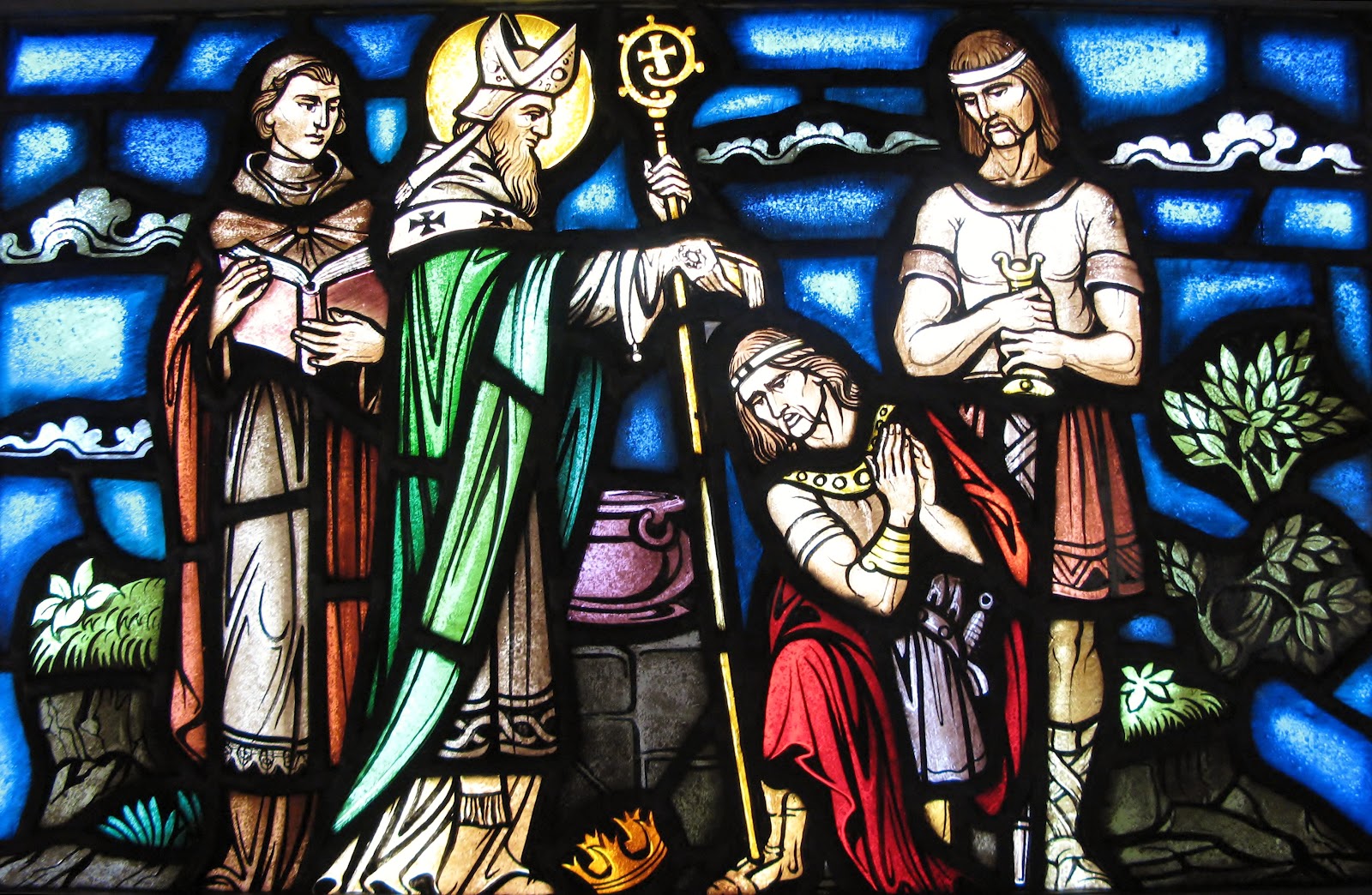
The name of the King was Aengus, and after learning about the Christian faith, Aengus earnestly desired to be baptised.  St. Patrick travelled to the royal seat of Munster, the Rock of Cashel, where he was eagerly welcomed by the people circa 445 AD.  Apparently the baptismal ceremony took place at the famous Rock, for it is also known as the Rock of Patrick.


 Image: The Rock of Cashel, site of Prince Aengus' baptism.
Hardly any ancient ruins are artifacts remain.
 The structures seen here date from the 12th and 13th centuries.


Now, St. Patrick had a habit of driving his crosier into the ground when needed, allowing him to free his hands and prepare for whatever ceremony he was presiding at, and from one version of the story I heard, St. Patrick’s pastoral staff actually had a sharp iron spike at the end.  Well, as the good saint was getting ready, he wasn’t paying too much attention to where everyone’s feet were at, so you guessed it ~ he drove his crosier right through the foot of King Aengus, nailing him to the spot.

Lo and behold, the king never uttered a sound. In fact, he stood impaled for practically the whole ceremony.

When St. Patrick was nearing the end of the ritual, he finally saw the blood flowing and realised what he had done.  He immediately freed his royal highness and cried: “I’ve injured you! Why didn’t you say something?"

The king answered simply as his wound was tended: “I thought it was part of the ceremony.”

“Why no, it’s not!  Your Highness should have spoken out! I’ve injured you, and you may be made lame for life!”

Still, King Aengus was not ruffled in the least. According to the version I heard, he replied something like this:

“Since Christ shed all His blood and gave His Life to save my soul, it is fitting I should shed a little of my blood for Him for Eternal Life.”

So, the King suffered for 'no reason', and yet for every reason!

Admiring his courage, St. Patrick took the king's shield and inscribed a cross on it with the spear point of the same crosier, saying that this shield would stand as a sign  of countless spiritual and temporal triumphs.
    

Image: stained glass window depicting St. Patrick baptising King Aengus. Author of photo unknown.

"The royal foot transfixed, the gushing blood
Enrich'd the pavement with a noble flood."


I find it interesting that the name 'Aengus' originates from the Proto-Celtic words  oino "one" and gus "strength" (or possibly "choice").  May we all be as strong and courageous in our faith as the King of Munster.

The saint stayed for some time in the province, for  the ancient Life of St. Patrick states:

"After Patrick had founded cells and churches in Munster, and had ordained persons of every grade, and healed the sick, and resuscitated the dead, he bade them farewell, and imparted his blessing to them." 

The same record also gives us the words of his blessing, which he gave from the hills of Tipperary:

A blessing on the Munster people —
Men, youths, and women;
A blessing on the land
That yields them fruit.

A blessing on every treasure
That shall be produced on their plains,
Without any one being in want of help,
God's blessing be on Munster.

A blessing on their peaks,
On their bare flagstones,
A blessing on their glens,
A blessing on their ridges.

Like the sand of the sea under ships,
Be the number in their hearths;
On slopes, on plains,
On mountains, on hills, a blessing.


Happy St. Patrick’s Day!


(Source for the information on on St. Patrick in Munster: 
www.newadvent.org/cathen/11554a.htm)

***

***
 
If you like my blog, you may LOVE my books!


Tuesday, 1 March 2016

O'Leary the Leering Leprechaun


By now, we all have seen,
That little eejit on the shelf,
The naughty, spying git,
The smug Christmas Elf.

We forget he’s sitting there,
He stares all day without a flinch,
Then, when all are fast asleep,
Comes alive to play the Grinch.

He flies to Santa the tattletale
With all the good and bad we’ve done,
Then, plays the downright hypocrite,
He spends the night in mischievous fun.

Well, if you think the Elf is creepy,
Have I got some news for you!
Let me introduce his cousin,
Leering Leprechaun O’Leary.

One bright St. Patrick’s Day
O’Leary came up with something new:
He thought long and hard upon his life,
How things had gone askew.

He and all his merry kin,
Once wee angels in the sky,
But swayed by Lucifer’s horrid sin,
From Heaven were forced to fly.
Not yet so bad to be sent to Hell,
But not good enough to stay On High,
Down to earth they were flung,
Banished from their angelic home
Soaring in the sky.

Now they wander Eire
Waiting for the end,
For when the Trumpets blow,
The Pit will receive them then.
Before their time will come, they figured,
“Why always be so glum?
While we trot about this earth,
We’ll have our share of fun.”

So, for eons they danced and played,
Enjoyed their gold, revelled and fought,
Drank and partied millenniums away,
Heaven? Nary a thought!

Then the light for a moment dawned
In Little O’Leary’s brain.
“Sakes! What’s the point of this,
If we can’t see Heaven again?
Hell is not the place to be,
I can see that clearly.”
So, the wheels began to turn,
In the crafty mind of O’Leary.

He noted his jingly cousin
That little eejit Elf,
Was on to something good,
By sitting, staring on the shelf.
“If me daft cousin can be a snoop
And spy for someone saintly,
Sure, I can do the same,
It might work, just maybe!”

It didn’t take him long at all
To think who he could aid,
Why, St. Patrick could use a hand,
And then, he’d have it made!

That saint had earned a special grace,
A blessed gift from above:
That he could greet the Irish,
The people that he loved.
He would get to judge them first,
Then, send their souls to God.

What?  How could so great a task
Be done by just one saintly man?
O’Leary could help keep track,
Of those Paddies in every land!
Spying on all the Gaels and Celts,
Now that’s a master plan!

He could easy creep them out,
With all his leery looks,
Freaking them into being good,
Or mark them in his books.

So many Paddies make a hames
Of St. Paddy’s special day,
O’Leary thought he’d make sure,
They’d spend it the right way.

A smithereen o’green,
Did ye forget to wear?
Ah, look out me friend,
Cead mille pinches beware!
Did ye go to Holy Mass,
Did ye say all ye’re prayers?
Or like ing-uns are ye’re sins and faults
Piled up in multi-layers?
Did ye go and take the time
To unload them in confession?
Or are ye just wasting time,
With all ye’re larkin’ and ye’re messin’?
Did ye think to thank the saint?
Nay! Ye’re  a gluttin’ on corned beef!
Ah, more’s the pity,
Ah, more’s the grief!
A drinking ye love to do,
The stout and whisky flows,
The Pledge is gone, the bottle remains,
Oh yes, O’Leary knows.

The list goes on and on,
What keeps us from the pearly gates,
O’Leary marks it down,
He and all his tiny mates,
For now every leprechaun,
Has latched to his bright idea,
If they help him out they figure,
They too will have no Hell to fear!

We know not what St. Patrick thinks,
O’Leary lacked the stout to ask him,
The leprechauns thought they’d save them up,
And all the records hand him.

How successful will they be?
‘Tis difficult to tell,
For they are all as cheeky,
As the family Christmas Elves.
At night they resume their auld ways,
It’s hard to stay so good!
Drinking, fighting and hoarding gold,
Divilment is in the blood.

But by day if they are caught,
You may see what they have done,
Poking in all your cupboards,
Or making sure your work’s undone.

Ah, ye little hypocrites,
To spy on us so sorely!
Then to find ye’re just as weak,
Ye’re virtues are sure poorly!

So beware, all ye who boast,
Irish ancestry in ye’re blood,
O’Leary and all his puckish mates
Know when ye’re up to no good.


Other St. Patrick Day Blog posts you may like:


When St. Patrick Impaled a Convert 
***
 
Like my blog? You'll LOVE my books!