Whatever curious and interesting subject strikes my fancy, be it silly or serious, gets posted for your reading pleasure.
Showing posts with label history. Show all posts

Saturday, 11 March 2017

Martyrdom by Passion (and a Brain-Ball): an Irish Legend


One day I was glancing through a booklet entitled "The History of St. Patrick's Parish and Church" of San Francisco printed in 1976 for the 125th Anniversary of the same.  Stained glass windows are one of my favorite decorative arts, and as the booklet features passages describing adornments of the sacred edifice, which was greatly influenced by Irish Catholic heritage, I was curious to see what I would find.

In addition to the attention given to the stained glass windows depicting Irish saints, such as St. Patrick founding his main diocese in Armagh pictured here, (Photo credit: Justin Zolli ) I discovered there are a series of Tiffany glass windows in the upper clerestory of the church that feature history and legends of the ancient pagan past of Erin, a gesture to the culture and traditions of Ireland before Christianity become the religion of the isle.


I was surprised at first, but then, this artistic nod to the ancient past in the Catholic Church is not unsual either depending on the pagans honoured by this gesture of recognition.


 It is no secret that the Vatican has masterpieces depicting the pagan past of Italy and Greece in its hallowed halls, and a handful of heathens have been given the distinction of being represented in the Sistine Chapel ~ the Nine Sybils ~ prophets and prophetesses that did not belong to the Jewish faith yet also predicted the coming of Christ.


I mention this rare honouring of the pagans because there is one stained glass window of St. Patrick's that could be described as a 'Sybil' where Irish history is concerned: the 'martyrdom' of King Conchobar (Conor) mac Nessa of Ulster.  

His story is often declared nothing more than a mythical legend, but ancient cultures like the Celts had a rich tradition of oral history that obviously morphed into legend, for as they say, myths usually have a basis in fact. Where fact ends and mythical stories and elaborate additions begin, we do not always know.  That is the delightful mystery with which the ancient tales continue to fascinate us.


Let us travel back to the ancient past of the warrior Celts: honour was won by daring feats of valour and great deeds in battle. The heads of defeated enemies were hung up as trophies displaying the number of men slain by a warrior indicating prowess in battle. Decapitating people and tossing their heads about was a manly thing to do it seems.


According to one legend, the warriors of Connacht and Ulster were staying in the home of Mac Dá Thó in Leinster as a guest. During a feast the soldiers held a contest with each other to determine who had the right to carve the hero's portion of the roast and thus commenced boasting of their mighty deeds. Cet mac Mágach of Connacht silenced them by reminding them how he had bested them all in his great exploits in battle and was about to carve the hero's portion when another warrior entered the scene, Conall Cernach of Ulster who was late to the party. Cet had to admit defeat when presented with Conall's list of deeds, but tried not to lose face entirely by claiming if his brother Anlúan was there, he would have to give him the honoured portion, for Anlúan was the best warrior among all present. What did Conall Cernach do? Reach into a sack and throw its contents at Cet ~ the head of Anlúan. End of contest. Conall got the lion's share of whatever they roasted that night.

  
However, the most fearsome and magically potent weapon a warrior could have was a 'brain-ball' to sling at his foes. A brain-ball was made using, (you guessed it), the brains of an enemy slain in battle and mixed with lime, which was then left to harden into a projectile. No doubt they were the most sought after weapon depending on whose grey matter went into the mix: the warrior Cet of Connacht re-enters our story as he dared to sneak into Ulster and steal a prized brain-ball from the King's treasury in Emain Macha. The ball was made from the brains of King Mesgedra of Leinster, and Cet kept it with him wherever he went.   A rare weapon like that couldn't be thrown at just any old common warrior you know!


King Conor Mac Nessa of Ulster mentioned earlier received that dubious honor, getting struck with his own weapon, for it was he who killed King Mesgedra of Leinster and had the brain-ball made as Mesgedra's head was too big to carry back as a trophy. One day the Connacht warriors raided King Conor's land and stole his cattle. A battle was eminent when Conor overtook the warrior-thieves in Westmeath. Conor was eager to prove himself in battle, but Cet who was lurking in ambush shot him with the dreaded brain-ball with his sling, which lodged right in King Conor's forehead.

However, he did not die. Fintan the physcian realised the best thing to do was not to touch it, for to remove it would bring on the King's death. In the end, the brain-ball was sewn into place with gold threads matching the colour of the king's hair to ensure it wouldn't move. The King was advised never to exert himself in any violent activity that could dislodge it, including horse riding, for if it moved it meant certain death.

According to the legend, the King lived for another seven years following this advice and had to forego the warring exploits he was accustomed to.  It is at this point we find a curious twist to his legend.

One mid-day the sky darkened, and troubled by the sight King Conor wished to know what this omen meant. 

He summoned his chief Druid to explain what was happening, and entering into a trance in a sacred grove the priest described a scene that horrified even the hard core, gore-accustomed Celtic king: the Druid saw a hill in a distant land upon which three crosses stood, on the three crosses there were human forms nailed, yet one of them was like unto the Immortals. In some accounts we hear the King was also allowed to see the vision.
 

The King recognised the scene was an execution and asked the Druid "if the one likened to the Immortals was a criminal?”


“Nay,” answered the Druid, “but the Son of the Living God,” and still in a trance he proceeded to relate the full details of Christ's execution.

The thought of mortals daring to kill this Immortal was too much for King Conor, and in a fury over so foul a deed he drew his sword with the cry: “Thus would I deal with His enemies!” and rising to battle-fury pitch, proceeded to hack the oak trees in the sacred grove despite the danger to his own life.

The passionate outburst dislodged the brain-ball, in some accounts we read that the ball literally burst into pieces with his exertions, and King Connor died wishing he could have defended the Christ while symbolically eradicating the hold of druid paganism over Ireland just before the Apostles began to spread the Faith.

To further seal his honour as the destined pagan, it is said he was born on the same day as Christ, (although not the same year).

Is this an early Medieval romanticised addition to the legend, or a tale of a true occurence that was rendered into myth at a later age? I will leave for the reader to decide.

As a result King Conor became honoured as the Druid pagan who ended up becoming a martyr for Christ by blood and courageous desire, and in a way, a Sybil of the new Faith brought centuries later by numerous missionaries and saints, including St. Patrick,  who would transform the Emerald Isle into the Island of Saints and Scholars.


(Image: King Conor's Vision, St. Patrick's Church San Francisco. Photo by Justin Zolli.)

Here are other St. Patrick's Day / Irish themed entries you may find interesting:


Monday, 25 January 2016

A Smidgeon of Babble


Considering this blog was supposed to feature some babble in the mix, it’s about time I added some.

I find it one of those odd facts of life that of all the time we are given, we forget the day to day details of life and discover we tend to remember highlights of everything we have experienced.  For instance, a whole year passes and for the most part we vividly remember only moments of it, many of these tend to be funny events that continue to stick simply because they are so vivid, unless of course you keep a daily journal.  (And nope, I don’t do that.)

Anyway, what got me on this train of thought is a particular poem that just lodged in my noggin’ when I was in third grade.  Of all the things I read and learnt that year, I only had to read it once and I’ve never been able to shake it since, probably because it was so ludicrous, not to mention somewhat ghastly!  Every now and again, that stupid poem just pops back up and I can’t get it out of my head, similar to hearing a catchy jingle for dog food or paint thinner you hear on the radio just once and you end up humming the stupid thing all day despite your best efforts.  This is how it went:


“One bright day in the middle of night,
Two dead boys got up to fight,
Back to back they faced each other,
Drew their swords and shot each other.
A deaf policeman heard the noise,
He came and shot the two dead boys.
If you don’t believe this lie is true,
Ask the blind man, he saw it too.”


After all these years, I’ve  remembered the poem, but not the author!  I recall it was in a children’s book about the history of America’s first artists and literati, which was printed in the 1950s or 60s judging from the style of the watercolour illustrations that would remind one of Cupie dolls.  It was  the hardback, cloth bound kind, its cover was deep red and faded after years of kiddies thumbing through it not to mention the times it lay forgotten, gathering dust on the shelf. 

 Thanks to Google, at least I now realise why I can’t recall the author: “Poem by Unknown” (also popularly known as Anonymous).  I’ve also discovered there are longer variants of the poem.  Were they added later?  Probably.  If you think you can survive more babble, here is one variant:


“One bright morning in the middle of the night,
Two dead boys got up to fight.
Back-to-back they faced one another,
Drew their swords and shot each other.
One was blind and the other couldn't see,
So they chose a dummy for a referee.
A blind man went to see fair play,
A dumb man went to shout "hooray!"
A deaf policeman heard the noise,
And came and killed those two dead boys.
A paralysed donkey walking by,
Kicked the copper in the eye,
Sent him through a rubber wall,
Into a dry ditch and drowned them all.
If you don't believe this lie is true,
Ask the blind man— he saw it too!”


Image result for grumpy catThere are a few other comical things I can remember from that book: there was an artist that used to make his own brushes by pulling out hairs from his cat’s tail.  I can recall the illustration for the poor thing, he looked like an ancestor to that famous Facebook feline, Grumpy Cat, and no wonder!  You would look grumpy too if you had a furry tail and it was plucked bare.  (The illustration showed that too.)   What that cat suffered for the name of art!   All I remember in that chapter in the book is the cat and have forgotten the artist, so back to Google to do some fact-finding ....

*Types in search box ‘American artist who used hair from his cat's tail to make paint brushes’*

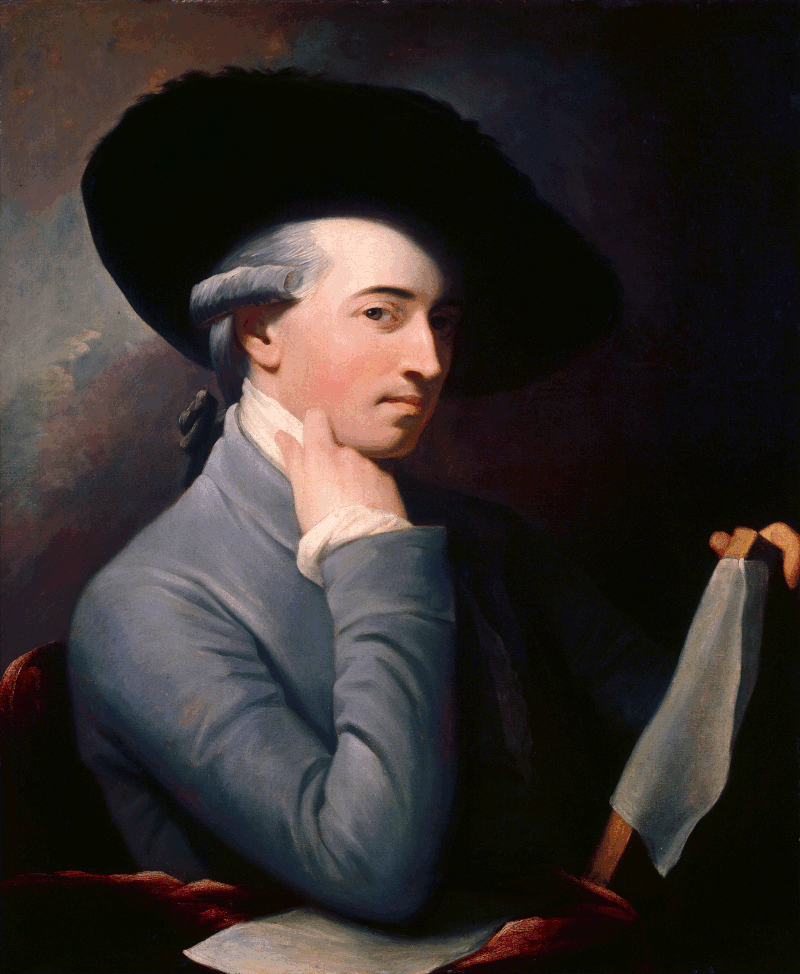
This time I’ve hit the jackpot and have discovered the artist was Benjamin West  (1738-1820), the ‘father of American painters’. (I also found out the cat became a major character in another children's book called "Benjamin West and His Cat Grimalkin" by Marguerite Henry.)  Was that the cat's real name?  I'm not sure, but now, I've found the artist!


BenjaminWestNGA.gif
(Image: Self portrait by Benjamin West, c. 1763)


According to my Google-ing, West was from a Quaker family that believed art was nothing short of indulging in  idolatry, but West was born with a gift that could not be stifled.  As a child, he learnt from the Indians how to make his own natural pigments with clay dug up from a riverbank mixed with bear grease, and thus taught himself how to paint during his early years.   Of course, it now makes sense: if art was frowned upon in his household, no wonder he had to make his brushes any way he could.  It was a good thing he followed his passion: he progressed so much so in his art and self-education that he became  the second president of the Royal Academy in London, serving from 1792 to 1805 and from 1806 to 1820.  He was offered a knighthood but refused it as he deemed himself more worthy of a peerage!


(Image below, another masterpiece by Benjamin sporting a very long title: "Death of a Stag or Alexander III of Scotland Rescued from the Fury of a Stag by the Intrepidity of Colin Fitzgerald, 1786." Not bad for a self-taught artist!)


One other story I remember from that old children's book was an artist who wanted to capture the Mississippi River for posterity,  (the river in those early days was still considered the frontier), but he had a daring project in mind that would surpass any normal painting.  Instead of a ho-hum flat square canvas, he wanted to recreate the experience of floating up and down the river, so drew an exact copy of the riverbank as seen by a boat, painting it on a giant horizontal scroll that could be unrolled in front of an audience and rolled up at the other end as the unveiling progressed. This art form was called the panorama.  Of course, I’ve forgotten the name of this artist too, so nothing for it, time for more Google-ing....

*types in search box ‘artist who painted Mississippi on huge rolling scroll canvas´ *
 
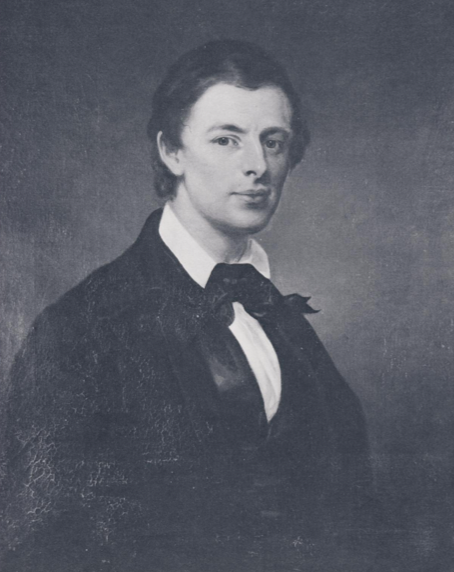
Eureka!   I’ve found him: John Banvard (1815-1891). 


(Image: Portrait of Banvard by Anna Mary Howitt, 1849)

 
There are quite  a few details I’ve just discovered about his work, he completed other panorama scrolls before the Mississippi project, such as scenes of Venice, Jerusalem, and one project that sounds like an imaginary journey to hell entitled, ‘The Infernal Regions’, but his gigantic picture of the Mississippi River became the most famous.  It was about half a mile long, although contemporary accounts tweaked the facts and inflated that measurement to three miles long! 

His show was so successful that it went on world tour and earned him a fortune after which he built an immense mansion on the North Shore of Long Island resembling Windsor Castle.  He named the estate Glenada after his daughter Ada, but his dream home was so extravagant it was nicknamed ‘Banvard's Folly’ by the locals. 

He was perhaps one of the first artists to ever become a millionaire, but then, Banvard eventually lost his fortune and was buried in a pauper’s grave in Watertown, a frontier town in the Dakota Territory.  He was almost completely lost to history, and many of his works were destroyed, a strange reversal of fortune for someone who become so famous. How did that happen?  The unravelling began when he tried to compete against P.T. Barnum’s Museum featuring strange extravaganzas showcasing the historical, the weird, the mysterious, which were sometimes outright half-credible hoax exhibits. Barnum would later become the creator of that famous entertainment intuition under the Big Top, yes, the three ring circus, the ‘Greatest Show on Earth’.

You can read more about John Banvard’s tale of rags to riches and back to rags again here in "The Atlas Excerpt: Banvard's Folly."

It’s interesting the odd stuff you can find when researching a bit of babble.


(Image below: Banvard showing his masterpiece to Queen Victorian and Prince Albert in 1849)


Wednesday, 2 September 2015

A Lover's Grief

(Post originally published February 14, 2013)

description 
  (Image: King Pedro I of Portugal, 1320-1367)

Ah yes, tales of doomed love. The first that springs to mind is Shakespeare's celebrated Romeo and Juliet, lovers from feuding households fated to meet a tragic end.


One cannot help but wonder what masterful drama the Great Bard might have penned if he had turned to Portugal instead of Verona for his inspiration. If I may dare make a suggestion, no doubt the tale of King Pedro I and Inês de Castro would be foremost on his list.


King Afonso IV (1291-1357), Pedro's father, promised him in marriage to a Castillian princess, Constance of Peñafiel. As with all members of royal dynasties in those days, Pedro was left with no choice and married the princess to secure the alliance between their two kingdoms, but immediately he fell in love with one of her ladies-in-waiting, Inês, who was the daughter of a prominent Castillian nobleman.


King Afonso hoped that nothing would come of the affair, but to his dismay, Pedro went to live with Inês in Coimbra after Constance's death, openly declared their love and had several illegitimate children, whom Pedro publicly recognized. The last straw occured when Pedro went so far as to grant several important posts to the Castillians. While Afonso wished to secure alliances with the court of Castille, there was always the danger that one day the Spanish could use these marriage alliances between their households to take over the crown of Portugal. Fearing that Inês and her supporters were growing in power and influence over his son, Afonso ordered that she be murdered. The horrific deed was accomplished in the town of Coimbra on January 7th, 1355. To this day, locals show the site where Inês was stabbed by three assassins. According to legend, a spring immediately began to flow that is now called the 'Fonte dos Amores'.


That is not the end of the story...

descriptionAfter Afonso´s death, the inconsolable Pedro ascended the throne and immediately sentenced to death the two assassins that were apprehended. Hanging would be too good for them, so would a quick beheading. 

What did Pedro demand as the mode of execution? He ordered their hearts to be ripped out, the perfect demise for those who had killed his lady love and in the process, tore out his own heart. According to some reports, he executed them with his own hands. Although there is no proof this ever happened, he was forever called Pedro 'The Cruel'. Next, he stunned the royal court by announcing that he and Inês were married. No one believed him, there was no proof of his claim as the wedding was obviously conducted in secret and therefore invalid, and yet, he commanded Inês´ body to be exhumed, that her corpse be dressed in the full royal regalia befitting a queen, that she be placed on throne beside him, and that all the royal court bow and kiss her hand, thereby publicly recognizing their true queen.

(Image, the dead queen honoured by the court with King Pedro overlooking the scene.)

 He then had her body taken to the monastery of Alcobaça, and had his own tomb prepared facing hers, declaring that she was the first person whom he wanted see when the dead would rise again on the Day of Judgement. Pedro died in 1367 and was buried according to his wishes. Today you can visit their elaborately carved Gothic tombs in the monastery of Alcobaça.

Verily a sad tale of love and grief turned to madness.


description     (Tomb of King Pedro)


description
(Inês' Tomb, Detail of the Last Judgement )


***
Like my blog?  You will LOVE my books!