Whatever curious and interesting subject strikes my fancy, be it silly or serious, gets posted for your reading pleasure.
Showing posts with label defense. Show all posts

Wednesday, 3 August 2016

Hillary, about those Nuclear Codes ...

Hillary is convinced that Trump is someone who should not be given the nuclear codes and thinks it would be a terrifying situation if he had his finger on the nuclear button.

Well, let me remind everyone of  Hillary's track record of pushing buttons way back in 2009 after Russia invaded Georgia, an action which 'crashed' relations between Russia and the US. 

As a gesture of goodwill to restore these former amicable relations, then Secretary of State Hillary Clinton presented the Russian Foreign Minister, Sergey Lavrov, with a symbolic 'reboot' button, which went horribly wrong.


Just see for yourself:


Transcript of video:


Hillary Clinton: “ I wanted to present you want represents what President Obama, Vice President Biden and I have been saying, and that is: we want to 'reset' our relationship. And secretary, we will do it together!”


* she presents the symbolic button to him *


Lavrov:“Thank you very much.”


Hillary: “You're very welcome: We worked hard to get the right Russian word. You think we got it?”


Lavrov: “You got it wrong.”


Hillary: “I got it wrong.”


Lavrov: “It should be “perezagruzka” [the Russian word for reset]," said Lavrov."This says ‘peregruzka,’ which means ‘overcharged.’” (Side note: it can also mean 'overload'. E.A.Bucc.)

* Laughter *

Clinton: "We won't let you do that to us, I promise. We mean it and we look forward to it."

Lavrov: “Okay, thank you very much. I will put it on my desk.”

***
D'oh!

In unison, the whole world slapped its forehead in one, big face-palm moment.

What makes this whole idea of a 'typo' more suspicious is that according to the book “HRC:
State Secrets and the Rebirth of Hillary Clinton” by Jonathan Allen and Amie Parnes (Random House February 2015)  it was joke-loving Clinton's senior advisor Philippe Reines who came up with the idea in the first place, but made a strange admission in that he had : “... sidestepped traditional protocol by not asking State’s team of translators to help with the project from the start. He later said he was unaware such resources were available to him.”


Are you kidding me? I am only a solitary American citizen in no way employed in a diplomatic position, and even I know that the US government has tip-top translators in its service.  How on earth can a country be expected to maintain international relations with other countries without translators? Come on people! You can't tell me Reines did not know the US would have had expert Russian translators on call, especially since the time of the Cold War!

But, we find out he did seek out assistance from some US experts on Russia, which makes this whole 'I didn't know I could get translators' excuse questionable. Authors Allen and Parnes have more to reveal about the incident:

[Reines] had asked NSC Russia director Mike McFaul for the word and both McFaul and State Russia expert Bill Burns signed off on the spelling...

Yikes! So, at the time we had two more in our government who had professional and diplomatic experience with Russian relations and therefore the Russian language ALSO BOTHCING UP THE TRANSLATION OF ONE WORD? This is very curious indeed.

You would nearly think they were purposely trying to insult Russia and destroy relations further. In fact, maybe that was their intention in the first instance.  Just think about it.

If the US was truly interested in restoring peaceful relations at that point, why did Hillary instead of politely apologising to the Russian Foreign Secretary for the blunder of the supposed typo referring to 'overcharging' by saying “Don't worry, we will not let the at happen to you', did the opposite and returned the symbolic reboot gesture with a threat: We won't let you do that to us, I promise. We mean it and we look forward to it.”

Strange how Hillary adamantly declared her team 'worked very hard' to get the 'right word' ~ and yes, Reines sought advice from NSC Russia director Mike McFaul and former US Ambassador to Russia, Bill Barnes, on the 'right' Russian word, and yet they all together 'accidentally' made a huge diplomatic blunder. It's only one word on button: how could they get it so wrong ~ unless they meant to?

With that button came one little word and a veiled threat under the cover of friendship~just smile while you knife them. A classic example of how a government can destroy relations even further.


Allen and Parnes then follow up and describe the humorous aftermath of the 'Reboot Button Affair', which is anything but laughable if you read between the lines:

“Reines tried to correct the error, asking Russia’s ambassador to Switzerland to give the gift back temporarily so that a new label – with the right word – could be printed and affixed to it.
“This is a gift from the United States. I don’t think I can give it back to you,” the ambassador replied with a smile. “If I did, my minister would be very upset.”
“If your minister doesn’t give that back, my minister,” Reines said, referring to Hillary, “is going to send me to Siberia.”


Not only that, authors Allen and Parnes state that the gaudy red and yellow 'reset' button was filched from the swimming pool or jacuzzi at the hotel.


So there you have it, The symbolic button was filched. What! Our government raking in millions of tax dollars couldn't shell out to buy a new button for this diplomatic gesture? If that isn't insulting. This is how Hillary and her staff tried to 'reset' peaceful relations with Russia? On the contrary!


It seems she and her diplomatic team were doing everything to add insult to injury without looking too obvious to the rest of the world under the cover of a joke, and what is more ominous, Russia was reluctant to give the button back to rectify the spelling: they had been given a 'gift' from the United States and said it would seem rude to return it, but in fact, I wouldn't be surprised if they were keeping it as a reminder of the insult they had received. As they say, beware Greeks bearing gifts, or it is it this case, Americans?  Ouch!


According to another BBC article dated March 2009,  Hillary and Lavrov tried to get over the gaffe later, Hillary stating: "The minister corrected our word choice. But in a way, the word that was on the button turns out to be also true. … We are resetting, and because we are resetting, the minister and I have an 'overload' of work."


But, try as they might, it's obvious the damage was done.


As recent as June 3, 2015, an article in the Washington Times  relates Foreign Secretary Lavrov is tired of people asking him about the button, declaring “it was the invention of Hillary Clinton and (the) Obama administration.


If you haven't noticed, relations between our two countries have deteriorated further since then, and Hillary has the audacity to maintain Trump shouldn't have his fingers on the nuclear buttons!


Okay, maybe you think that I'm making a big deal out of a symbolic button that didn't do anything when it was pushed, but please reconsider: as I said in my last blog post 'A Plea to the Next President of the United States', a symbol is important and image is everything. Successful diplomacy often hinges on the smallest but most significant symbolic gestures.


If Hillary and her team couldn't even handle a symbolic 'reset' button like this and in fact, made our nation look idiotic in front of the whole world, possibly further jeopardising peaceful relations with Russia in the process, and it would appear they did it on purpose, what ever makes her think we want her to have access to the nuclear codes? She thinks Trump is dangerous and will unsettle world peace? 
 
And I quote: “He (Trump) is not just unprepared. He is temperamentally unfit to hold an office that requires knowledge, stability and immense responsibility.”


Excuse me? It is said people accuse others of what they themselves are guilty of, better look in the mirror Hillary. You were lacking knowledge, stability, and had forgotten your immense responsibility as Secretary of State when you threaten Russia at the very moment you were supposedly trying to restore relations between our countries.


You know what Hillary? NOBODY should have access to nuclear codes of any kind. Unfortunately, it is the sad state of the world today that humanity now has such horrific destructive power at its fingertips.

According to your favourite line you mentioned at the DNC, it takes a village to build and hold fast a nation, but I think you forgot it also takes a village to produce an idiot capable of destroying the whole world on their whim. No more buttons for you.

 Let us pray you never get your hands on the nuclear codes, period.

(Update! Blurting out our country's nuclear response time to the world during the Third Presidential Debate, which is Top Secret information, only proves my point: you are unfit to hold the highest office the nation. Thanks to Wikileaks, we not only know you are a traitor that has sold her country out, you can't keep your mouth shut when yu're supposed to!)

I'm tired of the Clinton campaign and the 'Controlling Machine' of America offending me and insulting my intelligence, and I can state with certainity I am not the only American offended in this manner.

Wednesday, 2 September 2015

Where the Buck Stops

(Post originally published October 7, 2013)

description “Al Libby” was finally apprehended in Libya. If I have heard the news correctly, US special forces went in and whisked him out to a military detention centre. If you do not know who Al Libby is by now, he is an individual suspected of taking part in planning and carrying out the terrorist bombings against various US embassies in Africa a number of years ago. I do not know if I have spelled his name correctly, but this time I do not care. If you are a terrorist and have created havoc against my country, you do not deserve the dignity of having your infamous nom de guerre spelled correctly, but I digress.

Already the usual cries have risen up around the world declaring that America the ‘bully’ has once more barged in and stomped on the sovereign rights of other nations, in this case, Libya, without due process. While I disapprove of the concept of any government (including my own) jumping in and taking matters into their own hands regarding another country’s citizens or residents without resorting to proper extradition procedures, etc. etc., I was struck with the question: where does the buck stop?

How could we forget the millions if not billions of dollars the USA has been pouring into supposed allies like Pakistan in terms of governmental assistance and aid the last decade or so during the War on Terror only to be treated like a patsy for years with the Osama Bin Laden fiasco? Come on! If you claim to be our ally and are quite willing to take our citizens’ hard-earned tax dollars, not to mention claim to be anti- Al Qaeda like us, then you certainly have a moral obligation to hand over our enemies and not hide them for decades at a time! You cannot tell me the Pakistani government had no idea where Osama was, hiding out next to a military academy like he was in a huge complex with all his wives and followers in attendance. Uncle Sam had every right in that instance to fly in with guns blazing and go after him, having paid dearly for that right in blood and money.

So, what about all the other countries who so wilfully take all our aid and assistance to shore up their broke governments and militaries, and yet will do little or next to nothing to help apprehend our enemies, if not outright help to slow up the extradition process, allowing them to elude capture? You dare take our cash, call us ‘friend’, and stab us in the back? If those countries will not fulfil their moral obligation out of gratitude or a sense of duty, then it is my opinion America has certainly paid for the right to go in and grab a man or woman here or there that has done untold damage to our nation and our true allies, and bring them to justice. The US embassies in other countries are our sovereign soil too. Despite these strong opinions, I do not support torture nor long years of imprisonment without a fair trial. Our country should become a model of justice it hopes to show to the world, and I hope that after the suspects are apprehended, they are treated fairly and with due process of the law.

The conclusion to my political rant is this: dear countries of the world, if you do not want the US to interfere in the management of your affairs and your citizens, then please learn to support yourselves and return all monetary and all other grants that have been granted to you. In fact, I would also demand compound interest! On the other hand, if you agree to benefit by our generous help, then please note you have sold the right to sacrosanct boundaries when it comes to hiding terrorists and criminals, especially if they are affiliated in any way with Al Qaeda. Do not forget where the buck stops.

What Do We Do with a Bad Review?

(Post orginally published June 2012)

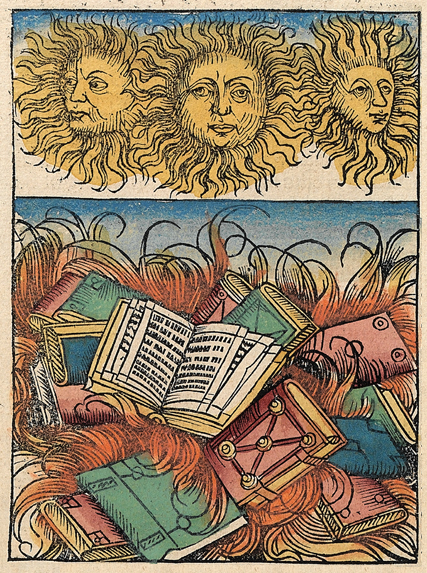
Nuremberg chronicles f 092v 1.png 
(Image from the Nuremburg Chronicle 1493, three suns observe a book-burning.


If you are an author, you will at one point or another be presented with a bad if not scorching review of your work. Quite possibly, you may receive an equal amount of negative criticisms and evaluations of your cherished creations in proportion to all the good reviews you receive. Hopefully, you will not receive more bad reviews than good!

How do we address the distressing reality of unjust criticism? The general rule has been to accept everyone is entitled to their opinions, be they good, bad, or incorrect, and simply ignore their bad comments. However, there are times when reviews are completely erroneous they leave us wondering if the reviewer had actually read the book and could comprehend its contents. Or, might we dare suggest, are deliberately condemning a work for some unknown ulterior motive? I have read reviews on other people's work that I had studied and the results were totally perplexing, (the reviewer reporting the author failed to address topics or issues when they had, or completely missed that author's point etc.), and now I too have fallen prey to the poison pen, or at least, a misguided one.

Must we authors stay silent, or are we entitled to defend our work and beat back the flames of unjust criticism?   In the case of an academic review, I think we may, since are academics are expected to be adept readers.  With your permission, I offer you an example below: a review of my work, Faust: My Soul Be Damned for the World Volume 1 , written by Nicholas Holland for Folklore, the Journal of the Folklore Society UK, published March / April 2012. My defense is presented in Italics.

~~~

“E.A. Bucchianeri's book, the first of a two-volume study, surveys works concerned with the famous magician Doctor Faustus from the earliest German notices to Christopher Marlowe's eponymous play. A short final section discusses seventeenth-century and eighteenth-century works before Goethe. The first chapter reviews German accounts of Faustus prior to the earliest known version of the German Faust Book, and places a particular emphasis on the search for biographical evidence about the historical Faustus. Bucchianeri surveys the various early accounts, including those of Trithemius, Melanchthon, and Weyer. The majority of the material covered will be familiar from other modern studies, but whereas the studies of Frank Baron, for example, draw out the complexities of the relationship between historical evidence and the subsequent fashioning of the legend, this study tends to place great emphasis on searching for insight into the biography of the historical Faustus; an approach that can be detrimental to the consideration of the sources surveyed in their historical context.”


(I tend to place more emphasis on the biography? Of course, we cannot see how the folklore developed without arriving at a clear picture of Faustus, this historical man of mystery. To all intents and purposes, I followed Baron's analytical example in discovering the historical Faustus, and offered additional findings / observations to the material Baron provided and discussed. The chapter dealing with Faustus' biography is only one quarter of Volume I, (125 pages) and roughly half of this chapter also examines the legend-formation process. The rest of Volume I (nearly 400 pages), features the Faust folklore / literature. Holland then declares in so many words it is 'detrimental' to piece together a biography of Faustus from the sources that exist and that I did not consider their historical context. Did Mr. Holland actually read and comprehend my work? ~ E.A.B.)


“For example, when considering the account of the famous abbot and philosopher Trithemius that Faustus declared himself the source of the necromancers, Bucchianeri's bewilderment that Faustus "would freely choose a profession that would utterly ruin his reputation" (p. 28) seemingly takes Trithemius's report at face value. Trithemius's opinions concerning Faustus surely demand more cautious consideration in the light of his own possible motivations, reputation, and interests; in particular since so little concerning the historical Faustus and his magical practices can confidently be corroborated using other sources. More generally, Bucchianeri's biographical focus in the early part of the book tends to direct the reader's attention away from what must be the most significant and astonishing aspect of the documentary legacy: the impact, durability, and openness to further interpretation of the legend of Faustus through the sixteenth and early seventeenth centuries, first in German and later in English culture. Whereas the historical Faustus is an almost invisible footnote in early modern intellectual history, the legend of Faustus became, in the hands of a number of important writers, a means of expressing early modern interest concerning both the potential power and also the potential dangers of magic.”


(I could find no evidence presented to date to doubt Trithemius' letter written to a friend and colleague, warning him to be wary of Faustus. The letter was reprinted during Faustus' lifetime, it could not be a bogus document. Trithemius may have aggrandized Faustus' claims concerning his magic skills, but this topic is discussed in detail. Faustus was known to declare himself a "necromancer" according to well-documented historical sources, therefore, according to the historical evidence, Trithemius was accurate in describing Faustus. I have examined the content of Trithemius' letter minutely from all aspects, similar to Frank Baron. To declare oneself a 'necromancer' was a serious matter in those times, Faustus could have been tried and executed. Why take such a risk? His motives had to be questioned, and these questions hypothetically answered. I find it curious Mr. Holland believes the biographical material in Volume I detracts from the efforts to describe the "impact" and the "openness to further investigation" of the legend: as I said, three quarters of Volume I (about 400 pages) explores the rich Faustian material inspired by his legend over the centuries and how it was used to deter people from studying magic in addition to admonishing people to live good Christian lives. Holland's conclusion that I digressed from explaining the "early modern" fascination and fear of black magic is erroneous. ~ E.A.B.)


“The remainder of the volume is mostly dedicated to substantial descriptive accounts of the German and English Faust books, and of Marlowe's Doctor Fautus. Bucchianeri's major new proposition concerning the latter is that the B-text shows that "Marlowe had regained a considerable measure of the defiant 'Machiavellian' optimism", which was absent from the A-Text (p. 368). Although precisely what she means by "Machiavellian" (or "liberal Epicurean," a phrase she applies to Marlowe's Faustus in the same passage) is unclear, her reading of the play evidently belongs to the school of interpretations which considers the overarching admonitory message of the play as being in some way questioned by the manner of its presentation. However, her core interest again is in trying to establish firm connections between biography and text. Her proposal is that the B-text of the play is a revision of the A-text chiefly undertaken by Marlowe himself in the light of personal experiences and historical events that enable it to be dated to 1592. This is an unusually precise stance concerning the genesis and authorship of this text, but ultimately fails to persuade. For example, some basic textual evidence seems to conflict with such a precise and confident dating. The author argues, in particular, that the references to the Anti-Pope Bruno in the B-Text are inspired by news of the arrest of Giordano Bruno in Venice in 1592. However, if a similar method is applied to the reading of two of the most striking points of similarity between the fictional Bruno and the historical Bruno, these events have no direct connection to 1592. The fictional Bruno undergoes excommunication, a punishment which the historical Bruno stated to his interrogators in Venice he knew had been imposed on him in absentia by a hearing convened by the Dominicans in Naples prior to this period in England (1583-5). The execution by burning for heresy, pronounced on the fictional Bruno by Faustus in disguise, was visited on the historical Bruno as late as 1600, seven years after Marlowe's death. While there is a case to be made for the influence of the historical Bruno's person and thought on Marlowe via the circle of Earl of Northumberland, there is in fact nothing tangible to link the scene in Doctor Faustus more strongly to the news of 1592 than to the news of any other year of a period spanning the whole of Marlowe's writing career. Furthermore, by attempting to bind the play's genesis too tightly to Marlowe's biography, the author underestimates not only the imaginative capacities of Marlowe himself and of the other writers who most probably had a hand in the B-Text, but also the uncertainties that cloud our understanding of Marlowe's personal beliefs. Such an approach also fails to place sufficient emphasis on the need to understand the contents of Doctor Faustus in the context of the early modern performance traditions upon which it draws.”


(The terms "Machiavellian" and "Epicurean" may be on the same page, but not in the same paragraph. From the context of the study, Holland should have understood the term "machiavellian" to mean Faustus' thirst for power and his determination to acquire it by whatever means or cost. The philosophical term Epicurean was explained in the first chapter, but possibly Holland forgot: "... pleasure is the supreme goal one should aim for in life, particularly intellectual pleasures above those of sensual ones. Epicurus taught that one could only acquire true happiness and serenity by conquering one’s fear of the gods, death, and the afterlife. He also believed that humans ceased to exist after death, declaring the soul died with the body." The term was referred to in this philosophical context throughout the chapter on Marlowe, and we note Faustus in Marlowe's play begs his soul to dissolve at death. The context of Epicurean should have been clear from the beginning.

I am sorry if my argument concerning the dating of the A and B Texts "failed to persuade" Mr. Holland, but I notice he discussed only one piece of evidence I presented, and omitted to mention all other observations pertaining to the 1592 date. If it was a matter of that one detail, Bruno's arrest, then there would not be enough evidence, but a good detective should look at all the evidence presented.

I also notice Mr. Holland points out every historical detail of the the real Bruno, and how this factual information does not match the action of Marlowe's play: must everything in the drama display historical fact? Surely, Marlowe had the creativity to imagine the scene of Bruno's arrest and make artistic predictions concerning the possible outcome of that event, even if they proved incorrect in the future. In this instance, Holland has failed to follow his own conclusion and has committed the same supposed 'error' he condemns me for, that is, trying to find the historical details that correspond with Marlowe's biography and are included in the play ~ let us note that Holland's states "by attempting to bind the play's genesis too tightly to Marlowe's biography, the author underestimates not only the imaginative capacities of Marlowe himself and the other writers who most probably had a hand in the B Text". In so many words, Holland has proposed that authors, playwrights and artists are uncreative and unimaginative when they draw upon their life experiences, (and therefore, contemporary history), for their material. Interesting observation, Mr. Holland.

He also says by binding the play´s genesis too closely to Marlowe's biography, I also "underestimated the uncertainties" that cloud everyone's understanding of Marlowe's personal beliefs. Not so. It was due to these uncertainties I conducted a close reading of Doctor Faustus with Marlowe's known biography. I simply examined the claims Marlowe was an "atheist" in that he did not believe in the established Christian religions, and noted how these claims may have a basis in fact through a close reading of Doctor Faustus. I endeavoured to shed some light on the accusations levied against Marlowe, and if possible, display how close the creative soul of the writer is to his work. ~ E.A.B)


“The stated aim of this study is to provide a "comprehensive exploration" of Faustus and his legacy. It provides lengthy descriptive discussion of the contents of the texts surveyed and, to some extent, it offers a useful single point of reference for them, although it must also be noted that the author's digressive style makes it relatively hard to read. As a work of analysis, however, its most serious failing is that it does not examine more fully and in a more systematic way the complex forces that worked to shape the legend of Faustus within a wider cultural context, and instead places its primary focus on an attempt to find close relationships between biography and text. As a consequence, it fails to offer readings of the material under consideration which have the depth of insight or nuance of the most valuable works already written on the various works it surveys.”


(The aim of this study was to provide "a comprehensive exploration of Dr. Faustus, the man who sold his soul to the devil, and those who lived to tell his tale" ~ so yes, providing detailed explanations of the texts and why each author presented the Faust material as they did was the object of the work. I do not see how Holland thinks this does not present the "complex forces" that shaped the legend of Faustus, when everything from religious intolerance, the Reformation, academic competition, fear of black magic, the scientific discoveries of the day such as the Copernican / Galileo controversy, folklore and history, and how they were included in the Faustian tales, are discussed. Can the "cultural context" become any wider? If this study lacks "the depth of insight or nuance of the most valuable works" already written on the subject of Faust and Faustian literature, I shall leave it to you, the reader, to discover if this be true or not. I thank Mr. Holland for his review, albeit it took nearly four years for it to appear from the time the paperback edition was published and sent in for review. E.A.B.)

~~~

Faust  My Soul Be Damned for the World Volume 1 by E.A. Bucchianeri