Whatever curious and interesting subject strikes my fancy, be it silly or serious, gets posted for your reading pleasure.
Showing posts with label academic. Show all posts

Sunday, 9 September 2018

The Freshman Essay Writer – A Funny Blast from the Past – Plus Useful Tips on How to Write a College Essay

As I was recently cleaning out some of my bookshelves and drawers to get ready for the next writing project now that my latest novel has finally been published, (you can learn more about that by clicking here), I came across a reference sheet handed out to us in our Freshman year in college typed up by Dr. Michael Murphy who taught the Romantic Era Music course in the department. 


If you are wondering what my major was, I studied music / musicology at UCC, Ireland.


Amazing I still had this leaflet after all this years, but then again, right now I still have all my college notes - never throw out a useful piece of information is my motto!


The sheet includes basic but some helpful advice on how to write college essays – and I couldn't help but have a good laugh over it. The good Professor had a sense of humour when it came to whipping the inexperienced writers into shape with his handouts.


It's worth sharing for its practical information, and, to show what greenhorns we were when it came to writing on an academic level. Hey, we were fresh out of high school after all, and in Ireland what they called an 'essay' in English class is what I would call creative writing and short story lessons, we hardly received a lesson on how to produce a real hard-core essay arguing a point, not like I remember when I was in grade school in the States. (Yeah, my Fifth and Sixth Grade teachers believed in starting early when it came to college preparation!)


However, the English classes in Ireland were different.  As a result, the professors had a mess on their hands when we Freshmen all arrived.   I was certainly rusty even after the 'creative writing classes'. They must have had a good snicker or two over the first wonky 'scholarly' scribbles we handed in as 'essays'. Prof. Murphy kindly gave us the following to sort us out.


Of course, the old sheet I discovered is geared to music students, but you can still learn a lot from this if you're new to essay writing, and, you might get a good chuckle to make your day. Here it is, an example essay title and how to begin along with Professor Murphy's comments. (My comments / explanations will be in red if and when needed):


::::::::::::::


STUDIES IN REPERTORY MUS 115

ESSSAY TITLE (with advice)


'Outline and discuss the main issues of Romantic programme music.'


There are two tasks involved (i) outline or identify and (ii) discuss the main (most important, seminal) issues (topics, themes, concepts as you perceive them) of Romantic programme music. You should identify the origins of programme music, the main genres which were dedicated to prog mus, the composers who championed it, the philosophy of prog mus (e.g. the nineteenth-century idea that instrumental music has the power to speak and be 'poetic', that music didn't need words to be complete, that music was more suggestive and expressive and insightful of the imagination than words could be because words are too specific whereas music has access to the imaginative world and can bypass consciousness without hindrance from specific categories.) There is also the issue of prog mus, symphonic poem and nationalism. Throughout your essay you must refer to specific works which were dealt with in class and with which you have become familiar from your own study. You may photocopy extracts from works to illustrate your points or you may refer to specific bar numbers. If you wish to quote an author or lecturer you must acknowledge the source in a footnote. (I have given advice on this below). It is immediately obvious if you copy something directly out of a book because the prose style suddenly changes (not always for the better) even if you scrape around for synonyms and alternate words and alternate grammar structures. There is nothing wrong with quoting other people. In fact you are supposed to do it, but you should (i) acknowledge your source and (ii) make an intelligent comment about the quote (e.g. state why you are quoting this author (because you can't think of anything of your own to write is not a good reason), do you agree with his / her point, do you wish to modify it, contradict it, do you think it clarifies some issues etc). Your first point of reference should be the Grove Dictionary of Music and Musicians. There are two copies of it in the library (if you don't know where it is- I mean the dictionary of course) then ask a librarian or another music student. You should consult the article on Romanticism, Programme music, Symphonic poem / tone poem, and the article on relevant composers, and genres.
 
Please don't start your essay with a long definition from the Grove of what prog mus means. I know what the Grove and most other books have to say about the issue, I am more interested in what you have to say. Also don't write biographies of the composers. You should set out your main points in the first introductory paragraph.


Some points about writing an essay.


Refrain from using conversational idioms and informal phrases. Such as ' Ya know the way that Chopin begins the Ballade is a sort of like an introductory bit.' Don't ask questions in the essay for example, 'Why does Liszt give titles for his symphonic poems?'. Don't write long meandering sentences which never get anywhere, and which, through the inclusion of many, and sometimes superfluous clauses, tend to elongate the sentence to monstrous proportions which have the effect (and an undesired one at that) of boring the reader to distraction. Keep the sentences short and to the point. Don't use abbreviations when writing long words. You may type your essay. Use a dictionary (or spell checker) to clarify any spelling you are not sure of. All of these instructions are designed to get you writing in a professional manner. To be a good writer you have to be a good reader which means reading with a dictionary and with a critical attitude. Just because something is written in a book doesn't mean it is true. It could be an opinion, and opinions can be wrong or misinformed. You are in a university to form your own informed opinions. There is little merit in stating something without being able to support it with evidence and thought.


CORRECT             INCORRECT (even if I do it in handouts)

do not                             don't
cannot                           can't
does not                        doesn't
separate                       seperate
programme music      prog mus


Please note the difference between nineteenth-century and nineteenth century. The first one is as follows: 'Chopin is a nineteenth-century composer, and the Ballade is a 
nineteenth century programmatic genre.' In this case nineteenth-century is descriptive as an adjective. The other one is simply 'In the nineteenth century blah blah blah'.


PLEASE TAKE NOTE OF THE FOLLOWING SPELLINGS.

Rythmn, genre, dialogue, legato, dissonant, virtuoso, interrupt, domineering, definite, equal, arabesque, metre, centre, programme (not 'program' which is the American style. Use the Anglo version of words.) competent. Not the difference between 'to compliment' and 'to complement' – I'm not going to tell you. Consult a dictionary.


(Note: Since the classes were very small, about 20 to 30 Freshman students if I recall, I think the rat-a-tat-tat about American spelling was added for my benefit. In Ireland the Anglo spelling of words is used. Hence, they did a good job of knocking the American spelling out of me! So, if you wonder about the British style is in my works with switched 'r' and 'e's, extra 'u's, not to mention 's' instead of 'z', things like that, now you know.   Also, as a music student we have to understand musical terms and titles in other other languages, which explains the next part. German terms and titles can be confusing!)


ALSO NOTE THE FOLLOWING GERMAN WORDS

'lied' = German song
'lieder' = plural of 'lied'
Ein Heldenleben
Dichterliebe ('liebe' means love)
Liederkreis


THERE ARE SOME THINGS YOU SHOULD NEVER DO IN WRITING AN ESSAY. THE FOLLOWING EXAMPLES ARE TAKEN FROM YOUR LISTENING TEST ANSWERS.

(In 'listening exams', we had to recognise a piece played over the sound system, the composer, and if we didn't know the piece, that is if it was a surprise sound clip or we couldn't remember the piece, we had to explain who we thought it was and why, explain the style etc. Our listening test answers were also just as wonky!)


IF YOU SEE ONE OF YOUR MISTAKES IN THE LIST BELOW DON'T PANIC. I DIDN'T TAKE ANY MARKS OFF FOR THEM AND I WON'T REVEAL YOUR IDENTITY TO ANYONE UNLESS THE PRICE IS RIGHT. (Yes, the Professor typed that!)


Don't use words you don't fully understand, and don't use words in the wrong context e.g. 'befuddling' is not an apt choice in reference to piano technique.

Don't write 'Chopin wrote a lot of piano music in his day.'

Don't write 'This music is difficult to play live.'

Please don't write 'Strauss takes the mickey out of his critics in Ein Heldenleben.' Try to be more professional 'Strauss satirises his critics' would be more appropriate.

Don't write 'This music is definitely danceable to.'


Don't write 'In this piece there is a question and answer type of thing'.

Some of you are a bit confused as to which century you are in. Chopin was very dead in 1935 but he was composing in 1835.


(Chopin is not impressed.  Sorry, I couldn't help myself.)


Please don't repeat the same thing over and over and over and over and over again and again and again and again and again etc etc etc etc because it tends to make the reader very very bored and somewhat tired indeed when he / she realises that the writer has little to say but insists on saying it many times just to fill out the page with ink. State your point once and leave it at that. If you want to refer to a point you made earlier then do it, but don't repeat the same thing ad nausem.


GUIDELINES FOR (I) FOOTNOTES (II) BIBLIOGRAPHY

KEEP THIS PAGE FOR REFERENCE IN FUTURE YEARS


Footnotes:

The function of footnotes is to allow you to give the source of a book from which you quoted something in your main text. You can also use a footnote to add some opinion of your own to a statement in the text or to give some extra information which would interrupt the flow of your text (see example x, number 3 below).

Footnote can be located in two place (i) at the bottom of the page (ii) at the end of the essay. The choice is yours. Footnotes must be numbered (i.e. not with letters). There is a format as to how you present the information in the footnote. See example x


example x

1 Carl Dalhaus, Esthetics of Music, tr. William Austin, Cambridge University Press, Sydney, 1982, p. 122. (Henceforth Esthetics)
2 Ibid., p. 123.
3 Schumann also wrote songs to poetry by Heine.
4 Esthetics. p. 124.


In this example note the following:

(I) After the footnote number you give the Author's name <Carl Dahlhaus,>
  1. After the comma you give the name of the book which should be underlined in Italics <Esthetics of Music,> (if a word is underlined it means it is in italics. If you are using a word processor you should give book titles in italics).
    (III) if the book is translated into English you give the translator's name (in this case <tr. William Austin,> if the book is not translated then ignore this section
  1. then you give the publisher <Cambridge University Press>
  2. Then you give the place of publication <Sydney>. Sometimes there are a few places given: give the first one mentioned.
  3. Then give the year of the most recent edition / publication (sometimes it give the date of earlier editions)
  4. Then you give the page number from which you have quoted.

In example x I have written in brackets (Henceforth Esthetics). This simply means that if I refer to this book again I don't have to write out al the details as before but I can just write the word Esthetics and then the page number, e.g. Esthetics, p. 124 as I have shown in number 4. However, if I refer to the same book twice in a row you can just write Ibid., followed by the page number as I have shown in number 2. Ibid. simply means 'same as the previous title'.


BIBLIOGRAPHY


The layout of the bib is a tad different from the footnote layout. The bib comes at the very end of the essay and is arrange in alphabetical order. The examples below start at letter S. Please read through them very carefully. I chose these examples because they show you how to deal with a number of situations which arise when making out a bib.


Samson, J., The Music of Szymanowski, Kahn & Avril, London and New York, 1980.

Samson, J., (ed.), Chopin Studies, CUP, 1988.

Samson, J., (ed.) The Late Romantic Era: Man & Music vol. 7, Macmillan Press, London, 1991.

Samson, J., Chopin: The Four Ballades, CUP, 1992

Schoenberg, A., Structural Functions in Music, ed. Leonard Stein, London, 1969.

Schoenberg, A., Style and Idea, ed. Leonard Stein, University of California Press, 1984.

Stein, J., Richard Wagner and the Synthesis of the Arts, Wayne State University Press, 1960.


There are a number of things you should notice from the above examples.

  1. Although they are arranged in alphabetical order, in the case where an author is quoted a number of times you arrange the books in chronological order (i.e. by year, see the Samson and Schoenberg examples)
  2. CUP is an abbreviation for Cambridge University Press and OUP is an abbreviation Oxford University Press. Only use such abbreviations when you quote the same publisher numerous times.
  3. There are finicky things like getting the commas in the right place. For example Arnold Schoenberg is given with the surname first and then the initial of the christian name followed by a full stop and then a comma.
  4. Above you see Samson as an author and as an editor, hence you have (ed.) after his name to show he edited the book which is a collection of essays by different authors.


:::::::::::::::


This is where the Professor's handout ends. Of course, if you are currently in college and your professors have a different layout they would prefer you to use in your essays, do follow that. If you haven't been given a guide, well, now you have!


For fun, see if you can guess which one of the essays WASN'T written while I was still in college.


Also, if you want some more in-depth help when writing for the University, or even creative writing / fiction, etc, this is an excellent book, click on the title to read my review:  


Wednesday, 2 September 2015

What Do We Do with a Bad Review?

(Post orginally published June 2012)

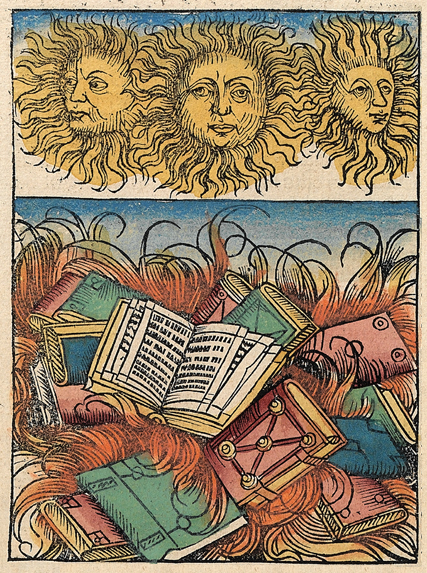
Nuremberg chronicles f 092v 1.png 
(Image from the Nuremburg Chronicle 1493, three suns observe a book-burning.


If you are an author, you will at one point or another be presented with a bad if not scorching review of your work. Quite possibly, you may receive an equal amount of negative criticisms and evaluations of your cherished creations in proportion to all the good reviews you receive. Hopefully, you will not receive more bad reviews than good!

How do we address the distressing reality of unjust criticism? The general rule has been to accept everyone is entitled to their opinions, be they good, bad, or incorrect, and simply ignore their bad comments. However, there are times when reviews are completely erroneous they leave us wondering if the reviewer had actually read the book and could comprehend its contents. Or, might we dare suggest, are deliberately condemning a work for some unknown ulterior motive? I have read reviews on other people's work that I had studied and the results were totally perplexing, (the reviewer reporting the author failed to address topics or issues when they had, or completely missed that author's point etc.), and now I too have fallen prey to the poison pen, or at least, a misguided one.

Must we authors stay silent, or are we entitled to defend our work and beat back the flames of unjust criticism?   In the case of an academic review, I think we may, since are academics are expected to be adept readers.  With your permission, I offer you an example below: a review of my work, Faust: My Soul Be Damned for the World Volume 1 , written by Nicholas Holland for Folklore, the Journal of the Folklore Society UK, published March / April 2012. My defense is presented in Italics.

~~~

“E.A. Bucchianeri's book, the first of a two-volume study, surveys works concerned with the famous magician Doctor Faustus from the earliest German notices to Christopher Marlowe's eponymous play. A short final section discusses seventeenth-century and eighteenth-century works before Goethe. The first chapter reviews German accounts of Faustus prior to the earliest known version of the German Faust Book, and places a particular emphasis on the search for biographical evidence about the historical Faustus. Bucchianeri surveys the various early accounts, including those of Trithemius, Melanchthon, and Weyer. The majority of the material covered will be familiar from other modern studies, but whereas the studies of Frank Baron, for example, draw out the complexities of the relationship between historical evidence and the subsequent fashioning of the legend, this study tends to place great emphasis on searching for insight into the biography of the historical Faustus; an approach that can be detrimental to the consideration of the sources surveyed in their historical context.”


(I tend to place more emphasis on the biography? Of course, we cannot see how the folklore developed without arriving at a clear picture of Faustus, this historical man of mystery. To all intents and purposes, I followed Baron's analytical example in discovering the historical Faustus, and offered additional findings / observations to the material Baron provided and discussed. The chapter dealing with Faustus' biography is only one quarter of Volume I, (125 pages) and roughly half of this chapter also examines the legend-formation process. The rest of Volume I (nearly 400 pages), features the Faust folklore / literature. Holland then declares in so many words it is 'detrimental' to piece together a biography of Faustus from the sources that exist and that I did not consider their historical context. Did Mr. Holland actually read and comprehend my work? ~ E.A.B.)


“For example, when considering the account of the famous abbot and philosopher Trithemius that Faustus declared himself the source of the necromancers, Bucchianeri's bewilderment that Faustus "would freely choose a profession that would utterly ruin his reputation" (p. 28) seemingly takes Trithemius's report at face value. Trithemius's opinions concerning Faustus surely demand more cautious consideration in the light of his own possible motivations, reputation, and interests; in particular since so little concerning the historical Faustus and his magical practices can confidently be corroborated using other sources. More generally, Bucchianeri's biographical focus in the early part of the book tends to direct the reader's attention away from what must be the most significant and astonishing aspect of the documentary legacy: the impact, durability, and openness to further interpretation of the legend of Faustus through the sixteenth and early seventeenth centuries, first in German and later in English culture. Whereas the historical Faustus is an almost invisible footnote in early modern intellectual history, the legend of Faustus became, in the hands of a number of important writers, a means of expressing early modern interest concerning both the potential power and also the potential dangers of magic.”


(I could find no evidence presented to date to doubt Trithemius' letter written to a friend and colleague, warning him to be wary of Faustus. The letter was reprinted during Faustus' lifetime, it could not be a bogus document. Trithemius may have aggrandized Faustus' claims concerning his magic skills, but this topic is discussed in detail. Faustus was known to declare himself a "necromancer" according to well-documented historical sources, therefore, according to the historical evidence, Trithemius was accurate in describing Faustus. I have examined the content of Trithemius' letter minutely from all aspects, similar to Frank Baron. To declare oneself a 'necromancer' was a serious matter in those times, Faustus could have been tried and executed. Why take such a risk? His motives had to be questioned, and these questions hypothetically answered. I find it curious Mr. Holland believes the biographical material in Volume I detracts from the efforts to describe the "impact" and the "openness to further investigation" of the legend: as I said, three quarters of Volume I (about 400 pages) explores the rich Faustian material inspired by his legend over the centuries and how it was used to deter people from studying magic in addition to admonishing people to live good Christian lives. Holland's conclusion that I digressed from explaining the "early modern" fascination and fear of black magic is erroneous. ~ E.A.B.)


“The remainder of the volume is mostly dedicated to substantial descriptive accounts of the German and English Faust books, and of Marlowe's Doctor Fautus. Bucchianeri's major new proposition concerning the latter is that the B-text shows that "Marlowe had regained a considerable measure of the defiant 'Machiavellian' optimism", which was absent from the A-Text (p. 368). Although precisely what she means by "Machiavellian" (or "liberal Epicurean," a phrase she applies to Marlowe's Faustus in the same passage) is unclear, her reading of the play evidently belongs to the school of interpretations which considers the overarching admonitory message of the play as being in some way questioned by the manner of its presentation. However, her core interest again is in trying to establish firm connections between biography and text. Her proposal is that the B-text of the play is a revision of the A-text chiefly undertaken by Marlowe himself in the light of personal experiences and historical events that enable it to be dated to 1592. This is an unusually precise stance concerning the genesis and authorship of this text, but ultimately fails to persuade. For example, some basic textual evidence seems to conflict with such a precise and confident dating. The author argues, in particular, that the references to the Anti-Pope Bruno in the B-Text are inspired by news of the arrest of Giordano Bruno in Venice in 1592. However, if a similar method is applied to the reading of two of the most striking points of similarity between the fictional Bruno and the historical Bruno, these events have no direct connection to 1592. The fictional Bruno undergoes excommunication, a punishment which the historical Bruno stated to his interrogators in Venice he knew had been imposed on him in absentia by a hearing convened by the Dominicans in Naples prior to this period in England (1583-5). The execution by burning for heresy, pronounced on the fictional Bruno by Faustus in disguise, was visited on the historical Bruno as late as 1600, seven years after Marlowe's death. While there is a case to be made for the influence of the historical Bruno's person and thought on Marlowe via the circle of Earl of Northumberland, there is in fact nothing tangible to link the scene in Doctor Faustus more strongly to the news of 1592 than to the news of any other year of a period spanning the whole of Marlowe's writing career. Furthermore, by attempting to bind the play's genesis too tightly to Marlowe's biography, the author underestimates not only the imaginative capacities of Marlowe himself and of the other writers who most probably had a hand in the B-Text, but also the uncertainties that cloud our understanding of Marlowe's personal beliefs. Such an approach also fails to place sufficient emphasis on the need to understand the contents of Doctor Faustus in the context of the early modern performance traditions upon which it draws.”


(The terms "Machiavellian" and "Epicurean" may be on the same page, but not in the same paragraph. From the context of the study, Holland should have understood the term "machiavellian" to mean Faustus' thirst for power and his determination to acquire it by whatever means or cost. The philosophical term Epicurean was explained in the first chapter, but possibly Holland forgot: "... pleasure is the supreme goal one should aim for in life, particularly intellectual pleasures above those of sensual ones. Epicurus taught that one could only acquire true happiness and serenity by conquering one’s fear of the gods, death, and the afterlife. He also believed that humans ceased to exist after death, declaring the soul died with the body." The term was referred to in this philosophical context throughout the chapter on Marlowe, and we note Faustus in Marlowe's play begs his soul to dissolve at death. The context of Epicurean should have been clear from the beginning.

I am sorry if my argument concerning the dating of the A and B Texts "failed to persuade" Mr. Holland, but I notice he discussed only one piece of evidence I presented, and omitted to mention all other observations pertaining to the 1592 date. If it was a matter of that one detail, Bruno's arrest, then there would not be enough evidence, but a good detective should look at all the evidence presented.

I also notice Mr. Holland points out every historical detail of the the real Bruno, and how this factual information does not match the action of Marlowe's play: must everything in the drama display historical fact? Surely, Marlowe had the creativity to imagine the scene of Bruno's arrest and make artistic predictions concerning the possible outcome of that event, even if they proved incorrect in the future. In this instance, Holland has failed to follow his own conclusion and has committed the same supposed 'error' he condemns me for, that is, trying to find the historical details that correspond with Marlowe's biography and are included in the play ~ let us note that Holland's states "by attempting to bind the play's genesis too tightly to Marlowe's biography, the author underestimates not only the imaginative capacities of Marlowe himself and the other writers who most probably had a hand in the B Text". In so many words, Holland has proposed that authors, playwrights and artists are uncreative and unimaginative when they draw upon their life experiences, (and therefore, contemporary history), for their material. Interesting observation, Mr. Holland.

He also says by binding the play´s genesis too closely to Marlowe's biography, I also "underestimated the uncertainties" that cloud everyone's understanding of Marlowe's personal beliefs. Not so. It was due to these uncertainties I conducted a close reading of Doctor Faustus with Marlowe's known biography. I simply examined the claims Marlowe was an "atheist" in that he did not believe in the established Christian religions, and noted how these claims may have a basis in fact through a close reading of Doctor Faustus. I endeavoured to shed some light on the accusations levied against Marlowe, and if possible, display how close the creative soul of the writer is to his work. ~ E.A.B)


“The stated aim of this study is to provide a "comprehensive exploration" of Faustus and his legacy. It provides lengthy descriptive discussion of the contents of the texts surveyed and, to some extent, it offers a useful single point of reference for them, although it must also be noted that the author's digressive style makes it relatively hard to read. As a work of analysis, however, its most serious failing is that it does not examine more fully and in a more systematic way the complex forces that worked to shape the legend of Faustus within a wider cultural context, and instead places its primary focus on an attempt to find close relationships between biography and text. As a consequence, it fails to offer readings of the material under consideration which have the depth of insight or nuance of the most valuable works already written on the various works it surveys.”


(The aim of this study was to provide "a comprehensive exploration of Dr. Faustus, the man who sold his soul to the devil, and those who lived to tell his tale" ~ so yes, providing detailed explanations of the texts and why each author presented the Faust material as they did was the object of the work. I do not see how Holland thinks this does not present the "complex forces" that shaped the legend of Faustus, when everything from religious intolerance, the Reformation, academic competition, fear of black magic, the scientific discoveries of the day such as the Copernican / Galileo controversy, folklore and history, and how they were included in the Faustian tales, are discussed. Can the "cultural context" become any wider? If this study lacks "the depth of insight or nuance of the most valuable works" already written on the subject of Faust and Faustian literature, I shall leave it to you, the reader, to discover if this be true or not. I thank Mr. Holland for his review, albeit it took nearly four years for it to appear from the time the paperback edition was published and sent in for review. E.A.B.)

~~~

Faust  My Soul Be Damned for the World Volume 1 by E.A. Bucchianeri